
The care plan form sits blank in front of you, your patient has three problems at once, and the label you pick decides the whole plan. This common nursing diagnoses list gathers the 30 diagnoses students reach for most, sorted into four bedside groups, each with its usual cause, the clues that prove it, and a worked example.
Every label here follows the same three-part shape: the diagnosis, what it is related to, and the evidence you can chart. Learn to read that shape and the list stops being a memorization chore; it becomes a way of sorting what you see at the bedside into the problem you treat first.
| Course | Care Plans |
| Best for | Care plan assignments and exam priority questions |
| Study time | About 20 minutes |
Quick Reference

Every diagnosis on this sheet is built from the same three parts, the format the Nurseslabs nursing diagnosis guide walks through step by step. If the parts feel new, the walkthrough of the parts of a nursing care plan shows where the diagnosis sits inside the full plan.
| Part | What it holds | Example |
|---|---|---|
| Problem | The NANDA-I label: the patient response the nurse treats | Acute Pain |
| Etiology | The cause after the words “related to” | surgical tissue injury |
| Signs and symptoms | The clues after “as evidenced by”: what you assessed and can chart | a stated pain rating and guarding of the incision |
Breathing and Circulation

Breathing and circulation labels come first on almost every care plan, because a blocked airway or a falling output outranks everything below it. Read the cause column as the thing your interventions aim at, and the last column as the proof you chart.
| Diagnosis | Usually related to | Look for |
|---|---|---|
| Ineffective Airway Clearance | Retained secretions and a weak cough | Ineffective cough, thick sputum, noisy breathing |
| Ineffective Breathing Pattern | Pain, anxiety or a weak breathing effort | Rapid, shallow breathing and use of accessory muscles |
| Impaired Gas Exchange | Damaged alveoli and poor air movement in the lungs | Low oxygen saturation, restlessness, rapid breathing |
| Decreased Cardiac Output | A weak or overworked heart muscle | Low blood pressure, rapid weak pulse, cool clammy skin, low urine output |
| Ineffective Tissue Perfusion | Poor blood flow out to the body tissues | Cool pale skin, slow capillary refill, weak pulses |
| Deficient Fluid Volume | Fluid lost through vomiting, bleeding or drainage | Dry mucous membranes, poor skin turgor, low urine output, rapid pulse |
| Excess Fluid Volume | Fluid retained by a struggling heart or kidneys | Edema, crackles in the lungs, weight gain, bounding pulse |
| Risk for Bleeding | Clotting problems or blood-thinning treatment | Low platelet count, anticoagulant therapy, a recent operation |
Read it as one sentence: Impaired Gas Exchange related to alveolar damage as evidenced by low oxygen saturation, restlessness and a rapid breathing rate. The pneumonia nursing care plan builds a whole plan around that label, and the nursing care plan for copd shows it ranked first for a patient whose lungs fail slowly instead of suddenly.
Elimination, Nutrition and Skin

These eight labels cover what goes in, what comes out and the skin that holds it all together. Watch the pair near the end: one label for skin damage already present, and its risk twin for damage the plan exists to prevent.
Impaired Urinary Elimination
Related to: urinary tract infection or a weakened bladder · AEB: frequent urges, dribbling and nighttime voiding
This label fits a patient whose bladder no longer empties on a normal pattern: the urge comes often, the stream starts and stops, or small leaks slip out between trips to the bathroom. Example: a patient two days after a catheter comes out who voids small amounts every hour, still feels full afterward, and has started limiting fluids on purpose, which makes the plan worse.
Constipation
Related to: low fiber intake, low fluid intake and immobility · AEB: hard dry stools, straining and a bloated abdomen
Constipation is a pattern, not a single missed day: stools turn hard and dry, they come less often than the patient’s normal, and passing them takes straining. Example: a patient on bed rest after abdominal surgery who has not passed stool in four days, reports cramping and fullness, and is eating less because every meal adds to the pressure.
Diarrhea
Related to: infection, tube feeding or a medication effect · AEB: frequent loose watery stools and urgent cramping
Diarrhea means loose, watery stools passing more often than the patient’s normal, usually with urgency that is hard to hold and cramping that comes in waves. Example: a patient on a new antibiotic who has six watery stools in one day, sore and reddened skin from wiping, and early signs of drying out that put fluid balance on the plan too.
Imbalanced Nutrition: Less Than Body Requirements
Related to: poor appetite, nausea or trouble swallowing · AEB: weight loss, eating less than half of meals and low energy
This label says intake has fallen below what the body needs to heal, hold its weight and keep its strength, and the chart proves it over days, not one skipped meal. Example: a patient recovering from pneumonia who leaves most of every tray untouched, whose clothes fit looser than last week, and who tires before finishing a short walk.
Imbalanced Nutrition: More Than Body Requirements
Related to: intake above activity level and frequent high-calorie meals · AEB: a rising weight trend and a waist size above the healthy range
The mirror image of the label above it: the body takes in more energy than it burns, day after day, until weight and waist size climb and the risks stack up quietly. Example: a patient whose weight has risen at three clinic visits in a row, who eats most meals at a desk and walks only from the car to the door.
Impaired Swallowing
Related to: weakened throat muscles after a stroke · AEB: coughing during meals, a wet gurgly voice and food pocketing in the cheek
Impaired swallowing means food or fluid does not travel safely from the mouth to the stomach, and aspiration, food or fluid entering the airway, is the danger standing behind the label. Example: a patient in the first days after a stroke who coughs on thin liquids, holds food in one cheek without noticing, and sounds wet and gurgly after a sip.
Impaired Skin Integrity
Related to: pressure and moisture over a bony area · AEB: broken or reddened skin over the sacrum
Use this label when the skin is already damaged: redness that does not fade when pressed, a blister, or an open shallow area over a pressure point. Example: a patient who cannot turn without full help and now has a shallow open area over the tailbone, found on the morning round before it deepened, with drainage just starting at the edges.
Risk for Impaired Skin Integrity
Risk factors: immobility, moisture from incontinence and poor nutrition · Watch for: redness over a pressure point that does not fade
This is the risk form of the label above: the skin is still whole, but the conditions for breakdown are stacked up, so prevention, turning, dry skin and offloading, becomes the plan. Example: a patient who is incontinent and too weak to shift position alone, whose heels and sacrum are checked every round because the breakdown has not happened yet.
Read it as one sentence: Impaired Skin Integrity related to pressure and moisture as evidenced by broken, reddened skin over the sacrum. Nutrition and skin labels rarely travel alone for long; the diabetes nursing care plan works several of this group’s labels into one patient’s plan, where slow healing makes every one of them sharper.
Mobility, Pain and Safety
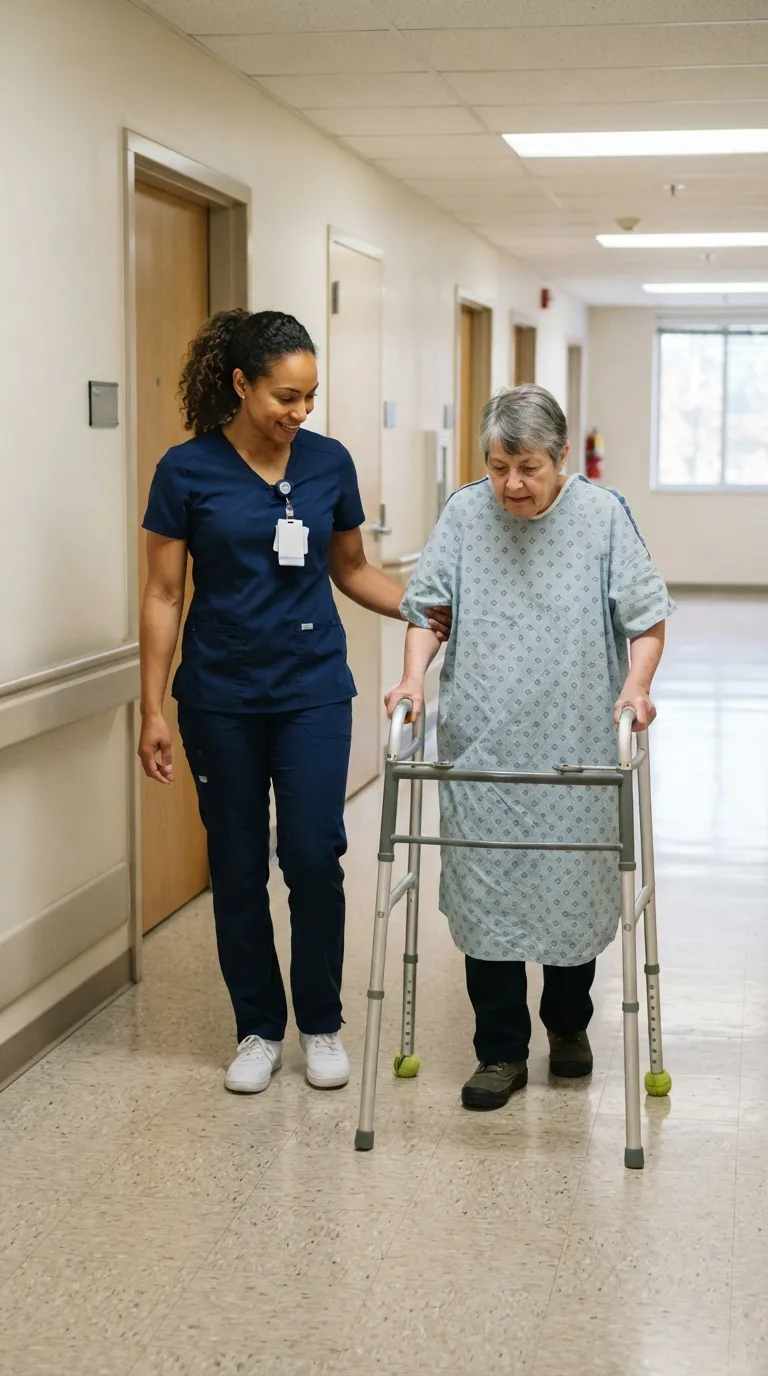
Movement, pain and safety decide how fast a patient gets home, and examiners return to them because each one hides a priority call. Pain labels take the patient’s own report as their evidence; the risk labels take the scene around the bed: the gait, the medicines, the path to the bathroom.
| Diagnosis | Usually related to | Look for |
|---|---|---|
| Impaired Physical Mobility | Pain, weakness or a healing fracture | Limited range of motion, slow unsteady movement, help needed to move |
| Activity Intolerance | A weak heart or low stamina after illness | Breathlessness and a racing pulse with simple activity, long rest needed after |
| Acute Pain | Fresh tissue injury or inflammation | The patient reports pain, with guarding and grimacing |
| Chronic Pain | Long-term joint or nerve damage | Pain present beyond three months, guarded movement, low mood |
| Fatigue | Illness, poor sleep or anemia | Tiredness that rest does not fix, low energy for daily tasks |
| Risk for Falls | Weakness, dizziness and an unsteady gait | Medicines that lower blood pressure, a past fall, a cluttered path to the bathroom |
| Risk for Injury | Confusion, poor vision or an unfamiliar setting | Trying to get up alone, wandering, reaching for support that is not there |
Read it as one sentence: Acute Pain related to a healing fracture as evidenced by a stated pain rating, guarding and a reluctance to move the limb. For the patient whose confusion drives the safety risk instead, the glasgow coma scale score tells you how deep that confusion runs before you rank the safety labels.
Mind, Learning and Coping

The last group covers what the patient feels, knows and manages day to day, and students underuse it because its evidence is spoken rather than measured. A shaky voice, a wrong teach-back and three broken nights of sleep are chartable clues, the same as any number on a chart.
Anxiety
Related to: an upcoming procedure or an uncertain diagnosis · AEB: restlessness, a racing pulse and repeated worried questions
Anxiety is a vague, uneasy feeling about something coming, a threat the patient often cannot name, and the body usually shows it before the patient says a word about it. Example: a patient the night before surgery who cannot settle in bed, asks the same questions every hour, startles at small sounds and keeps pressing the call light.
Fear
Related to: a named threat such as a biopsy result · AEB: the patient names the fear, tenses up and avoids the topic
Fear differs from anxiety in one clean way: the patient can point straight at the thing that frightens them, and the care plan works on that named thing. Example: a patient waiting on biopsy results who goes quiet when the topic comes up, grips the bed rail and says, in plain words, that she is scared of the answer.
Deficient Knowledge
Related to: new information never taught, or taught too fast to stick · AEB: wrong teach-back answers and questions that show the gap
This label is not an insult and not a judgment on the patient; it says one specific topic was never taught, or was taught too fast to stick, and the fix is teaching. Example: a patient starting a blood thinner at home who cannot say which bruises, bleeds or foods to report, and who has been guessing at the dose timing.
Disturbed Sleep Pattern
Related to: pain, ward noise and nighttime care interruptions · AEB: waking often, trouble falling back asleep and daytime napping
Hospital nights break sleep into pieces: alarms, checks, pain and a strange bed all take their turn, and the label fits when the broken pattern starts costing the patient the next day. Example: a patient woken nearly every hour through the night who then sleeps through breakfast, therapy and the teaching session planned for the morning.
Ineffective Coping
Related to: stress beyond the patient’s usual supports · AEB: withdrawal, poor concentration and giving up on care tasks
Coping turns ineffective when the ways a patient usually handles stress stop working and care itself starts to slide: meals skipped, sessions missed, decisions avoided. Example: a patient facing a long recovery who has stopped eating properly, refuses the therapy gym two days running and answers most questions with the same flat line: there is no point.
Grieving
Related to: a real or expected loss · AEB: tearfulness, appetite change and talking often about what was lost
Grieving is a normal human response to loss, and it still belongs on the care plan when it starts shaping eating, sleep, energy and healing. Example: a patient whose spouse died last month and who cries quietly through morning care, eats only a few bites, sleeps in short pieces and keeps the framed photo turned toward the bed.
Ineffective Health Management
Related to: a complex home routine and low support at home · AEB: missed doses, skipped checks and appointments not kept
This label covers a patient whose home routine for a long-term condition keeps breaking down, even when the knowledge is there and the intention is real. Example: a patient with heart failure whose pill organizer is found untouched for days, whose daily weight checks never happen, and who arrives at the clinic surprised that the swelling is back.
Read it as one sentence: Deficient Knowledge related to a new medicine routine as evidenced by a wrong teach-back on the first try. When a label from this group ranks first on the plan, the work of the day is mostly conversation, careful listening and teaching in small pieces, and that is real nursing work, not a soft extra.
Quick Questions
What makes a diagnosis a NANDA diagnosis and not a medical diagnosis?
A medical diagnosis names the disease: pneumonia, diabetes, a fracture. A NANDA nursing diagnosis names the patient’s response to it: the breathing pattern, the skin risk, the knowledge gap. Nurses treat the response with their own interventions, which is why both labels can sit on the same chart.
When do you use a risk diagnosis instead of an actual one?
Use a risk diagnosis when the problem has not happened yet but the risk factors are clearly present: the skin is whole, the patient has not fallen, the infection has not started. There are no signs to chart, so the statement lists risk factors only, and the plan is prevention.
How many diagnoses belong on one care plan?
Fewer than students expect. List what you find, then rank it: airway, breathing, circulation and safety first, and build the working plan around the top two or three that drive today’s care. The rest stay noted for later shifts, because a plan that tries everything treats nothing well.
How to Remember It on Exam Day
One last tip: stop memorizing labels as one flat list and file each one under the patient who taught it to you. The nursing care plan study tips page turns that habit into a daily routine: one label, one cause, one set of clues, reviewed in the order you would meet them on the unit.
Tonight, take any patient story from class and write the top three labels as full PES sentences, saying each one out loud as you write it. Ten minutes of that beats an hour of rereading, because exams hand you a patient, not a list, and your brain should answer in the same shape the question arrives in.
For study use only. Always follow your program, your facility’s policy and current drug and lab references.