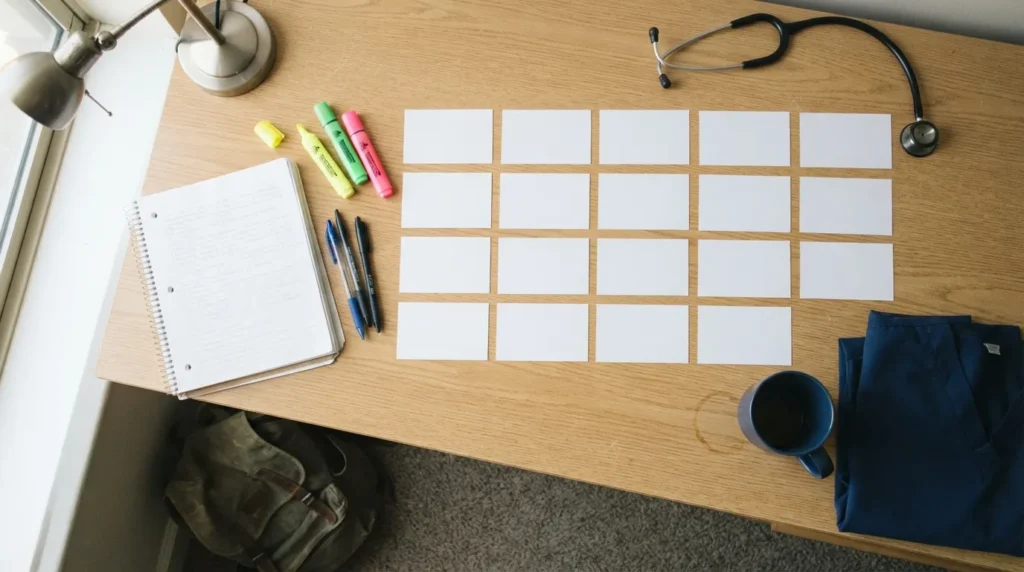

The night before a pharmacology quiz, one drug fills three notebook pages and the next gets two lines, and neither page is any help by morning. A good pharmacology template ends that unevenness: every drug gets the same boxes, so the facts sit in the same place on every card. This post walks through 10 templates for a notebook or card stack, from the classic five-box card to a one-minute pocket version, and fills one in fully.
Pick the template that matches your drug, not the one that looks neatest. Every value on a real card comes from a current reference, such as the MedlinePlus drug information pages, never from memory or an old screenshot. Start with the first; add the rest as your list grows.
The Classic Five-Box Card

Course: Pharmacology · Best for: one drug · Remember: five boxes, same order
The five-box card is where most students start. Five boxes: name and class, action, uses, side effects, nursing checks. Because the boxes never move, your eye learns where to land, and a gap shows at a glance.
- Name and class: furosemide, a loop diuretic.
- Action: it blocks sodium and chloride reabsorption in the loop of Henle, so water follows the salt out and urine output rises.
- Uses: fluid overload in heart failure and edema.
- Side effects: low potassium, low blood pressure, dehydration and dizziness on standing.
- Nursing checks: daily weight, intake and output, blood pressure lying and standing, and the potassium level.
Its teaching line reads: take it in the morning, rise slowly, expect extra urination for a few hours. Notice what this example leaves blank: the numbers. On a real card, copy every dose, range and timing value from a current reference, never from memory.
The Mechanism-First Card

Some drugs refuse to stick until the mechanism clicks. This card starts with the mechanism: the target, an arrow to what changes in the body, an arrow to what the patient feels. Three boxes under the chain hold the uses, the side effects and the checks.
It suits drugs whose effects make sense once the chain is clear, and it pays off when exam questions describe a mechanism instead of naming a drug. Its limit: a chain alone never tells you what to check, so keep the checks box even when space feels tight.
Study tip: read the chain aloud once without looking. Where you stall is the arrow to restudy.
The Safety-First Card

Course: Pharmacology · Best for: high-alert drugs · Remember: dangers on top, benefits below
The top third holds the red flags: the signs that mean stop, the hold-and-call points, and the interactions that change the plan. Only below that line do the uses and benefits appear.
This layout suits drugs with a narrow safety margin, where the job is catching trouble early. Give the card a rescue line naming the reversal where one exists, and keep the reversal agent notes nearby for the full picture. Its limit: a card that lists only dangers teaches fear, so the benefit rows still earn their space.
The Lab Watch Card

Two columns divide this card: what to check before the drug and what to check after. Each row pairs a lab value or vital sign with its reason, so the card reads as a monitoring plan, not a fact list.
Potassium before a diuretic, blood pressure before a drug that lowers it, blood glucose around insulin: the pattern repeats across classes. The limit: only some drugs carry a clear monitoring story. On a drug with none, the columns sit half empty, and a different template serves you better.
Study tip: cover the after column and say each expected change out loud before you peek.
The Patient Teaching Card

Course: Pharmacology · Best for: drugs taken at home · Remember: if they cannot repeat it, rewrite it
Every line on this card is written the way a patient hears it. One plain sentence each for what it does, how to take it, and what to report, with no unexplained terms.
Finish with a teach-back line: now tell me in your own words how you will take this at home. Timing does the heavy lifting for some drugs, and the insulin chart shows how much a simple timing grid can explain. The limit: plain words can soften a warning that must stay exact, so keep the signs-to-report line in the careful wording your program teaches.
The Comparison Card

When two drugs from one class keep trading places, build one card split down the middle. The same rows run down both sides, and only the differences get highlighted.
Build it the week you meet the second drug, while the first is still fresh. It suits look-alike pairs and same-class rivals. Its limit is size: the split holds two drugs well and turns cramped at three, so a large class becomes a set of pair cards.
Study tip: Build the comparison the day you meet the second drug, not the night before the exam, while the first drug’s card is still fresh enough to argue with.
Study tip: quiz the highlight column only; the highlights are where the exam questions live.
The Timeline Card

Course: Pharmacology · Best for: timing-heavy drugs · Remember: three points, one line
One horizontal line carries the whole card. Onset sits left, peak in the middle, duration at the right, the name and class above the line. Under it, one row holds the checks belonging to each point.
The sketch only works with real values, copied from the drug’s current label, not from memory: check the label on DailyMed and copy the three points from there. Timing shifts with the route and the patient, so treat the line as a study picture, never as a schedule for a real patient. That honesty is this card’s limit and its strength.
The Antidote and Rescue Card

Three rows hold this card: the drug and what too much of it looks like, the rescue that answers it, and the monitoring that follows. The toxicity picture comes first: signs you can see, not a dose.
Where a true antidote exists, its name sits in the rescue row; where none exists, the row holds the supportive care that carries the patient instead. Keep the antidotes cheat sheet within reach while you build these cards. The limit: rescue facts change, so rebuild this card from a current reference each term.
Study tip: study this card backwards, from the rescue to the drug, and the pairs lock in faster.
The One-Minute Card

Course: Pharmacology · Best for: the night before an exam · Remember: five lines, nothing more
This pocket card holds five lines: name and class, the action in six words, the effect you must not miss, the check you always run, and one teaching line.
It works because it is a memory trigger, not a study source. Every line points back to a full card you built earlier, and the stack fits a scrub pocket for the bus ride or the pre-quiz queue. Its limit: if a line means nothing when you read it, the full card underneath was never really learned.
The Case Card

A two-line adult scenario opens this card. A man in his sixties with heart failure reports tighter shoes and a weight gain over three days; which class fits, and what do you check first?
Under the scenario, the facts line up as the answer: the class, the action that meets the problem, the checks that prove it works. A short memory line helps the class stick, and these pharmacology mnemonics are a good shelf to borrow one from. The limit: one case teaches one angle, so rotate scenarios for drugs you must know well.
Study tip: swap case cards with a classmate; a scenario you did not write tests recall, not recognition.
Quick Questions
How many templates does one drug need?
One to start: the five-box card carries most drugs well. Add a second only when the drug earns it: a timeline card for timing-heavy drugs, a safety-first card for high-alert ones. Two finished cards teach more than five half-built layouts.
Can you copy a finished card from a classmate?
Use a finished card to check your own work, never as your own work. The learning happens while you decide what fits inside each box, and a copied card can carry copied errors. Write yours first, compare second, verify values against a current reference.
What makes a drug card useless?
Too much writing on it. A card crammed with every reported side effect and no nursing checks cannot be scanned in under a minute, and fast scanning is the card’s whole job. Cut lines until the drug’s story fits at a glance.
Which Idea Will You Try First?
Start tonight with the classic five-box card and one drug from this week’s list. It takes minutes, needs nothing you do not already own, and turns dense notes into something reviewable tomorrow.
From there, let the drugs assign the homework: a timeline card where timing rules, a safety-first card where the margin is narrow, a comparison card where two names keep swapping. When a whole class starts to blur, work through the corticosteroids notes beside your cards and watch the same boxes do their work. Which template will you copy first, the five boxes or the one-minute card?
For study use only. Always follow your program, your facility’s policy and current drug and lab references.