
Many students learn the total first and the parts second, and that order causes the most common mistake with the glasgow coma scale: reporting a single number, such as 10, without saying how the patient reached it. A total of 10 can come from very different patients, so the total alone hides what changed and what needs attention next.
This guide fixes that habit by working through all 15 responses, one at a time, with the score and the meaning for each one. Keep it beside a notebook during a study session, and it will fit a busy nursing student life without turning a neuro check into guesswork.
Quick Reference

The scale scores three responses: eye opening from 1 to 4, verbal response from 1 to 5, and motor response from 1 to 6. Add the three best responses for a total from 3 to 15, and always record the three parts separately, written as E, V and M, for example E3 V4 M3. The StatPearls Glasgow Coma Scale guide gives the same scoring, and severity bands for head injury run from 13 to 15 for mild, 9 to 12 for moderate, and 3 to 8 for severe.
| Response | Score | What you see | What it tells you |
|---|---|---|---|
| Eye: spontaneous | 4 | Eyes open on their own | Normal eye response |
| Eye: to sound | 3 | Eyes open when spoken to | Responds to sound only |
| Eye: to pressure | 2 | Eyes open to pressure stimulus | Responds to pressure only |
| Eye: none | 1 | Eyes stay closed | No eye response |
| Verbal: oriented | 5 | Knows person, place and time | Normal verbal response |
| Verbal: confused | 4 | Talks but is disoriented | Conversation without orientation |
| Verbal: words | 3 | Single words, not sentences | Words without conversation |
| Verbal: sounds | 2 | Moans or groans only | Sounds without words |
| Verbal: none | 1 | No sound at all | No verbal response |
| Motor: obeys commands | 6 | Follows a simple command | Normal motor response |
| Motor: localizes | 5 | Hand moves toward the stimulus | Purposeful movement to pain |
| Motor: withdraws | 4 | Arm bends away from pain | Withdrawal, not purposeful |
| Motor: abnormal flexion | 3 | Arm flexes inward, legs extend | Decorticate posturing |
| Motor: abnormal extension | 2 | Arms and legs extend stiffly | Decerebrate posturing |
| Motor: none | 1 | No movement at all | No motor response |
Eye Opening Responses

Score the best eye response you see, and start with the least stimulus. Watch first for spontaneous opening, then speak, and only then use pressure, following facility policy. Swelling around the eyes can block this part, so note that limit instead of forcing a score.
Spontaneous Eye Opening
Component: Eye · Score: 4 · Best response: Spontaneous
The eyes open on their own, before any voice or touch. This is the normal eye score, and it counts even when the patient is drowsy between checks, as long as the eyes open without a stimulus. Record E4 and move on to the verbal response.
Eye Opening to Sound
Component: Eye · Score: 3 · Best response: To sound
The eyes stay closed until the patient hears a voice, a shout or a spoken command, and then open. This response shows that sound still reaches the patient, but spontaneous opening is absent. Record E3, and check whether the patient also answers, since eye and verbal scores often fall together.
Eye Opening to Pressure
Component: Eye · Score: 2 · Best response: To pressure
The eyes open only after a pressure stimulus, such as fingertip or nail bed pressure, or a central stimulus if facility policy calls for one. No response to sound plus a response to pressure means a deeper level of impairment than E3, so report the change and recheck on schedule.
Safety note: Never pry swollen eyelids open to force a score, and never use a stimulus that could injure the patient. Record the eyes as untestable when swelling or injury blocks the check, and tell the provider.
No Eye Opening
Component: Eye · Score: 1 · Best response: None
The eyes stay closed after sound and after pressure. This is the lowest eye score, and it calls for prompt reporting, a full set of observations and close watching of the airway. Record E1, and do not add a point for an eyelid flutter that never becomes a real opening.
Verbal Responses

Score the best verbal response, and judge conversation, not just sound. A patient who talks in full sentences but has the wrong place and time is confused, not oriented, and that one word difference changes the score. The NCBI Bookshelf GCS table lists the same five levels, from oriented down to none.
Oriented Conversation
Component: Verbal · Score: 5 · Best response: Oriented
The patient talks in sentences and correctly gives person, place and time. This is the normal verbal score. A short, correct answer to each orientation question is enough, and small slips about the exact date still count as oriented when the overall picture is clear.
Confused Conversation
Component: Verbal · Score: 4 · Best response: Confused
The patient talks in sentences and holds a conversation, but is disoriented about place, time or what happened. Sentences sound normal, so this level is easy to miss when the check is rushed. Ask the orientation questions directly, listen to the answers, and record V4 when orientation is wrong.
Inappropriate Words
Component: Verbal · Score: 3 · Best response: Words
The patient says single words, or a few words at a time, but cannot hold a conversation. The words may be clear, yet they do not answer the question or form a sensible reply. Record V3, and note the exact words when they help the next nurse see whether the level is stable.
Incomprehensible Sounds
Component: Verbal · Score: 2 · Best response: Sounds
The patient makes moans or groans but forms no words at all. Sounds alone, without even one clear word, score V2. Timed practice helps here too, and a short set of nclex dosage calculations practice questions can train the same habit of scoring only what was actually observed.
No Verbal Response
Component: Verbal · Score: 1 · Best response: None
The patient makes no sound after speaking and after pressure. When a tube or injury makes speech impossible to test, mark the part untestable instead of scoring 1, and do not report a total for that check. Record V1 only when no sound occurs and no factor blocks the test.
Motor Responses
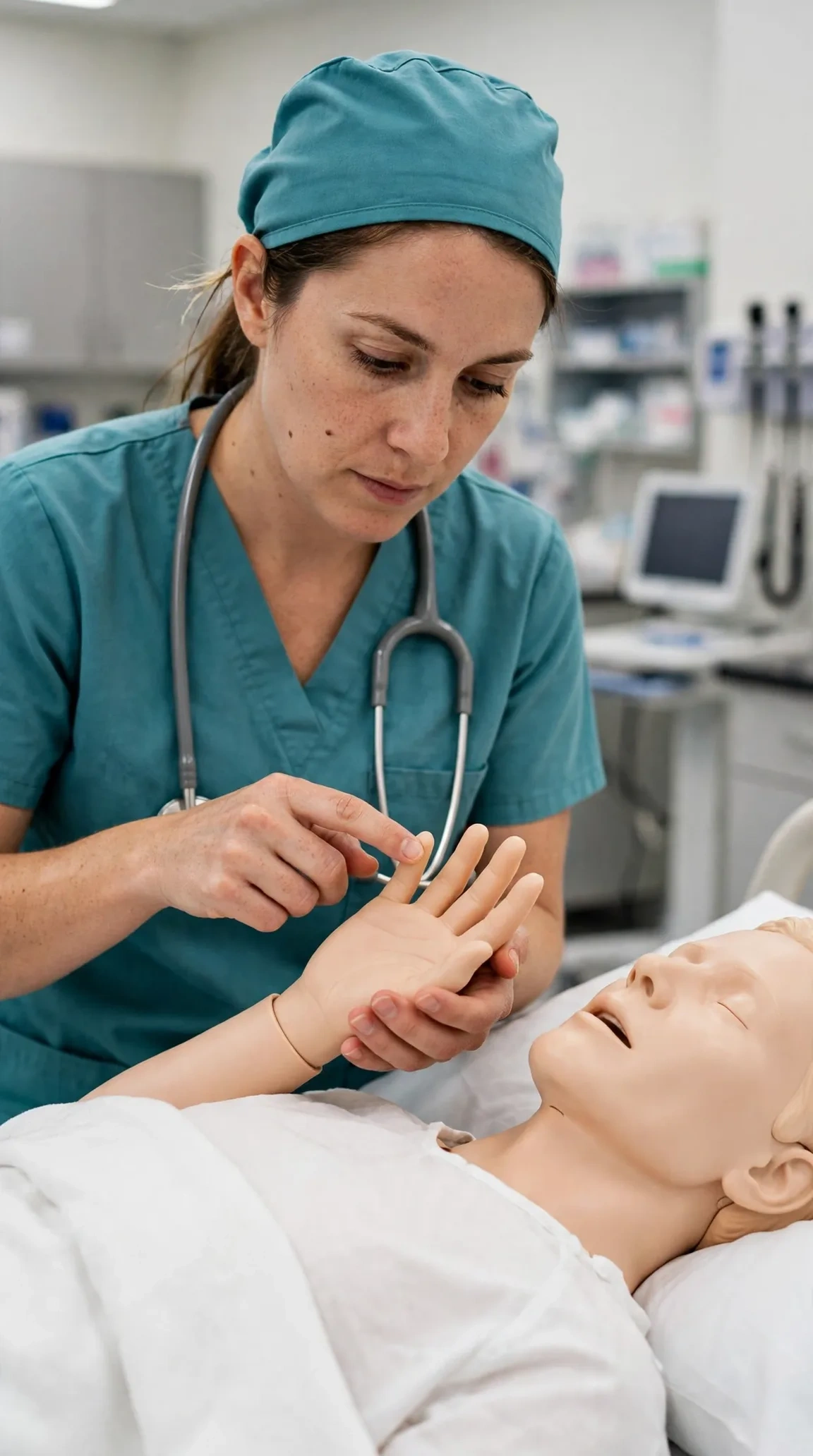
Score the best motor response, and watch the arms, since arm movement separates most motor levels. The hard pair is localizing against withdrawing: a hand that moves toward the stimulus scores higher than an arm that simply bends away from it. Practice that pair until the difference feels automatic.
Obeys Commands
Component: Motor · Score: 6 · Best response: Obeys commands
The patient follows a simple command, such as showing two fingers or squeezing a hand on request. The movement must match the command, not just happen at the same time as it. Record M6, the normal motor score, when the patient obeys on purpose.
Localizes to Pain
Component: Motor · Score: 5 · Best response: Localizing
The hand moves toward the stimulus and tries to remove it, for example crossing toward the chin after a central stimulus or reaching across the midline after nail bed pressure. This purposeful movement toward pain is the key sign of M5. A hand that only rises without reaching toward the stimulus does not count.
NCLEX tip: Exam questions often pair localizing with withdrawing as the two closest options. Ask one question: did the hand move toward the stimulus or only away from it? Toward means localizing, away means withdrawing.
Withdraws From Pain
Component: Motor · Score: 4 · Best response: Withdrawal
The arm bends at the elbow and pulls away from pain, but the hand does not move toward the stimulus. This is normal flexion, a step below localizing, and it still shows that pain is felt and the limb can move. Record M4, and watch whether the response stays at this level or falls further.
Abnormal Flexion
Component: Motor · Score: 3 · Best response: Abnormal flexion
The arms flex inward toward the chest in a slow, stiff pattern, while the legs extend. This decorticate posturing looks different from a quick withdrawal, because the movement is stereotyped and the same each time. Record M3 and report it promptly, since it signals severe impairment.
Abnormal Extension
Component: Motor · Score: 2 · Best response: Abnormal extension
The arms and legs extend stiffly, with the wrists turned inward, in decerebrate posturing. Extension scores below flexion, so a move from M3 to M2 means the patient got worse, not better. Record M2, protect the airway, and report the change right away.
No Motor Response
Component: Motor · Score: 1 · Best response: None
The limbs do not move at all after sound, voice and pressure. This is the lowest motor score, and it goes with a total at the severe end of the scale. Record M1, keep the patient safe and observed, and hand over the full E, V and M scores with the time of the check.
Quick Questions
Why is the lowest total 3 and not 0?
Each part starts at 1, not 0, so the lowest possible sum is 1 plus 1 plus 1, which equals 3. A total of 3 means no response in any part. Scores of 0 are never used, because 0 would look like a missing check rather than a real finding.
What do you write when the patient is intubated?
Mark the verbal part untestable, since an intubated patient cannot speak for the test, and do not report a total for that check. Record the eye and motor scores with a note about the tube, so the next nurse knows why the verbal part is blank.
Which part changes first when a patient gets worse?
No single part always changes first, which is why all three parts are recorded separately at every check. Watch the motor part closely, since a fall from localizing to withdrawing, or from flexion to extension, often shows a worsening picture before the total makes it obvious.
Which Step Will You Practice First?
Start with the motor pair that causes the most errors: localizing against withdrawing. Practice it with a classmate until the toward-or-away question takes only a second, then add the eye levels in order from spontaneous down to none.
Then turn the step into a habit by writing each practice check as a full E, V and M note, the way nursing care plan study tips turn a single observation into a clear plan entry. Which step will you practice first, and which response still trips you up?
For study use only. Always follow your program, your facility’s policy and current drug and lab references.