
On the NCLEX, the test plan files conversation skills under psychosocial integrity, yet the same replies are tested in med surg, fundamentals and maternity questions, because every unit runs on talk. This guide compares 24 therapeutic communication techniques side by side: what each one does, an example line you can borrow, and the moment it beats the alternatives.
The 24 are grouped by job, not by textbook order: listening and opening, reflecting and clarifying, guiding the talk deeper, then responding and wrapping up. Barriers like false reassurance and giving advice appear only as contrasts, so you can see what each technique replaces, and when to leave it in the drawer.
Listening and Opening the Conversation
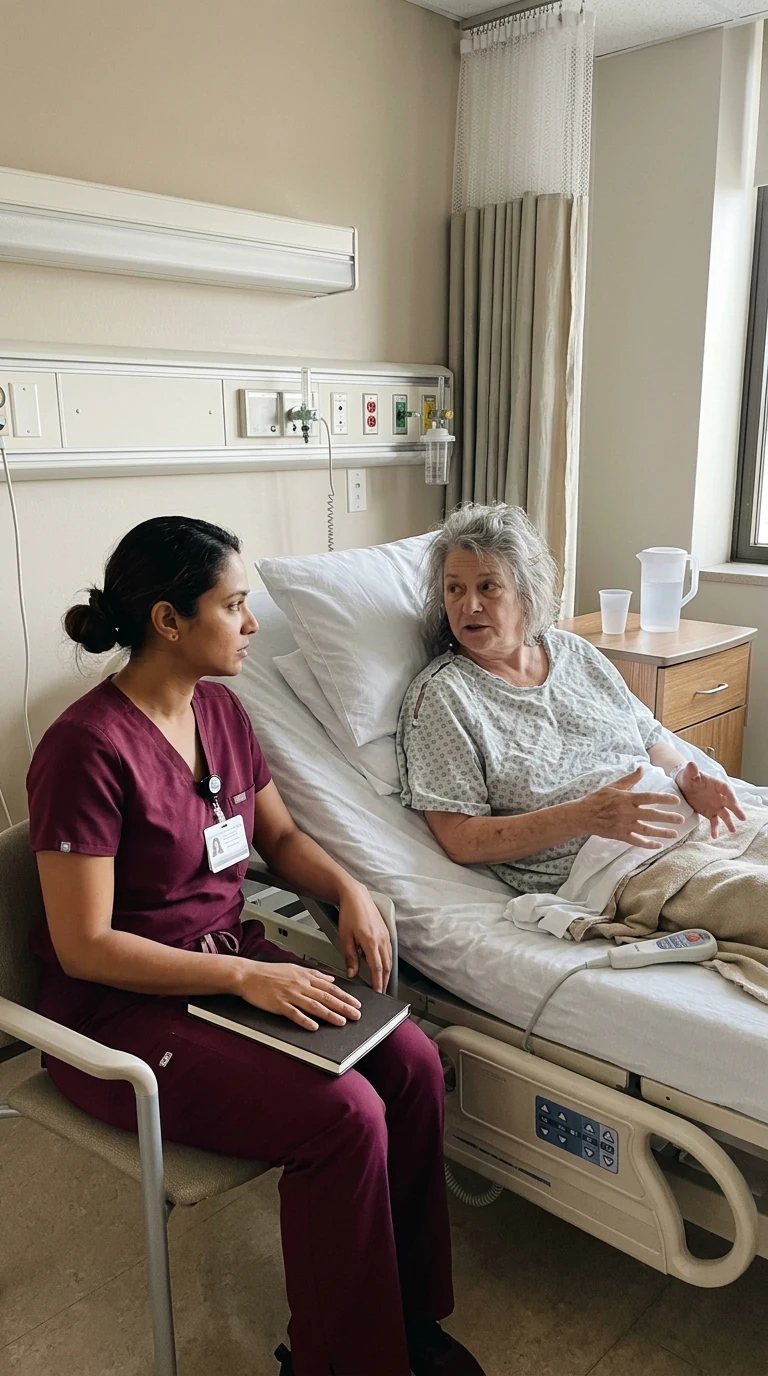
Some techniques add no information at all. They open the door, keep it open, and give the patient room to walk through it. These six cover how you sit, how you start, and how you stay quiet on purpose, where every good interview begins.
Active Listening
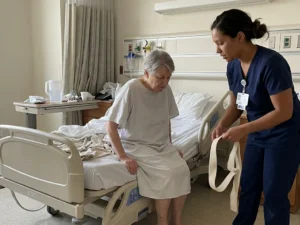
Active listening is the base technique the other 23 stand on. You face the patient, sit or stand at eye level, keep an open posture, and track the words and the feelings under them. On the NCLEX it is often the answer hiding inside a longer reply: listen first, and you learn what the patient actually fears.
- Posture: sit at eye level, lean slightly in, arms uncrossed and hands still.
- Attention: follow the words, tone and pauses, not the monitor or the door.
- Feedback: nod and use short prompts like “Mm-hm” and “Go on.”
- Beats: rushing to reassure, because listening collects the facts that every later technique needs.
Silence
Silence is a planned pause, not an empty one. After a heavy statement, a patient often needs ten quiet seconds to find the next sentence, and filling that gap with a question steals it. Silence beats restating when the patient is crying or has just heard hard news; your presence says the feelings are allowed.
Hold eye contact, stay relaxed, and let the patient break the silence. Count slowly to ten before you speak. If the quiet stretches, a soft “Take your time” reopens the door without pushing.
Study tip: practice a full ten-second pause with a classmate in lab; the urge to fill it fades by the third try.
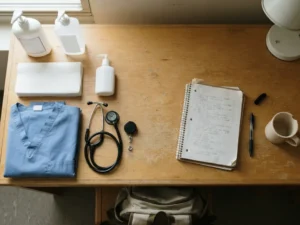
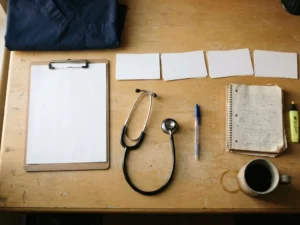
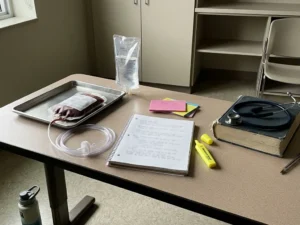
What you’ll need: a chair pulled to the bedside so you sit at eye level, a quiet corner away from hallway noise, and tissues and water within reach. For lab practice, add a classmate, a timer and your skills checklist.
Offering Self
Offering self means giving your time and presence without conditions: “I will sit with you while you wait for the surgeon.” It is not a promise about results, only about company. It beats giving information when anxiety is too high for facts to land; a calm presence lowers the panic that blocks learning.
- Say it plainly: “I can stay for a few minutes” or “I will be here when you wake up.”
- Mean it: only offer time you can give, then follow through.
- No strings: never trade your presence for cooperation, food or procedures.
- Skip it: when the patient asks to be alone; respect the closed door.
Broad Openings
A broad opening hands the topic choice to the patient: “What is on your mind this morning?” or “Tell me about how you have been sleeping.” The patient picks what matters most, often not the topic atop your task list.
Use them at the start of an interview or shift assessment. They beat open-ended questions early because they carry no topic at all, so the first answer shows where the real concern lives before you narrow in.
Study tip: memorize two broad openings word for word, so your first sentence never comes out as a pain scale question.
Open-Ended Questions
An open-ended question cannot be answered with yes or no: “How did you feel when the doctor explained the surgery?” It beats a closed question whenever you need the patient’s story or worries. It loses only when you need one fast fact, like an allergy, during an emergency.
- Start with how or what: “What worries you most about going home?”
- One at a time: two stacked questions get one answer, usually to the last one.
- Avoid why: “Why did you skip your insulin?” sounds like blame; ask “What got in the way?” instead.
- Follow up: let the answer choose your next technique, often restating or focusing.
Making Observations
Making observations means saying what you see without judging it: “I notice your hands are shaking” or “You have barely touched your lunch today.” Observations open topics the patient has no words for yet, and they work when a direct question would feel like an interrogation.
Chart what you observe, too: a change in behavior is assessment data. If a patient who was chatting at breakfast stops responding, that drop is scored and tracked with the Glasgow Coma Scale, and your observation triggers the check.
Study tip: phrase every observation as a plain fact, never a conclusion; “You seem sad” invites talk, while “You are depressed” ends it.
Reflecting and Clarifying Meaning
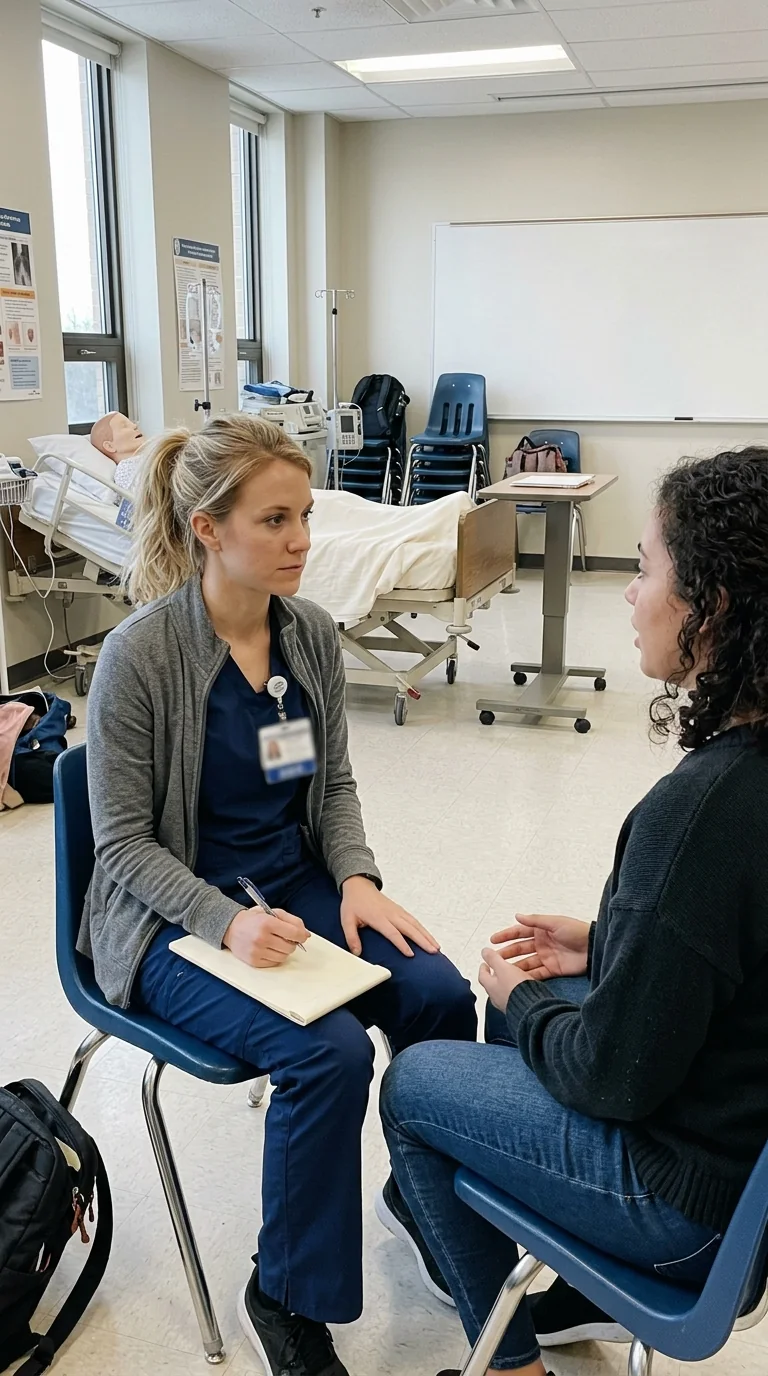
Once the patient is talking, your job shifts to checking meaning. These six play the message back, clean up the blurry parts, and name the feelings inside it, so the plan you build rests on what the patient actually meant, not your first guess.
Restating
Restating repeats the patient’s main idea in roughly the same words. Patient: “I could not sleep all night, I kept thinking about the biopsy.” Nurse: “You stayed awake worrying about the biopsy.” It confirms you heard the point, and it beats paraphrasing early because it changes nothing yet.
- Keep it short: repeat the core idea, not the whole speech.
- Use their words: clinical terms swapped in too early can shift the meaning.
- Then pause: give the patient room to confirm, correct or add.
- Watch the dose: restating every sentence sounds like a parrot; once or twice per topic is enough.
Paraphrasing
Paraphrasing restates the message in your own words: “So the nights are the hardest part right now.” Where restating echoes, paraphrasing translates, which makes it the better tool for long, tangled stories that need compressing into one line.
End with a check: “Did I get that right?” A wrong paraphrase still helps, because the patient corrects it, and you both end up with the accurate version instead of a polite misunderstanding.
Study tip: in practice questions, paraphrase the patient’s statement to yourself before reading the options; the correct reply usually matches your version.
Reflecting
Reflecting sends the feeling, and sometimes the question, back to the patient. “You sound angry about the delay.” Or, to “Do you think I should take the treatment?”, “You are unsure whether it is right for you.” Reflecting beats giving advice because the decision, and the feelings about it, stay with the patient.
- Name the feeling: angry, scared, relieved, torn; if you miss, the patient will correct you.
- Reflect questions: exam questions love this move; advice-giving is the classic distractor.
- Tone stays level: a cold guess shuts people down, so keep warmth in your voice.
- Best moment: when the feeling in the room is louder than the facts.
Clarifying
Clarifying asks the patient to make a vague statement sharper: “When you say the pain is bad, where is it worst?” and “What do you mean by dizzy: spinning, or lightheaded?” Vague words hide assessment gold; clarifying digs it out before you chart it.
A patient who nods at a dose schedule may be lost, so ask them to say the plan back in their own words. The gaps that surface are the same gaps students hunt when they drill medication calculation questions before an exam.
Study tip: collect clarifying stems: “Help me understand,” “Can you give me an example,” and “What happens right before it starts?”
Seeking Clarification
Seeking clarification checks your side of the message: you offer your understanding and ask the patient to grade it. “Let me make sure I have this right. The pain started after lunch, eased when you sat up, and came back on the stairs.”
- Summarize your take: two or three facts, in the order you heard them.
- Ask for the grade: “Is that how it happened?” invites correction.
- Fix it out loud: repeat the corrected version so the chart gets it right.
- Use before acting: clarify first whenever the next step is a call to the provider.
Acknowledging Feelings
Acknowledging feelings names the emotion as legitimate before anything else happens: “It makes sense that you feel frightened; this diagnosis came fast.” It differs from reflecting by adding acceptance: the feeling is not a problem to fix, only a fact to respect.
Acknowledgment beats false reassurance every time. “Do not worry, everything will be fine” shuts feelings down and breaks trust when things are not fine. “This is a lot to take in” keeps the door open and the trust intact.
Study tip: swap one reassurance for one acknowledgment in every practice scenario this week, and notice how much longer the patient keeps talking.
Guiding the Conversation Deeper
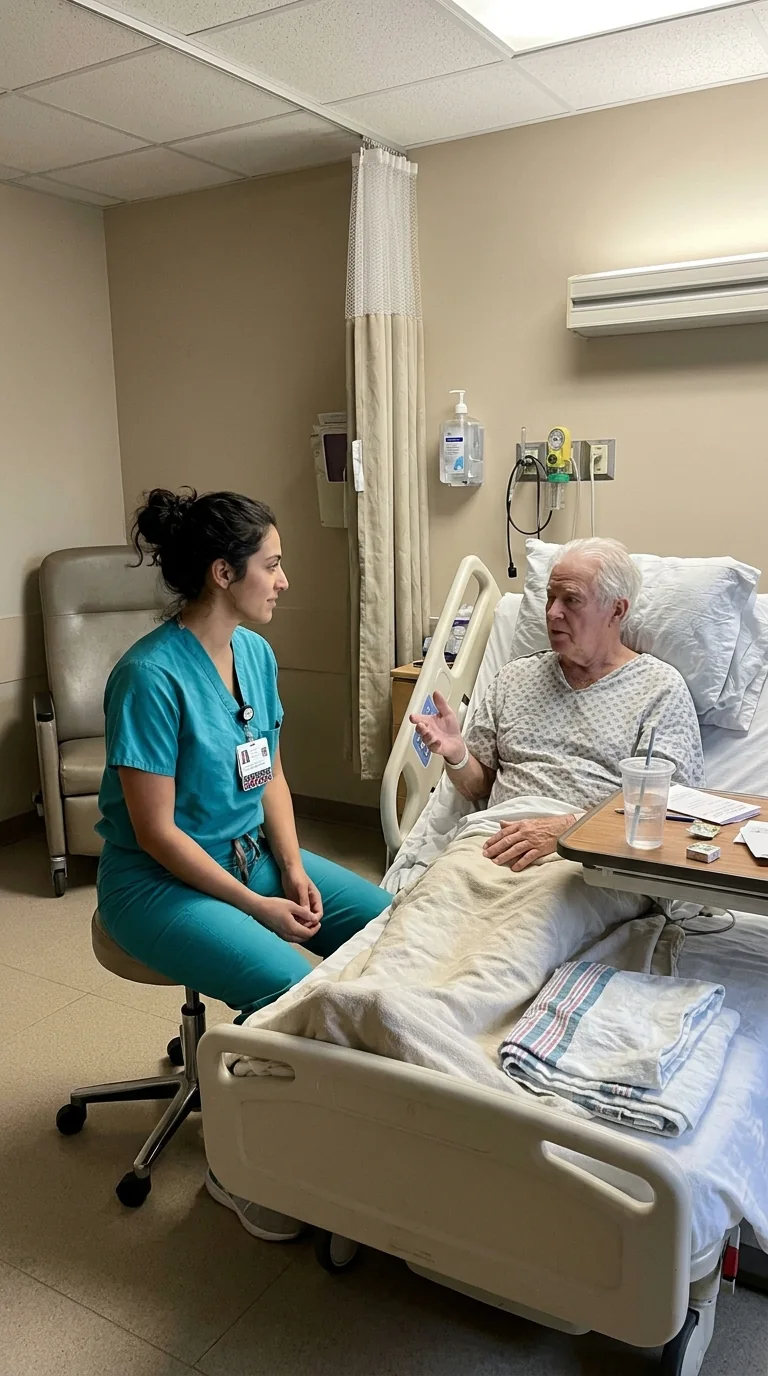
A good interview also needs steering. These techniques narrow a wide story to the point that matters, compare today with last week, and invite the patient to judge their own progress, without taking the conversation away from them.
Focusing
Focusing takes one thread of a long story and stays with it: “You mentioned the nausea three times; let’s stay with that.” It is the tool for patients who jump between topics, and for the last five minutes of an interview, when one clear problem matters more than six vague ones.
- Pick the repeated thread: the topic the patient keeps circling back to is usually the point.
- Say the turn out loud: “Let’s go back to the breathing for a moment.”
- One thread only: focusing on two things at once is just a new list.
- Go gently: if the patient resists the topic, note it and return later.
Exploring
Exploring asks for more about a topic the patient has already raised: “Tell me more about the pain at night.” It deepens without steering, which makes it the natural next step after a broad opening lands on something important.
Exploring beats focusing when the story is still thin. Focusing narrows what you have; exploring grows it first. Stop when the patient circles back to the same detail twice: the material is used up, and it is time to summarize or focus.
Study tip: “Tell me more about…” works almost anywhere; pair it with silence and let the patient do the work.
Translating Feelings
Translating feelings puts vague, loaded words into plainer ones the care team can act on. “I feel like nobody listens” becomes “You feel ignored when your call light takes a long time.” The patient hears their message cleaned up, and the chart gets a statement every reader understands the same way.
- Keep the patient’s meaning: translate the words, never upgrade or soften the emotion.
- Check the translation: “Is that close?” keeps ownership with the patient.
- Watch idioms: “I am at the end of my rope” is data, not a diagnosis; ask what it looks like this week.
- Skip it: when the patient uses a word deliberately, like a diagnosis they have accepted.
NCLEX tip: when four replies all sound kind, pick the one that keeps the patient talking about their own feelings. Advice, false reassurance and topic changes are the classic non-therapeutic distractors, even when warm and well meant.
Encouraging Comparisons
Encouraging comparisons asks the patient to set two moments side by side: “Was this episode like the one in March?” or “How is today’s pain different from yesterday’s?” Change over time is assessment data you cannot get any other way.
Comparisons beat exploring when a trend matters: appetite returning, sleep stretching, pain easing. They protect you at handoff, because “better than Tuesday, worse than this morning” tells the next nurse more than a number alone.
Study tip: ask one comparison question every clinical day; trends are the first thing preceptors ask about at post-conference.
Encouraging Evaluation
Encouraging evaluation invites the patient to judge their own situation: “How do you feel the new breathing exercises are working?” The patient, not the nurse, scores the progress, which surfaces doubts and small wins that vital signs never show.
- Ask, do not tell: “What has helped most this week?” beats “You are doing better.”
- Accept low scores: a patient who rates progress at two out of ten is handing you the teaching plan.
- Compare with goals: link the answer back to the target you set together.
- Document it: the patient’s own words about progress belong in the note.
Giving Recognition
Giving recognition acknowledges effort and progress without flattery: “You walked the hallway twice today” or “You asked every question on your list.” It names the behavior, not the person, which is why it lands as respect instead of praise.
Keep recognition specific and earned; empty compliments teach patients to discount your words. The same habit scales up: noticing real effort out loud gives weight to milestone moments, from a preceptor’s praise on the floor to the celebrations collected in these nurse graduation celebration ideas.
Study tip: end one patient interaction per shift with one specific recognition, and watch how it changes the next visit.
Responding and Wrapping Up

The last group handles the hard edges: the belief that is not true, the doubt you cannot remove, the facts the patient is owed, and the plan you build together. It ends with summarizing, which closes the interview and hands a clean story to the next nurse.
Presenting Reality
Presenting reality offers a plain fact when a patient misreads the situation, without arguing: “Your surgery is tomorrow, not today” or “I am your nurse, not your sister.” It corrects orientation and false beliefs calmly, and it never debates a delusion or plays along with one.
- One fact at a time: short, neutral, checkable.
- No arguing: state it once, kindly, then move on; repeating it louder helps no one.
- Pair with orientation: name, place, date and who you are, as often as needed.
- Skip the corrections tone: facts land better without a verbal eye-roll.
Giving Information
Giving information supplies facts the patient needs: what a test involves, why a gown and gloves appear at the door, when results usually return. Facts lower anxiety best when they arrive before the event, not after.
Keep each dose of information small and plain, then check it landed. A parent who understands why staff suit up for isolation precautions stops reading the gown as bad news, and a patient told the scan takes twenty minutes stops bracing for two hours.
Study tip: teach in chunks of two or three facts, then pause; a ten-fact lecture is forgotten by the second hallway.
Voicing Doubt
Voicing doubt questions a statement gently, without calling the patient wrong: “That does not match what the chart shows; help me understand,” or “It is hard to picture the medicine vanishing; let’s count the doses together.” It lets the patient revise an unrealistic or fearful claim themselves.
- Doubt the claim, not the person: keep your tone puzzled, not accusing.
- Offer the evidence: counts, times and observations beat opinions.
- Let it rest: plant the doubt and move on; pressure builds walls.
- Use sparingly: once per topic; repeated doubt feels like cross-examination.
Suggesting Collaboration
Suggesting collaboration turns the plan into a shared project: “Let’s work out a walking plan you feel safe with” or “Shall we practice the transfer together before your wife visits?” The word “let’s” does the heavy lifting; the patient becomes a partner, not a recipient.
A patient who helps design the plan follows it, which is why agreed routines, from call-light habits to scheduled walks, sit at the center of fall prevention basics on every unit.
Study tip: rewrite one order-style sentence a day as a “let’s” sentence; the habit transfers straight into patient teaching.
Appropriate Use of Touch
Touch is communication with the volume turned down: a hand on a forearm during hard news, a steady grip during a transfer. Used with permission and read correctly, it says what words cannot. Used carelessly, it invades. Culture, age, past experience and the patient’s response in the moment decide which it is.
- Ask or offer first: “Would it help if I held your hand?” respects the boundary.
- Keep it brief and plain: forearm or hand, never anywhere a gown covers.
- Read the response: a patient who stiffens or pulls away has answered; stop.
- Never a shortcut: touch supports words; it does not replace an explanation.
Summarizing
Summarizing pulls the whole conversation into a short, ordered recap: “So today we covered the pain pattern, your worry about the stairs at home, and the plan to practice transfers tomorrow.” It proves the patient was heard and catches anything missed before you leave.
A clean summary is a gift to your future self: it becomes the spine of your note and, with practice, one of the strongest nursing care plan study habits you can build, because it forces the story into priority order.
Study tip: summarize out loud at the end of every lab role-play, even when it feels awkward; fluency comes from reps.
Before Your Check-Off
Here is the comparison to carry into clinicals: every technique above does one of three jobs. It opens the conversation, checks the meaning, or steers it somewhere useful. When a reply feels wrong in a practice question, it is usually because it does none of the three and quietly closes the door.
One last tip: before your next skills check-off, run a five-minute role-play with a classmate and allow yourself only openers, reflections and summaries. No advice, no reassurance, no closed questions. The constraint feels strict for the first minute, and then the conversation starts doing the work for you.