
The nursing process has kept the same five steps since the American Nurses Association wrote them into its practice standards in 1973, and the order has never changed. Assessment, diagnosis, planning, implementation and evaluation still run every care plan you will write in clinicals, and nearly every care plan or priority question on the licensing exam sorts into one of the five. That is why the adpie nursing process framework is worth learning cold: these 18 points break each step down into what to do, what to chart and what examiners listen for.
You will see how to cluster cues before naming a diagnosis, how to write a goal a patient can actually reach, and where the cycle loops back when a plan misses. Keep a notebook nearby and test each point against your last clinical patient.
The Five Steps in One Pass

ADPIE is the short name for the nursing process: assessment, diagnosis, planning, implementation and evaluation. Read it as a cycle, not a staircase, because the final step sends you back to the first one. You gather data, name the patient’s problem, plan a response, carry it out, then judge what happened and start again. Every care plan and every care plan exam question fits inside one of these five steps.
- Assessment opens: every cycle starts with data you collect, never with a guess.
- Diagnosis names: the problem statement comes second, built only from the cues you found.
- Evaluation loops: the last step judges the result, then feeds straight back into assessment.
Assessment Starts With the Interview

Assessment begins with the conversation, because the patient tells you things no monitor can. A calm, focused interview draws out the chief concern, the history behind it and the details that numbers miss, and good therapeutic communication is what keeps that talk honest and unhurried. Ask open questions first, then narrow down. Save the measurements for after the story, or the story will quietly reshape itself around them.
Study tip: Practice opening lines out loud, since a smooth first question makes the whole interview easier.
Subjective Data vs Objective Data

Data comes in two kinds, and examiners love to test whether you can tell them apart. Subjective data is what the patient says: pain, nausea, dizziness, fear. These are symptoms, and only the patient can report them. Objective data is what you see, hear and measure: vital signs, skin color, lung sounds, intake totals. These are signs. Chart both, but label them correctly, because a diagnosis built on mixed-up data falls apart fast.
- Symptoms speak: “I feel dizzy” is subjective, even when you write it in the chart.
- Signs show: a blood pressure of 88/54 is objective, whoever reads the cuff.
- Quotes protect: chart the patient’s own words in quotation marks for subjective reports.
Cluster the Cues Before You Name Anything

One cue means almost nothing on its own. A fast pulse could point to pain, fever, bleeding or fear, so you group related findings before you name anything. Clustering means sorting your cues into piles that point the same way: the pale skin, the low pressure and the racing pulse belong together. Then validate anything that looks odd, by rechecking the measurement or asking the patient again, before the cluster hardens into a diagnosis.
Study tip: On scratch paper, draw a quick circle for each cluster and list its cues inside.
The Three-Part Diagnosis Statement

An actual nursing diagnosis is written in three parts, joined by two phrases. Part one is the problem, stated as a NANDA-I label. Part two is the cause, joined with “related to”. Part three lists the proof, joined with “as evidenced by”. Together they read like this in skeleton form: label, related to cause, as evidenced by signs and symptoms. Get the skeleton right and the full statement writes itself.
- Problem first: the label names the patient’s response, not the medical diagnosis.
- Cause second: the etiology is what your nursing care can actually treat.
- Proof last: the evidence comes only from your assessment data, never from a guess.
Risk Diagnoses Drop the Third Part

A risk diagnosis has no problem yet, only the chance of one, so the third part disappears. There is nothing to evidence, because the problem has not happened. The statement keeps two parts: the risk label and the risk factors that make it likely, joined in one sentence. Writing “as evidenced by” on a risk diagnosis is one of the most common care plan errors, and instructors circle it every time.
Study tip: If the patient already shows the problem, it is an actual diagnosis, so switch formats.
Study tip: Lay five blank cards on your desk, one per step, and sort clinical moments onto them as you study. Ten minutes of sorting teaches the cycle faster than rereading the chapter.
Planning Starts With Priorities

Planning starts by ranking, because you cannot fix everything in one shift. Airway, breathing and circulation come first, then safety risks, then pain and comfort, then teaching and longer goals. Maslow’s hierarchy gives the same order from another angle: body needs before safety, safety before belonging and esteem. When two problems compete, ask which one harms the patient sooner, and let that one lead the plan.
- ABCs rule: an airway problem outranks every other item on the list, always.
- Safety next: a fall risk or bleeding risk beats routine comfort care.
- Feelings later: teaching and esteem goals wait until the body is stable.
Goals Written the SMART Way

A goal you cannot check is just a wish, so plans use the SMART shape: specific, measurable, achievable, relevant and time-bound. Specific names the exact change. Measurable gives it a number, a scale or an observable sign. Achievable keeps it inside what this patient can do, and relevant ties it to the diagnosis. Time-bound adds the deadline, by tonight, by day two, by discharge, so evaluation later has something firm to judge against.
Study tip: Read your goal aloud and ask, could two nurses agree on whether this happened?
Outcomes You Can Actually Measure

Outcomes are the goal broken into patient results you can watch happen. Every outcome names the patient as the actor, uses a verb you can see or count, and carries a number and a time. “The patient will walk 50 feet by day two” passes all three tests. “The nurse will ambulate the patient” fails the first one, because it measures staff work, not patient progress.
- Patient acts: the subject of every outcome is the patient, never the nurse.
- Verbs show: walk, state, demonstrate and report beat vague words like understand or know.
- Numbers judge: distance, rate, scale score or count gives evaluation its evidence.
Three Kinds of Interventions

Interventions come in three kinds, sorted by who starts them. Independent actions are yours alone: repositioning, teaching, listening, raising the bed. Dependent actions need a provider’s order, like giving a medicine. Collaborative actions run with other disciplines, such as therapy, dietetics or pharmacy. Carrying out ordered isolation precautions sits in the dependent group, and doing it exactly as ordered is implementation, not paperwork.
Study tip: When a question asks what the nurse does first, look for the independent action.
Chart as You Go

Documentation is not a separate chore after implementation; it is part of implementation. Chart as you go, while the details are still exact: what you did, when you did it, what the patient said and how the patient responded. A note written three hours later guesses at times and misses reactions. On the exam, the same rule appears as a plain sentence: if it was not charted, it was not done.
- Times matter: record the real time of the action, not the time you charted it.
- Responses count: every intervention note ends with how the patient reacted to it.
- Facts only: chart what you saw and heard, never opinions about the patient.
What You May Delegate and What You May Not

Some of the work can be shared, and some can never leave your hands. Assessment, diagnosis, planning, evaluation and clinical judgment stay with the nurse, always. Stable, routine tasks, like bathing, feeding a patient who swallows safely, or taking vitals on a stable patient, may go to assistive personnel when the five rights of delegation are met: right task, circumstance, person, communication and supervision. You delegate the task, never the thinking behind it.
Study tip: If an answer choice hands assessment or evaluation to an aide, cross it out first.
Evaluation Has Three Honest Answers

Evaluation asks one question: did the patient reach the outcome by the deadline? There are only three honest answers. Met means the evidence matches the goal. Partially met means real progress happened but the target is not reached yet. Not met means the evidence shows no useful change. Write the answer the data supports, even when it is the third one, because an honest not met is what triggers a better plan.
- Compare evidence: set the latest findings next to the outcome, line by line.
- Name it plainly: met, partially met or not met, with the data attached.
- Decide next: each verdict leads to continue, adjust or rebuild the plan.
Safety note: Never chart a goal as met to close out a shift when the data says otherwise. The next nurse plans from your words, and a softened evaluation can hide a patient who is getting worse.
When the Plan Misses, Loop Back

A missed goal is information, not failure. When evaluation says not met, the cycle loops back to assessment instead of repeating the same plan louder. Recheck the data, because the original cues may have shifted. Question the diagnosis, because the label may have been wrong from the start. Then look at the goal itself: the interventions may be fine while the deadline was never realistic for this patient.
Study tip: Exam questions about an unchanged patient almost always want reassessment before more action.
Reassessment Runs Underneath Everything

Reassessment never switches off between the formal steps. You keep collecting data while you implement, watching for the change that rewrites the plan. A patient receiving blood transfusions is the clearest example: the nurse watches temperature, pulse and breathing during the transfusion, not just before it, because a reaction can start minutes in. That watching is assessment running underneath implementation, and it is why ADPIE is drawn as a circle.
- Watch during: new cues appear while care is happening, not only at the start.
- Compare trends: one reading means little; the direction across readings means a lot.
- Act on change: a new finding can pause implementation and reopen the whole cycle.
The Fall Plan as a Worked Example
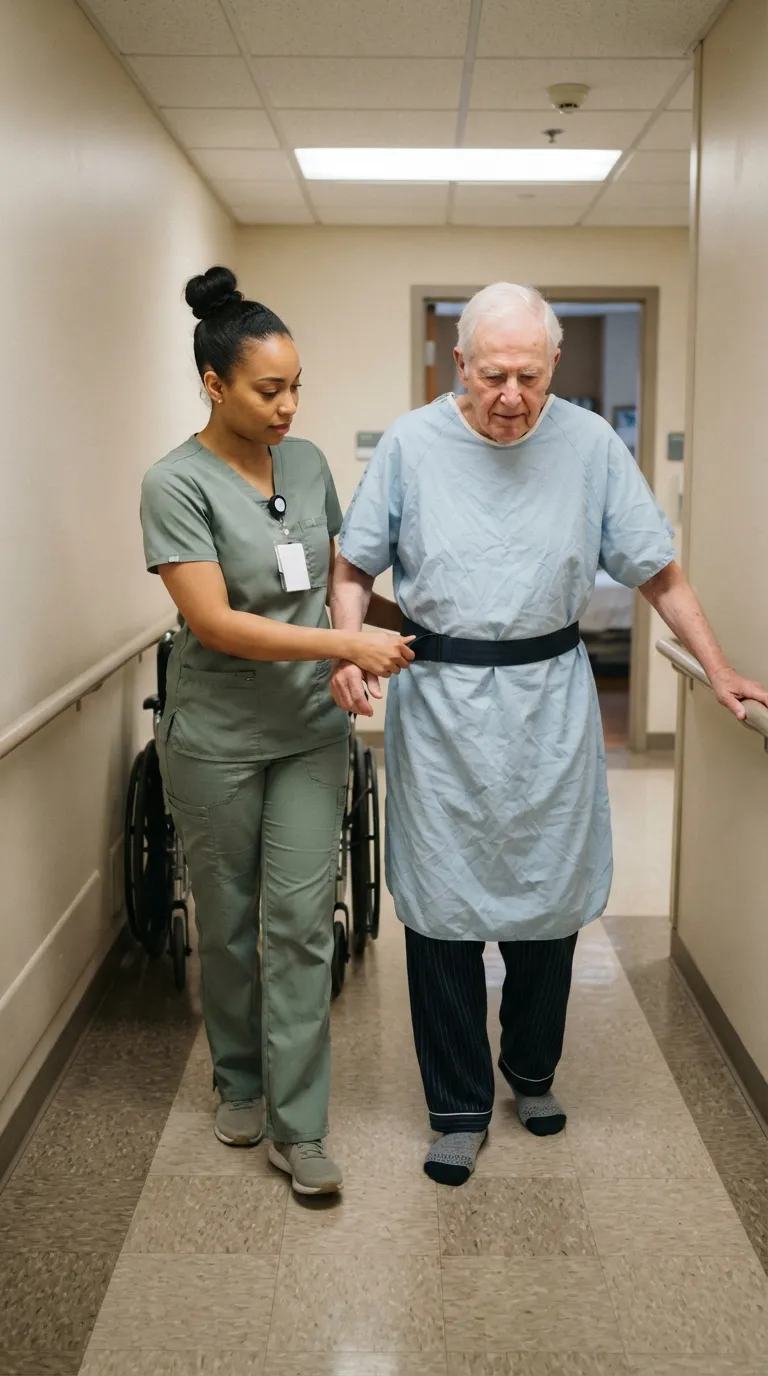
Here is the whole cycle in miniature, built on fall prevention. Assessment finds an older patient, weak after surgery, on a new sedating medicine, who tries to climb out alone. The risk diagnosis names the danger and its factors. The goal: the patient stays free of falls for the whole stay. Interventions follow: bed low and locked, call bell in reach, hourly rounds, help with every trip to the bathroom. Evaluation is simple to read: no fall, goal met; any fall, loop back and reassess.
Study tip: Build one mini plan like this for pain, skin and infection risk this week.
Words Examiners Listen For

Certain words act like signposts on the licensing exam, because they name the step a question is really about. Assess, gather, observe and check point to assessment. Verbalizes, demonstrates and reports point to outcomes and evaluation. First, priority and initial point to planning order. When a stem hides its step, hunt for these verbs before you read the options, and half the distractors fall away on their own.
- Assess words: collect, inspect, auscultate and ask all signal the first step.
- Outcome words: the patient will, followed by an action verb, signals a goal.
- Priority words: first and initial mean rank the options, not just pick a right one.
A Five-Minute ADPIE Drill

Close the loop with a drill that takes five minutes. Pick one patient from your last clinical day and say the cycle out loud: three cues you found, the diagnosis they cluster into, one SMART goal, two interventions and the verdict you would chart. Time yourself, and stop at five minutes even if the plan feels unfinished. Speed matters less than completeness: all five steps, in order, every single round.
Study tip: Run the drill with a classmate and swap patients, so unfamiliar cases stretch the cycle.
One Last Clinical Tip
One last tip: when a shift feels chaotic, shrink the cycle down to the patient in front of you. Assess what changed, name the one problem that matters most, do the next right action, and check the result before you move on. ADPIE was never meant to live only in care plan homework.
Tonight, take one old care plan from your binder and mark each line with its step. The lines you cannot label are the lines to rewrite, and that small habit will sharpen both your charting and your exam answers.