

Two pounds gained overnight is fluid, not fat: body fat cannot build that fast, but a failing heart can hold two pounds of water in a day. That single fact sits under a whole family of exam items, and these 25 nclex heart failure questions work through it: reading left-sided and right-sided signs, weighing and watching labs, handling the core medicines, and acting when an episode turns acute.
Each question gives four options, one best answer and a rationale that shows why the right call wins and where the traps sit. Work in order, cover the answers, and mark each miss by kind: a missed sign, a missed value, a wrong first move, a teaching slip.
How to Use This Practice Set
Cover each answer and rationale, read the stem, and commit to a letter out loud before you look. A choice you cannot explain is a guess, and these items punish guesses that skip the assessment.
Work one set at a time; mark each miss by kind: a sign sorted wrong, a loose value, a skipped check, a first move out of order. For plain-language background on symptoms, causes and treatment, the MedlinePlus heart failure summary is a steady reference.
Left-Sided and Right-Sided Signs
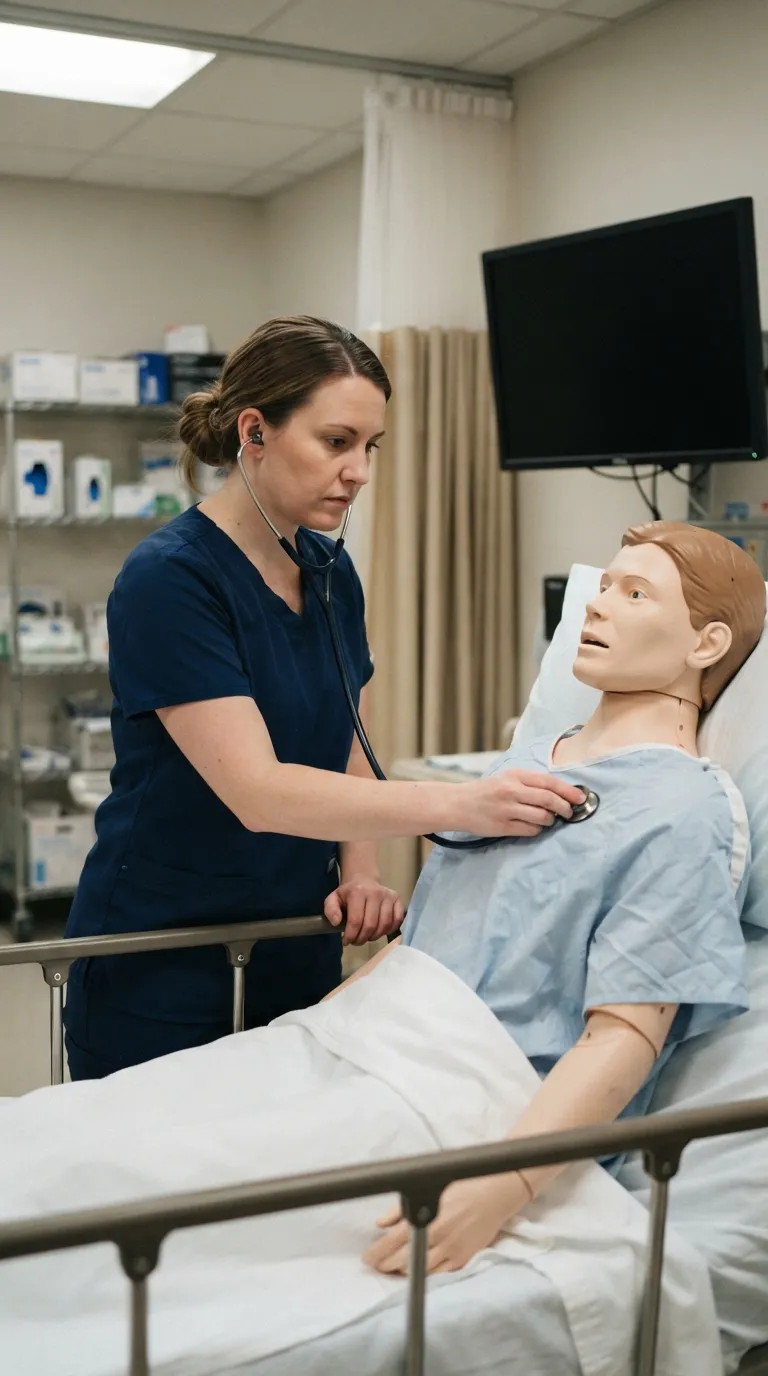
Question 1
A client is admitted with left-sided heart failure. Which assessment finding does the nurse expect?
- A. Neck veins distended while the client sits upright
- B. Pitting edema of both ankles by the end of the day
- C. Crackles at the lung bases and breathlessness lying flat
- D. A tender, enlarged liver
Answer: C. Crackles at the lung bases and breathlessness lying flat.
Rationale: Left-sided failure backs blood into the lungs: crackles, dyspnea, orthopnea. Neck vein distension (A), ankle edema (B) and liver enlargement (D) come from right-sided backup into the body.
Question 2
A client with heart failure reports waking suddenly about two hours after falling asleep, gasping, and needing to sit up to breathe. The nurse charts this as:
- A. Paroxysmal nocturnal dyspnea
- B. Cheyne-Stokes respirations
- C. Kussmaul respirations
- D. A panic attack during sleep
Answer: A. Paroxysmal nocturnal dyspnea.
Rationale: Lying flat lets fluid shift back into circulation; the failing left ventricle cannot move it on, so it backs into the lungs. Cheyne-Stokes (B) waxes and wanes with pauses. Kussmaul breathing (C) is the deep, fast pattern of metabolic acidosis. Panic (D) lacks the flat-hours pattern.
Question 3
Which finding cluster fits right-sided heart failure?
- A. Crackles, orthopnea and an S3 gallop
- B. Pink frothy sputum and severe dyspnea
- C. Fatigue, weak pulses and confusion
- D. Neck vein distension, dependent edema and weight gain
Answer: D. Neck vein distension, dependent edema and weight gain.
Rationale: The right side backs blood into the body’s veins: neck veins stand out, fluid settles low, the scale climbs. Crackles and frothy sputum (A, B) are left-sided lung signs. Fatigue and weak pulses (C) show low forward output, not congestion.
Question 4
Which finding tells the nurse the heart’s forward output is falling, rather than fluid backing up?
- A. Weight up 2 pounds since yesterday
- B. Weak, thready pulse with fatigue and trouble concentrating
- C. Crackles heard at both lung bases
- D. Neck veins visible at 45 degrees
Answer: B. Weak, thready pulse with fatigue and trouble concentrating.
Rationale: Forward failure means too little blood reaches the tissues: the pulse weakens, muscles tire, the brain slows. Weight gain (A), crackles (C) and neck vein distension (D) are congestion, fluid backing up on either side.
Study tip: sort every heart failure sign into two columns, lungs and body. Left-sided failure floods the lungs; right-sided failure fills the body’s veins. Most sign questions are won on that one sort.
Question 5
Auscultating a client with heart failure, the nurse hears an extra soft sound right after the second heart sound. This S3 gallop most often means:
- A. A normal finding in a healthy adult heart
- B. A narrowed valve forcing blood through a tight opening
- C. A dilated ventricle filling too fast with backed-up volume
- D. Inflammation of the sac around the heart
Answer: C. A dilated ventricle filling too fast with backed-up volume.
Rationale: An S3 in an adult with failure signals a stretched ventricle taking rapid filling against high volume: a congestion alarm, not a normal sound (A). Valve narrowing (B) makes murmurs, not an S3. Sac inflammation (D) causes a friction rub.
Question 6
A client with right-sided heart failure points to discomfort under the right ribs. Which explanation fits?
- A. The liver is swollen with backed-up blood and its capsule is stretched
- B. The stomach has shifted from the extra abdominal fluid
- C. Gallstones form quickly when the right heart fails
- D. The spleen is trapping the extra red cells
Answer: A. The liver is swollen with backed-up blood and its capsule is stretched.
Rationale: Right-sided backup congests the liver; the stretched capsule aches under the right ribs; ascites may follow. The stomach does not shift (B), gallstones (C) are unrelated, and the spleen (D) is not the congested organ tested here.
Question 7
A client with heart failure suddenly coughs up pink, frothy sputum and cannot catch a breath. The nurse reads this as:
- A. A stable finding that can wait for morning rounds
- B. A sign of right-sided failure only
- C. An expected effect of the evening diuretic dose
- D. Worsening pulmonary edema from left-sided failure that needs action now
Answer: D. Worsening pulmonary edema from left-sided failure that needs action now.
Rationale: Pink froth means fluid has flooded the air spaces: severe left-sided failure, an emergency. It is never wait-and-see (A), never right-sided (B), and never caused by a diuretic (C), which removes fluid rather than adding it.
Weights, Labs and Monitoring

Question 8
A nurse teaches a client with heart failure the home weighing routine. Which client statement shows the teaching worked?
- A. “I will weigh myself every Friday after dinner.”
- B. “I weigh each morning after urinating, in the same clothing, and call about a gain of 2 pounds in a day or 5 in a week.”
- C. “I only need the scale on days my ankles look swollen.”
- D. “Any scale will do, as long as I weigh once a week.”
Answer: B. “I weigh each morning after urinating, in the same clothing, and call about a gain of 2 pounds in a day or 5 in a week.”
Rationale: Daily weights are the earliest fluid signal, but only when conditions match: same time, scale and clothing. Weekly checks (A, D) miss the 2-pound daily alarm, and waiting for visible swelling (C) waits too long: fluid collects first.
Question 9
A client with heart failure calls the clinic: weight up 3 pounds since yesterday, breathing harder on the stairs. What is the nurse’s best response?
- A. Reassure the client and recheck the weight next week
- B. Tell the client to skip all fluids for the next day
- C. Advise an extra walk to sweat the fluid off
- D. Treat it as early fluid retention and notify the provider today
Answer: D. Treat it as early fluid retention and notify the provider today.
Rationale: Three pounds in a day plus new exertional dyspnea is the classic early decompensation pair: report it the same day, while a dose change can still prevent admission. Reassurance (A) wastes the warning. Cutting all fluids (B) or sweating fluid off (C) is unsupervised and unsafe.
Question 10
During a heart failure workup, a breathless client’s BNP returns at 85 pg/mL. How does the nurse read this result?
- A. Under 100 pg/mL, heart failure is unlikely, so another cause is sought
- B. The value confirms severe heart failure
- C. The value is a critical high that needs emergency treatment
- D. The test must be repeated within the hour to be valid
Answer: A. Under 100 pg/mL, heart failure is unlikely, so another cause is sought.
Rationale: BNP rises as the ventricles stretch, and under 100 pg/mL heart failure is unlikely as the cause of dyspnea, per the MedlinePlus BNP test notes. It neither confirms failure (B) nor reads as a critical high (C), and it is not a timed repeat test (D).
Question 11
Why does the provider order a BNP level for a client with new breathlessness and swollen ankles?
- A. It measures how well the kidneys filter waste
- B. It shows the oxygen level of arterial blood
- C. It rises when the ventricles are stretched by fluid overload
- D. It detects infection in the lungs or blood
Answer: C. It rises when the ventricles are stretched by fluid overload.
Rationale: Stretched ventricles release BNP, so the level climbs as failure worsens and separates cardiac dyspnea from lung causes. Kidney filtration (A) is read from creatinine. Oxygen levels (B) come from blood gas or oximetry. Infection (D) is tracked with cultures and white counts.
Question 12
An echocardiogram report lists an ejection fraction of 30 percent. The nurse explains this as:
- A. Preserved pumping function, within the usual range
- B. Reduced ejection fraction: each beat sends out a smaller share of the ventricle’s blood
- C. A normal result for any adult over 60
- D. A measurement of the pressure inside the lungs
Answer: B. Reduced ejection fraction: each beat sends out a smaller share of the ventricle’s blood.
Rationale: Usual ejection fraction runs about 55 to 70 percent; 40 percent or less is reduced, the weak-pump form of failure. It is not preserved (A), not an age allowance (C), and lung pressures (D) come from other tests.
Question 13
A client is receiving IV furosemide for fluid overload. Which set of assessments matters most during the infusion?
- A. Temperature and white blood cell count every hour
- B. Pupil size and response to light
- C. Bowel sounds in all four quadrants
- D. Intake and output, daily weight, blood pressure and potassium
Answer: D. Intake and output, daily weight, blood pressure and potassium.
Rationale: A loop diuretic is judged by what leaves and what it drags along: urine output and weight show fluid loss, blood pressure catches over-diuresis, potassium falls as urine flow rises. Fever and white cells (A), pupils (B) and bowel sounds (C) do not track it.
Heart Failure Medicines

Question 14
Before the morning digoxin dose, the nurse counts an apical pulse of 54 in an adult client. What does the nurse do?
- A. Hold the dose, assess the client, and notify the provider
- B. Give the dose with a full glass of water
- C. Give half the dose and recheck in one hour
- D. Give the dose and document the pulse in the chart
Answer: A. Hold the dose, assess the client, and notify the provider.
Rationale: Digoxin slows the heart, so an apical pulse under 60 is a hold parameter: stop, assess, report. Giving it anyway (B, D) can deepen bradycardia. Halving a prescribed dose (C) is not a nursing decision. The medication safety questions drill this hold habit.
Question 15
A client taking digoxin reports nausea, poor appetite, and seeing yellow-green halos around lights. The nurse’s first interpretation is:
- A. A stomach virus is going around the unit
- B. The client needs new glasses
- C. Possible digoxin toxicity: check the digoxin level and potassium
- D. A harmless effect that fades once the dose is raised
Answer: C. Possible digoxin toxicity: check the digoxin level and potassium.
Rationale: Gut upset plus vision changes is the classic digoxin toxicity pair; check the level (usual range about 0.5 to 2.0 ng/mL) and potassium before any more drug is given. A virus (A) and glasses (B) guess past a drug warning, and raising the dose (D) worsens it.
Question 16
A client takes digoxin and furosemide. The morning potassium returns at 3.1 mEq/L. Why does this raise the stakes?
- A. Low potassium weakens digoxin, so doses stop working
- B. Potassium has no connection to either drug
- C. Low potassium mainly causes muscle cramps, nothing more
- D. Low potassium makes the heart more sensitive to digoxin and invites toxicity and rhythm problems
Answer: D. Low potassium makes the heart more sensitive to digoxin and invites toxicity and rhythm problems.
Rationale: Furosemide drains potassium in urine; low potassium lets digoxin bind the heart more strongly, so toxicity risk climbs even at a usual dose. It does not weaken digoxin (A), it is tied to both drugs (B), and cramps (C) are the least of it.
NCLEX tip: the exam loves the potassium pair: loop diuretics push potassium down, spironolactone holds it up, and low potassium is the setup for digoxin toxicity. A potassium value in a stem is rarely decoration.
Question 17
The nurse prepares to give IV furosemide. Why is this drug pushed slowly?
- A. A fast push makes the drug stop working
- B. A rapid push can damage hearing
- C. A slow push keeps potassium from falling
- D. The drug must be diluted for a full hour first
Answer: B. A rapid push can damage hearing.
Rationale: Fast IV pushes of furosemide are linked to ototoxicity, hearing damage that can linger; a slow push avoids the harmful peak. Speed does not switch the drug off (A) or change potassium loss (C). Dilution follows the drug reference, not a fixed hour (D).
Question 18
A client takes spironolactone for heart failure. Which lab trend does the nurse watch for, the opposite problem of a loop diuretic?
- A. Potassium climbing too high
- B. Blood glucose rising sharply
- C. Calcium dropping below range
- D. Hemoglobin falling steadily
Answer: A. Potassium climbing too high.
Rationale: Spironolactone is potassium-sparing: it holds potassium in, so the watch flips from low potassium to high potassium, which threatens the heart’s rhythm. Glucose (B), calcium (C) and hemoglobin (D) are not this drug’s trap.
Question 19
A client taking carvedilol for heart failure says, “I feel fine now, so I am going to stop taking it.” Which response teaches the right rule?
- A. “That is fine; the drug has done its work.”
- B. “Take half a dose for a week, then stop.”
- C. “Stopping a beta blocker suddenly can strain the heart and worsen failure; keep taking it and raise any concerns with the provider.”
- D. “Save the tablets and restart them on a bad day.”
Answer: C. “Stopping a beta blocker suddenly can strain the heart and worsen failure; keep taking it and raise any concerns with the provider.”
Rationale: Beta blockers protect the failing heart over time; abrupt withdrawal can rebound heart rate and workload. Feeling well is the drug working, not a finish line (A). Self-tapering (B) and saving doses for bad days (D) hand dosing decisions to symptoms. The same family is drilled in the hypertension practice questions.
Acute Episodes and Home Teaching
Question 20
A client with heart failure suddenly sits bolt upright, gasping, coughing pink frothy sputum, oxygen saturation 84 percent. What is the nurse’s first action?
- A. Lay the client flat so a chest X-ray can be taken
- B. Leave the room to call the provider from the nurses’ station
- C. Begin chest compressions
- D. Sit the client fully upright with legs hanging down, give oxygen, and call for help
Answer: D. Sit the client fully upright with legs hanging down, give oxygen, and call for help.
Rationale: Position is the first treatment in pulmonary edema: upright with legs dependent pools blood in the legs and unloads the lungs; oxygen and a rapid call follow at once. Lying flat (A) drowns the lungs further. Leaving (B) abandons a client in distress; compressions (C) are for a pulseless client.
Question 21
Still in acute pulmonary edema, the client now sits upright on oxygen. Which prescribed treatment does the nurse expect first?
- A. A liter of IV fluid to raise the blood pressure
- B. An IV loop diuretic to pull fluid off the lungs
- C. An oral dose of digoxin for the fast pulse
- D. A sedative so the client can rest flat
Answer: B. An IV loop diuretic to pull fluid off the lungs.
Rationale: Once position and oxygen are set, the ordered IV loop diuretic removes the fluid causing the crisis; reassess breathing and saturation as it works. IV fluid (A) adds to the overload. Oral digoxin (C) is too slow for this minute, and lying flat to rest (D) undoes the position.
Question 22
At discharge teaching, which statement by a client with heart failure tells the nurse the teaching needs a correction?
- A. “I will check food labels for sodium before I buy.”
- B. “I will weigh myself every morning and write it down.”
- C. “I will call if I need an extra pillow to sleep.”
- D. “On days I stay home, I can skip my water pill.”
Answer: D. “On days I stay home, I can skip my water pill.”
Rationale: The diuretic is daily protection, not an outing accessory; skipping it invites the fluid gain the home scale exists to catch. Label reading (A), daily weights (B) and reporting new pillow needs (C), a sign of orthopnea, are the habits teaching aims for.
Question 23
An older client with heart failure wheezes, cannot lie flat and has swollen ankles. Which interpretation is correct?
- A. Wheezing always means asthma, so treat it as asthma
- B. Give a bronchodilator and reassess in the morning
- C. Fluid in the lungs can wheeze too, so assess for heart failure before calling it asthma
- D. Wheezing in an older adult is normal and needs no follow-up
Answer: C. Fluid in the lungs can wheeze too, so assess for heart failure before calling it asthma.
Rationale: Cardiac asthma is a real trap: fluid around the airways wheezes, but orthopnea and ankle swelling point to the heart, and the treatments differ. The asthma practice questions sharpen the true-asthma side of this comparison. Reassessing in the morning (B) and calling it normal (D) wait too long.
Question 24
Which lunch choice by a client with heart failure shows the low-sodium teaching landed?
- A. Canned soup with a deli meat sandwich
- B. Fresh grilled chicken, plain rice and unsalted vegetables
- C. A frozen pizza slice and pickles
- D. Processed cheese on crackers with tomato juice
Answer: B. Fresh grilled chicken, plain rice and unsalted vegetables.
Rationale: Fresh, plainly cooked food carries the least hidden sodium, the main driver of fluid retention. Canned soup and deli meat (A), frozen pizza and pickles (C), processed cheese with tomato juice (D) are sodium-heavy standards that undo a careful medicine plan.
Question 25
A client with stable heart failure is admitted in acute worsening after three days of fever, cough and thick sputum. Which factor most likely tipped the balance?
- A. A respiratory infection raising the heart’s workload
- B. Sleeping longer than usual for two nights
- C. Missing one daily walk during the fever
- D. Drinking one extra glass of water at lunch
Answer: A. A respiratory infection raising the heart’s workload.
Rationale: Infection is a leading decompensation trigger: fever demands more from a heart with no reserve. Extra sleep (B), a missed walk (C) and one glass of water (D) cannot overload it. The antibiotic practice questions cover the drug side of such infections.
Answer Review Tips
- Missed the side sort: rewrite each missed sign as lungs or body before you reread its rationale.
- Missed the value: 2 pounds a day, 5 pounds a week, BNP under 100, potassium 3.5 to 5.0. Say them aloud until they answer on their own.
- Missed the first move: in acute stems, position and oxygen beat every later drug answer.
- Missed the teaching check: the wrong statement is usually the one that stops a medicine, skips a weight, or waits out a red-flag sign.
Your Next Practice Set
Sort your misses by set before you study anything new. Sign misses mean the two-column sort needs another pass; medicine misses mean hold parameters and potassium pairs need a card of their own. Fix the weakest set first, then redo only its missed questions in two days, rationales covered.
From here, the natural next step is rhythm: a failing heart, digoxin and potassium all meet on the monitor. Work through the ECG practice questions next, and keep asking the same two questions of every stem: what is the danger, and what does the nurse do first?
For study use only. Always follow your program, your facility’s policy and current drug and lab references.