
Why does one client leave the clinic with a new prescription at 138/88 while another goes home with a log sheet and a recheck date? These 20 nclex hypertension questions sort out calls like that: how readings are taken and staged, which numbers mean crisis, what each drug class does, and the teaching that holds pressure down.
Four sets move from readings and classification to emergencies, then medications, and close with teaching and long-term control. Score each set before moving on, and use the same cover-and-commit habit that works for asthma practice questions: pick a letter and read why the wrong options fail.
How to Use This Practice Set
Cover the answer and rationale, read the stem, and say your choice and your reason out loud before you look. A reason you cannot say aloud is a guess.
Work one set at a time and mark every miss by kind: a misread stage, a wrong first move, a drug fact, a teaching point. The AHA blood pressure categories page lays out the same five ranges these questions use, from normal to crisis.
Readings and Classification
Question 1
A client’s averaged readings are 132/84 mm Hg on two separate visits. How is this blood pressure classified?
- A. Normal, since both numbers sit near 120/80
- B. Stage 1, because the diastolic falls in the 80 to 89 range
- C. Elevated, since the systolic is under 140
- D. Stage 2, because one high number sets the stage
Answer: B. Stage 1, because the diastolic falls in the 80 to 89 range.
Rationale: Stage 1 is systolic 130 to 139 or diastolic 80 to 89; the higher row wins, and the diastolic of 84 settles it. A fails: 84 passes the normal line of 80. C judges by the systolic alone. D skips a stage.
Question 2
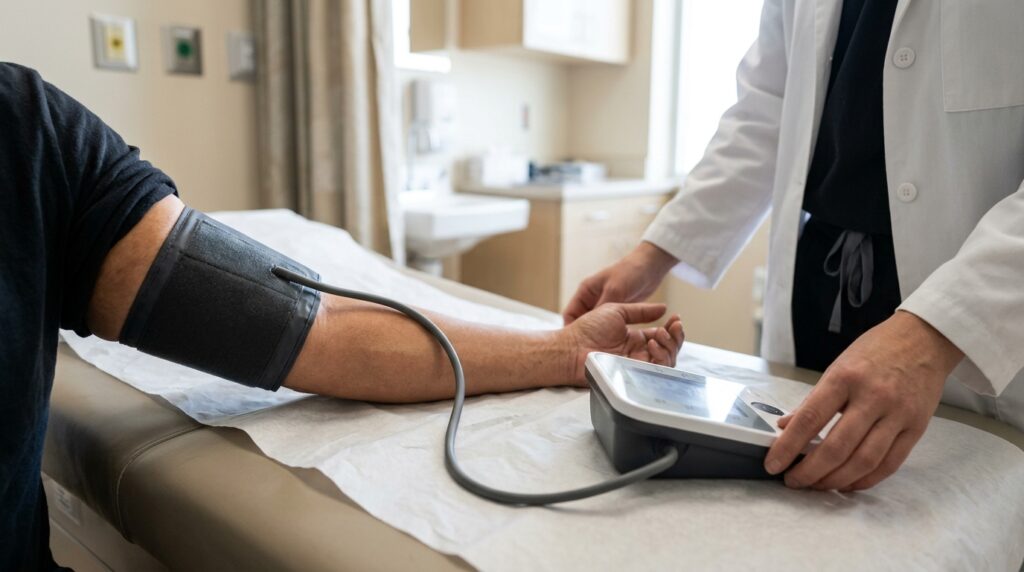
A nursing student sets up to measure a client’s blood pressure in the skills lab. Which part of the setup must be corrected before the cuff is inflated?
- A. Feet flat on the floor
- B. Arm supported on the table at heart level
- C. Bladder emptied, then 5 quiet minutes of rest
- D. The cuff is wrapped over a thick sweater while the client chats
Answer: D. The cuff is wrapped over a thick sweater while the client chats.
Rationale: Clothing under the cuff and talking push the number up, so the cuff goes on a bare arm and the client sits silent. A, B and C show correct technique: feet flat, arm supported, bladder emptied, 5 quiet minutes.
Question 3
A standard cuff is used on a client with a very large upper arm, and the reading comes back much higher than expected. Why?
- A. A cuff that is too small reads falsely high; recheck with a large cuff
- B. A large arm lowers the reading, so the value is higher
- C. The gauge loses accuracy on large arms
- D. White coat hypertension, until home readings prove otherwise
Answer: A. A cuff that is too small reads falsely high; recheck with a large cuff.
Rationale: The cuff bladder wraps about 80 percent of the arm. A too-small cuff reads falsely high and a too-large one falsely low, so the fix is a large cuff. B reverses the error. C blames the gauge. D needs correct technique first.
Question 4
Clinic readings are 146/92 and 148/94 mm Hg, but the home log for the past week averages 118/76 mm Hg. Which pattern fits?
- A. Masked hypertension
- B. Stage 2 hypertension needing two drugs today
- C. White coat hypertension
- D. Hypertensive urgency
Answer: C. White coat hypertension.
Rationale: White coat hypertension is high in the clinic and settled at home: exactly this gap. A is the mirror image, normal in clinic and high at home. B ignores the home average. D needs a crisis-level reading.
Question 5
A new client’s first clinic reading is 138/88 mm Hg; the client feels well, with no hypertension history. What does the nurse expect next?
- A. A stage 2 label and two starting drugs
- B. Confirmation with averaged repeat readings on separate visits, plus home readings
- C. A diagnosis from this single reading alone
- D. No follow-up for a year, since the client feels well
Answer: B. Confirmation with averaged repeat readings on separate visits, plus home readings.
Rationale: One reading never makes the diagnosis: it takes an average of two or more readings on two or more occasions, plus home readings for white coat and masked. A jumps past the evidence. C treats a screening number as final. D drops a stage 1 range.
Study tip: learn the categories as two staircases. Systolic steps up at 120, 130, 140 and 180; diastolic steps up at 80, 90 and 120. A reading takes the higher step of the two.
Emergencies and Red Flags

Question 6
Which confirmed reading reaches hypertensive crisis level, needing prompt care the same day?
- A. 142/90 mm Hg
- B. 156/98 mm Hg
- C. 168/104 mm Hg
- D. 186/124 mm Hg
Answer: D. 186/124 mm Hg.
Rationale: Crisis starts above 180 systolic and/or above 120 diastolic, and 186/124 clears both lines; repeat after a short rest to confirm. A, B and C are stage 2, not crisis.
Question 7
A client with a blood pressure of 192/126 mm Hg reports a severe headache and blurred vision. How is this classified, and what is the priority?
- A. Hypertensive emergency: organ damage is showing, so emergency care first
- B. Hypertensive urgency: an oral dose and a visit next week
- C. Stage 2 hypertension: recheck at the next routine visit
- D. White coat effect: repeat the reading later today
Answer: A. Hypertensive emergency: organ damage is showing, so emergency care first.
Rationale: Crisis numbers plus signs of organ injury, here brain and eyes, make a hypertensive emergency: lower the pressure under close monitoring. B fits the same numbers without organ damage. C and D delay care while organs signal injury.
Question 8
A repeat reading is 184/118 mm Hg: no chest pain, vision change, weakness or speech trouble, no acute injury in first labs. Which plan fits this hypertensive urgency?
- A. An IV drip to pull the pressure to 120/80 within the hour
- B. Reassurance and a routine recheck in six months
- C. Oral medicine, close follow-up within days, and a gradual lowering
- D. A sedative so the client sleeps while the pressure settles
Answer: C. Oral medicine, close follow-up within days, and a gradual lowering.
Rationale: Urgency is crisis-level numbers with no acute organ damage: oral medicine, a gradual fall over 48 hours, follow-up within days. A crashes the pressure. B leaves it unwatched for months. D sedates a calm client.
Question 9
In a hypertensive emergency, why is the pressure lowered in a controlled way instead of straight back to normal?
- A. IV blood pressure drugs cannot work any faster than that
- B. Organs adapted to high pressure can lose blood flow if it drops too fast
- C. Pressure rebounds above the crisis line within minutes
- D. Fluids given with the drugs hold the pressure up
Answer: B. Organs adapted to high pressure can lose blood flow if it drops too fast.
Rationale: Years of high pressure reset flow in the brain, heart and kidneys upward, so a drop starves them; keep the first-hour cut in mean arterial pressure at no more than 25 percent. A: the drugs act in minutes. C invents a rebound rule. D reverses fluids.
Question 10
A client arrives with a blood pressure of 198/128 mm Hg, chest pain and shortness of breath. Which assessments take priority?
- A. Breathing and saturation checks, cardiac monitoring with a 12-lead ECG, a neuro check
- B. A full diet history covering the past week
- C. A repeat reading in the other arm, then discharge
- D. Questions about caffeine at the last routine visit
Answer: A. Breathing and saturation checks, cardiac monitoring with a 12-lead ECG, a neuro check.
Rationale: Chest pain and breathlessness at this pressure threaten heart and lungs, so breathing, saturation, rhythm and a 12-lead tracing lead, with a neuro check; the same skills drilled in ECG practice questions. B waits for stability. C sends an unstable client out. D chases a minor trigger.
Blood Pressure Medications

Question 11
A client starts hydrochlorothiazide for stage 1 hypertension. Which lab value does the nurse watch most closely?
- A. The INR, for bleeding risk
- B. Fasting glucose, which doubles on this drug
- C. Serum calcium, which thiazides always push down
- D. Serum potassium, which can fall as the kidneys waste it
Answer: D. Serum potassium, which can fall as the kidneys waste it.
Rationale: Thiazides make the kidneys excrete potassium, so it can fall: cramps, weakness and rhythm problems, worse with digoxin aboard. A belongs to warfarin. B overstates a modest glucose effect. C flips it: thiazides cut calcium loss, so calcium rises.
Question 12
Three months into lisinopril, a client reports a dry, tickling cough that will not go away, with no fever, congestion or wheeze. What does the nurse suspect?
- A. A chest infection that needs an antibiotic
- B. New asthma developing alongside the hypertension
- C. The classic ACE inhibitor cough; report it, and expect a switch to an ARB
- D. A dose too low to control the pressure
Answer: C. The classic ACE inhibitor cough; report it, and expect a switch to an ARB.
Rationale: ACE inhibitors raise bradykinin, and a dry cough is their classic effect; reporting it earns a switch to an ARB. A treats a drug effect as infection, with no infection signs. B invents a disease. D blames the dose. One warning outranks it: lip, tongue or face swelling means angioedema.
Question 13
Thirty minutes after a first ACE inhibitor dose, a client’s lips and tongue swell and the voice sounds muffled. What is the nurse’s first action?
- A. Stop the drug, call for emergency help, and protect the airway
- B. Give an oral antihistamine and observe for an hour
- C. Finish the dose, then document the swelling
- D. Offer ice water and recheck the swelling tomorrow
Answer: A. Stop the drug, call for emergency help, and protect the airway.
Rationale: This is angioedema, the ACE inhibitor reaction that can close an airway: stop the drug for good, call for emergency help, protect the airway. B underestimates swelling that blocks breathing fast. C adds more of the cause. D waits a day.
Question 14
A client on amlodipine reports new ankle swelling by evening, with no breathlessness, rapid weight gain or chest pain. What is the best explanation and action?
- A. Heart failure: stop the drug tonight
- B. A leg clot: strict bed rest
- C. An allergy: no calcium channel blocker ever again
- D. A known amlodipine effect: report it and keep taking it
Answer: D. A known amlodipine effect: report it and keep taking it.
Rationale: Amlodipine widens arteries, so fluid shifts into the ankles; the swelling is dose-related. Report it and let the prescriber judge. A names the fear to exclude; its signs are absent. B needs one-sided pain and redness. C mislabels an effect as allergy.
Question 15
A client with diabetes takes metoprolol. Which teaching point about low blood sugar matters most?
- A. Stop the metoprolol on any day the glucose runs low
- B. Low blood sugar feels stronger on this drug, so symptoms are easy to catch
- C. It can hide the racing heart and shakiness of low blood sugar, so check glucose on schedule
- D. Take extra insulin whenever the pulse feels slow
Answer: C. It can hide the racing heart and shakiness of low blood sugar, so check glucose on schedule.
Rationale: Beta blockers blunt the tremor and pounding heart that warn of low blood sugar, so a low arrives quietly; sweating is not blocked and may be the only clue. A stops a drug without an order. B states the opposite. D adds insulin to a slow pulse. The class can tighten airways: asthma clients start elsewhere.
Teaching and Long-Term Control
Question 16
Which daily eating pattern matches DASH teaching for a client with stage 1 hypertension?
- A. Processed meats and salty snacks with a sweet soda
- B. Vegetables, fruit, grains and low-fat dairy, with protein and little added salt
- C. Grapefruit and water only until the pressure falls
- D. Extra salt at meals to balance the potassium in fruit
Answer: B. Vegetables, fruit, grains and low-fat dairy, with protein and little added salt.
Rationale: DASH, Dietary Approaches to Stop Hypertension, builds on produce, grains, low-fat dairy and protein, low in saturated fat and salt, rich in potassium and fiber. A is the pattern DASH replaces. C is a fad fast. D cancels the sodium cut: potassium softens sodium; it does not pair with it.
Question 17
A client asks how to cut sodium without giving up flavor. Which answer does the nurse give?
- A. Switch to sea salt, which does not affect blood pressure
- B. Use soy sauce without limit, since liquid seasonings do not count
- C. Judge by taste: packaged food is fine when it is not salty
- D. Read labels, rinse canned beans and vegetables, and season with herbs
Answer: D. Read labels, rinse canned beans and vegetables, and season with herbs.
Rationale: Most sodium hides in packaged and restaurant food, so labels and rinsing canned foods do the cutting; aim near 1,500 mg a day. A swaps salts: sea salt is still sodium chloride. B pours on a salty liquid. C trusts taste, and sodium often never tastes salty.
Question 18
A client is starting home blood pressure checks. Which routine does the nurse teach?
- A. Rest 5 minutes, feet flat, arm supported at heart level, two readings a minute apart, log both
- B. Measure right after climbing stairs
- C. Stand with the arm hanging straight down
- D. Record only the best of several readings each day
Answer: A. Rest 5 minutes, feet flat, arm supported at heart level, two readings a minute apart, log both.
Rationale: Home readings guide care only when technique mirrors the clinic: rested, seated, supported arm, two readings a minute apart, logged. The cuff and log travel to visits to be checked against the clinic device; averaging the pairs is the same averaging drilled in medication calculation questions. B measures exercise. C drops the arm. D cherry-picks the log.
Question 19
A client’s pressure crept up despite every dose taken on time; the history shows daily ibuprofen for knee pain and two drinks most evenings. What is the nurse’s best response?
- A. Take a second diuretic dose daily until the numbers improve
- B. Stop the blood pressure medicine, since it is not working
- C. Report both habits: NSAIDs and regular alcohol can raise pressure
- D. Double the morning dose on days the knee hurts most
Answer: C. Report both habits: NSAIDs and regular alcohol can raise pressure.
Rationale: NSAIDs make the kidneys hold sodium and water, blunt several pressure medicines, and regular alcohol pushes pressure up too; both belong in the visit talk. A and D change the plan without an order. B quits what holds pressure down. Adherence is not the problem: every dose was taken.
Question 20
At a recheck, a client whose pressure now reads 126/78 mm Hg says: I feel completely fine, so I can stop the pill now. What is the nurse’s best reply?
- A. Agree, and suggest a month off the drug to test it
- B. Feeling fine is the medicine working; stopping lets the pressure climb silently, so keep taking it
- C. Take the pill only on days a home reading is high
- D. Stop the pill, but keep salt low and weight steady
Answer: B. Feeling fine is the medicine working; stopping lets the pressure climb silently, so keep taking it.
Rationale: A controlled reading on treatment is the treatment working, not the disease cured; stop the drug and pressure climbs again within weeks, still with no symptoms. Rechecks after any change run monthly until controlled, then every 3 to 6 months. A runs an unmonitored experiment. C steers by daily numbers. D trades a drug for habits.
Answer Review Tips
- Missed the stage: match both numbers to the staircase; when they land in different rows, the higher category wins.
- Missed the first move: sort by organ damage: symptoms or injury mean emergency; a big number in a well client is urgency, on oral medicine and close follow-up.
- Missed the drug fact: attach one watch item to each class: potassium with thiazides, cough and swelling with ACE inhibitors, ankles with amlodipine, hidden lows with beta blockers.
- Missed the teaching: say the plan out loud in client words; the MedlinePlus high blood pressure guide shows the same DASH, sodium and home log teaching in plainer words.
Which Questions Did You Miss?
Start where the misses cluster. Staging misses mean the category cutoffs need another pass before the drugs; drug misses mean the class warnings need sorting. The antibiotic practice questions reuse the same drug-class habits: one class, one watch list.
Pick the weakest set, redo it tomorrow with the rationales covered, and check that the traps no longer catch you. Which set will you rerun first: the readings, the red flags, or the drug warnings?
For study use only. Always follow your program, your facility’s policy and current drug and lab references.