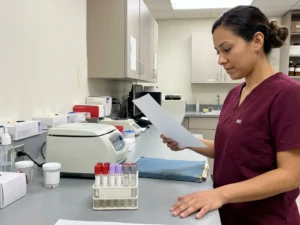

The medication room is quiet except for the scanner. A nursing student reads a vial label twice, checks it against the screen, and still feels her heart going, because one letter separates two drug names that sound like twins. Moments like that are exactly what these 25 nclex medication safety questions rehearse: the checks, the holds and the judgment calls that keep a med pass safe.
Each question gives four options, one clearly best answer and a rationale that explains the right call and why the traps fail. Work through rights and verification first, then high-alert drugs, error response and bedside administration, and finish by sorting the misses with the review tips.
How to Use This Practice Set
Cover each answer and rationale, read the stem, and say your choice and your reason out loud before you look. A reason you cannot say aloud is a guess, and guesses are what these questions are built to catch.
Work one set at a time: verification, high-alert drugs, error response, bedside practice. Mark every miss by kind: unknown fact, unchecked parameter, or a shortcut that sounded efficient.
Rights, Allergies and Labels

Question 1
A nurse is about to give a dose of metoprolol to a client whose heart rate is 52 beats per minute. The order gives no hold parameter. What should the nurse do first?
- Give the dose, then recheck the heart rate in 30 minutes.
- Hold the dose and call the prescriber before giving it.
- Give half the dose and document the heart rate.
- Ask the client whether they feel dizzy, then decide.
Answer: B. Hold the dose and call the prescriber before giving it.
Rationale: A beta blocker can slow an already slow heart rate further. With no hold parameter and a rate of 52, giving the dose risks symptomatic bradycardia, while holding and seeking an order protects the client. Rechecking after the dose, splitting a dose without an order and deciding on symptoms alone all skip the prescriber decision the situation requires.
Question 2
A nurse notes a client has a documented penicillin allergy and a new order for amoxicillin. What should the nurse do first?
- Give the first dose and watch for a reaction.
- Hold the dose and clarify the order with the prescriber.
- Give an antihistamine first, then the antibiotic.
- Ask the client whether the allergy was mild.
Answer: B. Hold the dose and clarify the order with the prescriber.
Rationale: Penicillin and amoxicillin share a beta-lactam structure, so cross-reactivity is a real risk. The safe first move is to hold and clarify rather than test the allergy with a dose. An antihistamine does not make the order safe, and the client’s memory of severity does not replace a prescriber review.
Question 3
Two vials look alike, and the labels differ by one letter. Which action best prevents a look-alike drug error?
- Store the vials side by side so the difference is visible.
- Read the full label, including strength and concentration, against the order.
- Check the expiry date before opening the drawer.
- Ask a colleague to confirm the color of the cap.
Answer: B. Read the full label, including strength and concentration, against the order.
Rationale: Look-alike errors happen when the eye reads what it expects. Comparing the full label, strength and concentration included, against the order breaks that pattern. Side-by-side storage increases confusion, expiry checks do not address identity, and cap color is not a reliable identifier.
Question 4
A client refuses a scheduled dose of antihypertensive medication. What should the nurse do first?
- Document the refusal and move on to the next client.
- Explain the risks and ask why the client is refusing.
- Crush the tablet into food so the client takes it unknowingly.
- Call the prescriber before speaking with the client.
Answer: B. Explain the risks and ask why the client is refusing.
Rationale: Refusal is a right, and the first step is understanding it: the reason may be a side effect, a misunderstanding or a fear that teaching can address. Documenting without a conversation, hiding a drug in food and escalating before listening all skip the assessment that could resolve the refusal safely.
Question 5
A nurse is preparing insulin and notices the order reads 10 units but the syringe is drawn to 100 units. What should the nurse do first?
- Give 10 units and discard the rest.
- Discard the drawn dose, start again and have a second nurse verify.
- Inject the full syringe slowly and monitor glucose.
- Document the error and continue the med pass.
Answer: B. Discard the drawn dose, start again and have a second nurse verify.
Rationale: A tenfold insulin error is a high-alert danger. The drawn syringe cannot be trusted or adjusted safely, so it is discarded and redrawn with an independent double check. Giving a partial syringe, injecting the full amount or documenting and moving on all risk a severe hypoglycemia event.
Question 6
Which statement about the right route is correct?
- A tablet ordered orally may be crushed and given IV if the client cannot swallow.
- The route on the order must match the route actually used.
- An intramuscular drug may be given subcutaneously at the same dose.
- The route matters less than the dose for most drugs.
Answer: B. The route on the order must match the route actually used.
Rationale: Route changes absorption, onset and safety, and some formulations are dangerous or useless by another route. Crushing an oral tablet for IV use, swapping intramuscular for subcutaneous and treating route as unimportant all violate the right route and can harm the client.
Question 7
A nurse scans a client’s wristband and the medication barcode, and the system flags a mismatch. What should the nurse do first?
- Override the alert and give the dose if the label looks right.
- Stop, check the order, the client and the drug, and resolve the mismatch.
- Scan again until the alert clears.
- Ask another nurse to scan it for them.
Answer: B. Stop, check the order, the client and the drug, and resolve the mismatch.
Rationale: A barcode mismatch is a safety stop, not a nuisance alert. The nurse pauses and verifies all three elements before proceeding. Overriding, rescanning until it clears or handing the scan to someone else all defeat the check that caught the potential error.
High-Alert Medications
Question 8
A client is prescribed warfarin and the nurse notes the latest INR is 4.8. What should the nurse do first?
- Give the dose as ordered and recheck the INR tomorrow.
- Hold the dose and notify the prescriber.
- Give vitamin K with the dose.
- Ask the client to eat more leafy greens.
Answer: B. Hold the dose and notify the prescriber.
Rationale: An INR of 4.8 is above the usual therapeutic range and raises bleeding risk, so the dose is held and the prescriber notified for direction. Giving the dose, adding vitamin K without an order and adjusting diet on the spot all skip the clinical decision the result demands.
Question 9
Which drug class requires an independent double check before administration in most facilities?
- Insulin and heparin.
- Antacids and laxatives.
- Multivitamins.
- Topical moisturizers.
Answer: A. Insulin and heparin.
Rationale: Insulin and heparin are high-alert drugs where small dose errors cause serious harm, so facilities require two nurses to verify them independently. Antacids, laxatives, multivitamins and moisturizers do not carry the same error risk and are not double-checked as a rule.
Question 10
A nurse finds that a heparin infusion pump is running at twice the ordered rate. The client shows no bleeding. What should the nurse do first?
- Slow the pump to the ordered rate and document the event.
- Stop the infusion and notify the prescriber immediately.
- Restart the pump at the ordered rate without telling anyone.
- Wait for the next aPTT result before acting.
Answer: B. Stop the infusion and notify the prescriber immediately.
Rationale: A doubled heparin rate is an active overdose risk even without bleeding yet. Stopping the infusion and escalating at once limits further exposure. Merely slowing the pump, restarting quietly or waiting for labs all delay the response a high-alert error requires.
Study tip: keep a short card of your facility’s high-alert list and the double-check steps for insulin, heparin and opioids. When a stem names one of them, your first thought should be verification, not speed.
Question 11
A client on opioids has a respiratory rate of 8 breaths per minute and is hard to arouse. What should the nurse do first?
- Give the next scheduled opioid dose on time.
- Stimulate the client, assess airway and breathing, and call for help and naloxone per protocol.
- Increase the oxygen flow and recheck in an hour.
- Document the sedation and continue monitoring.
Answer: B. Stimulate the client, assess airway and breathing, and call for help and naloxone per protocol.
Rationale: A rate of 8 with difficult arousal signals opioid-induced respiratory depression, an emergency. Stimulation, airway assessment and escalation with naloxone per protocol come first. Giving another dose, adjusting oxygen alone or documenting and watching all delay the rescue.
Question 12
Which finding must be checked before giving a dose of digoxin?
- Blood glucose.
- Apical pulse for a full minute.
- Respiratory rate only.
- Urine output for the last hour.
Answer: B. Apical pulse for a full minute.
Rationale: Digoxin slows and strengthens the heartbeat, so the apical pulse for a full minute is the standing pre-dose check, with hold parameters commonly set below 60 beats per minute. Glucose, respiratory rate alone and one hour of urine output do not govern a digoxin dose.
Question 13
A nurse is about to give a crushed tablet through a nasogastric tube. Which check matters most?
- Whether the tablet is crushable and the tube is patent and correctly placed.
- Whether the client prefers juice or water.
- Whether the tablet dissolves quickly in the cup.
- Whether the tube feed is due at the same time.
Answer: A. Whether the tablet is crushable and the tube is patent and correctly placed.
Rationale: Extended-release and enteric-coated tablets must never be crushed, and a misplaced or blocked tube makes any dose unsafe. Those two checks come before flavor, dissolution speed or feed timing.
When an Error Happens

Question 14
A nurse realizes she gave a medication to the wrong client. The client is stable. What should the nurse do first?
- Assess the client, then notify the prescriber and follow the incident reporting policy.
- Chart the dose as given to the correct client.
- Wait to see whether symptoms develop.
- Tell only the next shift nurse at handover.
Answer: A. Assess the client, then notify the prescriber and follow the incident reporting policy.
Rationale: Client safety comes first: assess for harm, then escalate and report through the proper channels so monitoring and prevention follow. Charting falsely, waiting for symptoms or limiting disclosure to handover all hide the error and delay care.
Question 15
Which action best supports a culture of medication safety after an error?
- Reporting the error honestly so the system can be fixed.
- Keeping the error quiet to protect the unit’s record.
- Blaming the nurse who was rushed.
- Adding a new rule without reviewing the workflow.
Answer: A. Reporting the error honestly so the system can be fixed.
Rationale: Honest reporting exposes system weaknesses, such as look-alike storage or unclear orders, that can actually be fixed. Silence, blame and rule-stacking without review all preserve the conditions that caused the error.
Question 16
A nurse catches a near miss: the wrong dose was drawn up but not given. What should the nurse do first?
- Discard the dose safely and report the near miss per policy.
- Give the dose anyway since no harm occurred.
- Put the syringe back for the next nurse.
- Document it as a completed dose.
Answer: A. Discard the dose safely and report the near miss per policy.
Rationale: Near misses are free lessons: discarding the wrong dose removes the hazard, and reporting lets the system fix the cause before a client is harmed. Giving it, saving it for someone else or charting it as completed all turn a caught error into a real one.
Question 17
After a medication error, the prescriber orders monitoring and the client asks what happened. What should the nurse do first?
- Give an honest, factual account within facility policy and document the discussion.
- Say nothing and hope the client does not notice.
- Blame the pharmacy to reassure the client.
- Promise the client it will never happen again.
Answer: A. Give an honest, factual account within facility policy and document the discussion.
Rationale: Clients have a right to know, and honest disclosure within policy preserves trust and the record. Silence, blame and sweeping promises all breach that duty and can worsen the situation legally and clinically.
Question 18
Which documentation entry after a medication error is correct?
- An objective record of what was given, the client’s response, notifications made and monitoring done.
- A note that an incident report was filed, with the report’s contents copied in.
- A brief entry saying an error occurred, with no details.
- No entry, since the incident report covers it.
Answer: A. An objective record of what was given, the client’s response, notifications made and monitoring done.
Rationale: The clinical record must show facts, response and follow-up; the incident report is a separate quality document and is generally not referenced or copied into the chart. Vague entries and missing entries both leave the record incomplete.
Question 19
A nurse is reviewing a new order that reads “metoprolol 50 mg PO BID” but the client’s chart shows a heart rate of 48 and a blood pressure of 88/52. What should the nurse do first?
- Give the dose and monitor the client closely.
- Hold the dose and contact the prescriber with the vital signs.
- Give half the dose to reduce the effect.
- Wait until the next vital signs round.
Answer: B. Hold the dose and contact the prescriber with the vital signs.
Rationale: Bradycardia and hypotension together make a beta blocker dose unsafe until the prescriber reviews the numbers. Holding and reporting the vitals is the protective move; giving, halving or waiting all leave the client exposed.
Safe Administration Practice

Question 20
Which habit most reliably prevents interruptions during a med pass?
- Preparing all doses for all clients at once.
- Using a no-interruption zone and completing one client’s medications before moving on.
- Answering every call during the med pass.
- Skipping the final label check to save time.
Answer: B. Using a no-interruption zone and completing one client’s medications before moving on.
Rationale: Interruptions are a leading cause of med pass errors, and a protected zone with one client at a time directly removes them. Batch preparation, answering every call and skipping the final check all add error opportunities instead.
Question 21
A nurse is teaching a client starting a new anticoagulant. Which teaching point matters most?
- The brand name and tablet color.
- Bleeding signs to report and the need for regular blood tests as ordered.
- The pharmacy’s opening hours.
- How to store the bottle.
Answer: B. Bleeding signs to report and the need for regular blood tests as ordered.
Rationale: Anticoagulant safety depends on the client recognizing bleeding and keeping monitoring appointments. Brand, color, pharmacy hours and storage matter far less than knowing what to report and when to be tested.
Question 22
A nurse is about to give a medication and the client says, “I have never taken that one before.” What should the nurse do first?
- Reassure the client and give the dose.
- Stop and verify the order, the drug and the client’s identity before proceeding.
- Ask the client to trust the prescriber.
- Document the client’s concern and give the dose anyway.
Answer: B. Stop and verify the order, the drug and the client’s identity before proceeding.
Rationale: A client questioning a drug is a safety signal, not a complaint to smooth over. Stopping to re-verify order, drug and identity can catch a wrong-client or wrong-drug error. Reassurance, appeals to trust and documenting while giving the dose all ignore the warning.
NCLEX tip: when a stem makes the nurse hurry, the correct answer usually slows down. Look for the option that checks, holds, verifies or escalates before giving anything.
Question 23
A nurse finds two different concentrations of the same drug in the drawer. What should the nurse do first?
- Use whichever concentration is closer to hand.
- Separate the concentrations, verify the order and report the storage problem.
- Label one bottle by hand to tell them apart.
- Return both bottles to the pharmacy without telling anyone.
Answer: B. Separate the concentrations, verify the order and report the storage problem.
Rationale: Mixed concentrations invite tenfold errors. Separating them, verifying against the order and reporting the storage flaw fixes the system risk. Grabbing the nearer bottle, hand-labeling or quietly returning stock all leave the hazard in place.
Question 24
A client is prescribed a drug that requires renal dose adjustment, and the latest creatinine is rising. What should the nurse do first?
- Give the usual dose and recheck creatinine tomorrow.
- Hold the dose and clarify with the prescriber and pharmacist.
- Increase fluids and give the dose.
- Split the dose across the day.
Answer: B. Hold the dose and clarify with the prescriber and pharmacist.
Rationale: Rising creatinine means the drug may accumulate to toxic levels, so the dose needs review before it is given. Giving, diluting with fluids or splitting the dose all skip the adjustment decision the lab result demands.
Question 25
A nurse is double-checking a high-alert infusion with a colleague and finds a rate disagreement. What should the nurse do first?
- Start the infusion and sort it out later.
- Stop, recalculate together from the order and resolve the disagreement before starting.
- Use the average of the two rates.
- Ask the client which rate seems right.
Answer: B. Stop, recalculate together from the order and resolve the disagreement before starting.
Rationale: A double-check disagreement is the system working: it means something is wrong and must be resolved before the drug flows. Starting, averaging or asking the client all defeat the purpose of the independent check.
Answer Review Tips
- Missed the first move: redo the question and name the check, hold or escalation you skipped.
- Missed the hold: write the parameter, such as heart rate, blood pressure or INR, beside the drug name.
- Missed the check: practice the verification sequence out loud until it runs without thinking.
- Missed the system step: note what reporting, separation or double-check would have caught it.
Where to Go From Here
Run the full set again tomorrow with the rationales covered, and sort every miss into one of the four review buckets above. Patterns appear fast: most students miss holds, not facts, and holds are the easiest misses to fix.
A question missed twice is a topic, not a slip: give it a full review session. Rebuild that drug’s checks from the order to the bedside, then teach the sequence to a classmate without notes.
For study use only. Always follow your program, your facility’s policy and current drug and lab references.