
Your pediatrics instructor slides the med math quiz back across the desk, and the same thing is circled in red again: the kilogram conversion you skipped. That skip is not a small slip on a pediatric unit, because the patient may weigh 10 kilograms, not 70. This set works through 20 pediatric dosage calculation problems in four sets, each solved step by step with units shown, so you can see exactly where a dose is won or lost.
The sets build in order: weight-based doses, safe range checks, liquids and reconstitution, then IV flow math. Keep a dosage calculations cheat sheet beside you, write every unit into your setup, and cover each answer before you peek. Weights round to the nearest tenth of a kilogram, volumes to tenths of a milliliter (hundredths under 1 mL), and drops to whole numbers.
How to Use This Practice Set
Work each problem on paper first. The habit that protects a real patient is boring on purpose: weight first, dose second, volume or rate last, then a backward check. Most solutions use dimensional analysis, so the units cancel in the open.
Give yourself two minutes per problem, quiz pace. When a solution marks an order unsafe, say out loud what you would do instead: that sentence is the action the NCLEX is grading.
Set 1: Weight-Based Dose Basics
Problem 1
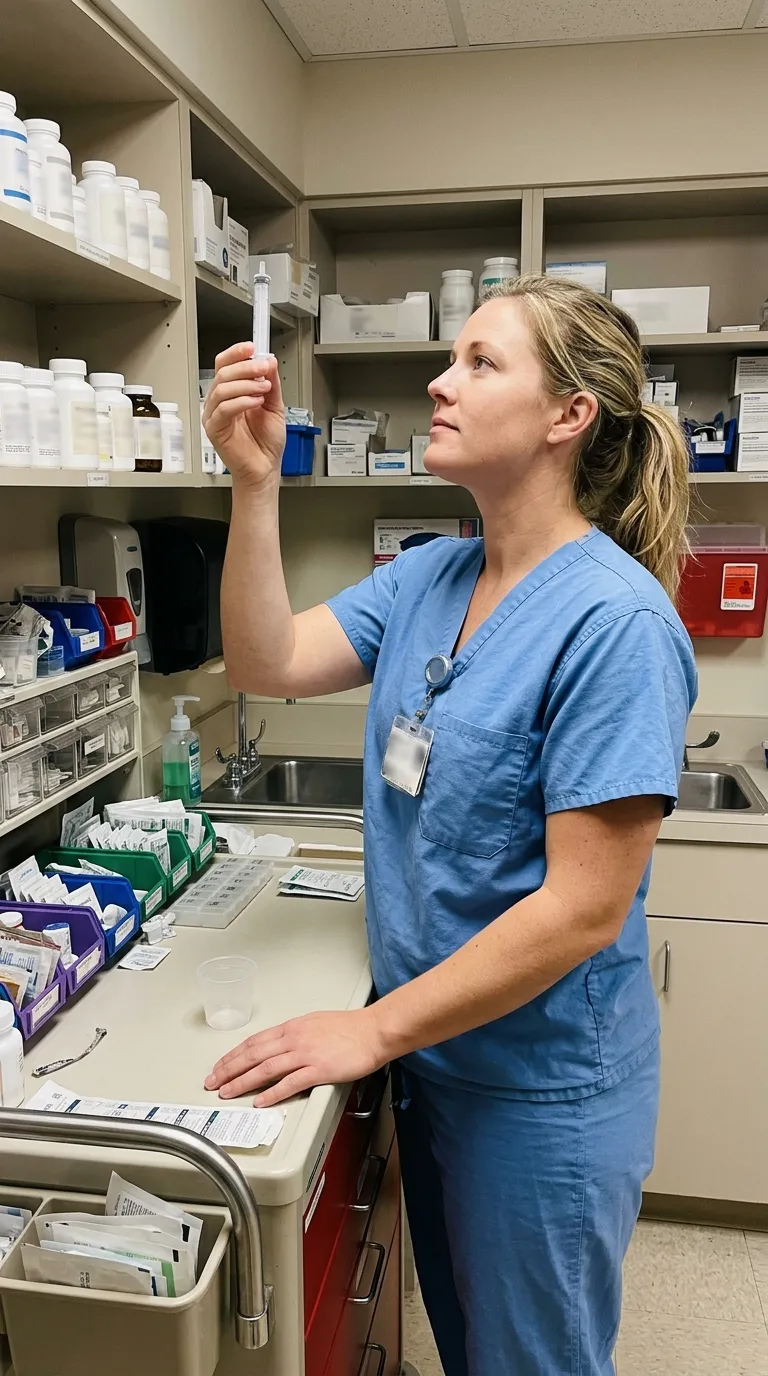
Problem: A 44 lb child is ordered amoxicillin 20 mg/kg PO every 8 hours. The suspension is labeled 400 mg/5 mL. How many milliliters do you give per dose?
Formula: Dose in mg = mg/kg x kg. Volume = (Desired / Have) x Quantity.
- Convert the weight: 44 lb / 2.2 lb per kg = 20 kg.
- Find the dose: 20 mg/kg x 20 kg = 400 mg.
- Find the volume: (400 mg / 400 mg) x 5 mL = 5 mL.
- Daily check: 400 mg x 3 = 1,200 mg/day = 60 mg/kg/day, inside the usual 40 to 90 range.
Answer: 5 mL for one dose.
Check: Reverse it. 5 mL holds 400 mg = 20 mg/kg, the ordered dose. The MedlinePlus amoxicillin page covers the suspension basics.
Problem 2
A 15 kg child has a fever. The order reads acetaminophen 15 mg/kg PO, one dose. The bottle is 160 mg/5 mL. How many milliliters do you measure?
- A. 7.0 mL
- B. 3.5 mL
- C. 1.4 mL
- D. 14.1 mL
Answer: A. 7.0 mL.
Rationale: The dose is 15 mg/kg x 15 kg = 225 mg, and (225 / 160) x 5 mL = 7.03 mL, rounded to 7.0 mL, at the top of the usual 10 to 15 range, so it is safe. B halves the dose. C drops the 5 mL quantity. D doubles it, reading the concentration backward.
Problem 3
Problem: An 18 kg child is ordered ibuprofen 10 mg/kg PO, one dose. The suspension is labeled 100 mg/5 mL. How many milliliters do you give?
Formula: Dose in mg = mg/kg x kg. Volume = (Desired / Have) x Quantity.
- The weight is already in kilograms: 18 kg.
- Find the dose: 10 mg/kg x 18 kg = 180 mg.
- Find the volume: (180 mg / 100 mg) x 5 mL = 9 mL.
- Check: 10 mg/kg is the top of the usual 5 to 10 range, so the dose is safe.
Answer: 9 mL for one dose.
Check: Reverse it. 9 mL holds 180 mg = 10 mg/kg, the ordered dose.
Problem 4
A child who weighs 25 kg starts azithromycin for an ear infection. Day 1 order: azithromycin 10 mg/kg PO, one dose. The suspension is 100 mg/5 mL. How many milliliters do you measure?
- A. 2.5 mL
- B. 12.5 mL
- C. 6.3 mL
- D. 25 mL
Answer: B. 12.5 mL.
Rationale: Dose: 10 mg/kg x 25 kg = 250 mg, and (250 / 100) x 5 mL = 12.5 mL. Day 1 at 10 mg/kg is the standard start; the dose drops on days 2 to 5. A drops the 5 mL quantity. C uses half the dose, the later-days amount a day early. D doubles the volume.
Study tip: Write the child’s weight in kilograms at the top of every problem, before the drug math. Most pediatric errors are conversion errors in a dosage costume; a weight written once is a weight checked once.
Problem 5
Problem: A 24 kg child with an asthma flare is ordered prednisolone 1 mg/kg PO once daily. The liquid is labeled 15 mg/5 mL. How many milliliters do you give?
Formula: Dose in mg = mg/kg x kg. Volume = (Desired / Have) x Quantity.
- The weight is already in kilograms: 24 kg.
- Find the dose: 1 mg/kg x 24 kg = 24 mg.
- Find the volume: (24 mg / 15 mg) x 5 mL = 8 mL.
- Check the range: guides list 1 to 2 mg/kg/day for a flare, so this sits at the safe low end.
Answer: 8 mL for the daily dose.
Check: Reverse it. 8 mL holds 24 mg = 1 mg/kg, the ordered dose.
Set 2: Safe Dose Range Checks

Problem 6
A 16 kg child is ordered amoxicillin 250 mg PO every 8 hours. The guide lists 40 to 90 mg/kg/day as safe. The suspension is 250 mg/5 mL. What do you do?
- A. Give 5 mL; the total is in range.
- B. Hold; the total is above the range.
- C. Hold; the total is below the range.
- D. Give 2.5 mL instead.
Answer: A. Give 5 mL.
Rationale: For 16 kg the safe range is 640 mg (40 x 16) to 1,440 mg (90 x 16). The order gives 250 x 3 = 750 mg, inside it; volume (250 / 250) x 5 = 5 mL. B and C misread the total; D halves a correct dose.
Problem 7
Problem: A child weighs 20 kg. The order reads acetaminophen 300 mg PO every 4 hours around the clock. The liquid is 160 mg/5 mL. The guide lists 10 to 15 mg/kg per dose, maximum 75 mg/kg/day. Is this order safe as written?
Formula: Daily total = dose x doses per day; compare with the mg/kg/day maximum.
- One dose: 300 / 20 kg = 15 mg/kg, the top of the range, so a single dose looks fine.
- Count: every 4 hours means 6 doses in 24 hours.
- Find the daily total: 300 mg x 6 = 1,800 mg a day.
- The maximum is 75 x 20 kg = 1,500 mg a day; the order passes it by 300 mg.
Answer: No. Hold the dose and call the provider before giving it.
Check: The per-dose math was never the problem; the schedule was. The MedlinePlus acetaminophen page warns against more than the recommended daily amount.
Problem 8
A 28 kg child is ordered ceftriaxone 50 mg/kg IV once daily. The guide lists 50 to 75 mg/kg/day. The reconstituted vial is 350 mg/mL. How many milliliters do you draw up?
- A. 4 mL
- B. 2 mL
- C. 1.4 mL
- D. 40 mL
Answer: A. 4 mL.
Rationale: The dose is 50 mg/kg x 28 kg = 1,400 mg, the low end of the safe range, and 1,400 / 350 mg per mL = 4 mL. B uses half the ordered mg/kg. C is the dose in grams, not a volume. D reads the concentration as 35 mg/mL.
Problem 9
Problem: A child weighs 12 kg and has a middle ear infection. The order reads amoxicillin 80 mg/kg/day PO divided every 12 hours. The suspension is 400 mg/5 mL. How many milliliters per dose?
Formula: Dose per dose = Daily dose / doses per day. Volume = (Desired / Have) x Quantity.
- Find the daily dose: 80 mg/kg/day x 12 kg = 960 mg a day.
- Divide: q12h means 2 doses a day, and 960 / 2 = 480 mg per dose.
- Find the volume: (480 mg / 400 mg) x 5 mL = 6 mL.
- Check: 80 mg/kg/day sits inside the 40 to 90 range, at the high end used for ear infections.
Answer: 6 mL for one dose.
Check: Work backward. 6 mL holds 480 mg; two doses make 960 mg = 80 mg/kg/day ordered. More sets like this: dosage calculations with answers.
Problem 10
A 22 kg child is ordered ibuprofen 200 mg PO every 4 hours around the clock. The guide lists 5 to 10 mg/kg per dose, maximum 40 mg/kg/day. The suspension is 100 mg/5 mL. What do you do?
- A. Give 10 mL; each dose is in range.
- B. Hold and call the provider.
- C. Give 5 mL instead and chart it.
- D. Give 10 mL, then stretch later doses yourself.
Answer: B. Hold and call the provider.
Rationale: One dose is fine: 200 / 22 kg = 9.1 mg/kg, inside 5 to 10, volume (200 / 100) x 5 = 10 mL. But 6 doses make 1,200 mg a day against a maximum of 880 mg (40 x 22). A and D give an unsafe total; C changes the dose without an order.
NCLEX tip: When a stem gives you both a per-dose range and a daily maximum, the daily maximum is usually the trap. Multiply dose by doses per day before calling any order safe.
Set 3: Liquids and Reconstitution
Problem 11
Problem: A bottle of amoxicillin powder is reconstituted to 250 mg/5 mL. A 15 kg child is ordered amoxicillin 25 mg/kg PO every 12 hours. How many milliliters per dose?
Formula: Dose in mg = mg/kg x kg. Volume = (Desired / Have) x Quantity.
- Find the dose: 25 mg/kg x 15 kg = 375 mg.
- Find the volume: (375 mg / 250 mg) x 5 mL = 7.5 mL.
- Daily check: 375 mg x 2 = 750 mg/day = 50 mg/kg/day, inside the usual 40 to 90 range.
Answer: 7.5 mL for one dose.
Check: Reverse it. 7.5 mL holds 375 mg = 25 mg/kg ordered. Sets like this fill these dosage calculation examples.
Problem 12
An infant weighs 10 lb. The order: furosemide 1 mg/kg IV, one dose. The guide lists 0.5 to 1 mg/kg per dose. The vial is 10 mg/mL. How many milliliters do you draw up?
- A. 0.45 mL
- B. 4.5 mL
- C. 0.9 mL
- D. 0.05 mL
Answer: A. 0.45 mL.
Rationale: Convert first: 10 lb / 2.2 = 4.5 kg. Dose: 1 mg/kg x 4.5 kg = 4.5 mg, the top of the listed range. Volume: 4.5 / 10 mg per mL = 0.45 mL, measured to the hundredth. B gives milligrams as milliliters, C doubles the dose, D drops a decimal place.
Problem 13
Problem: A 500 mg vial of ampicillin powder, reconstituted with 4.8 mL of sterile water, gives 100 mg/mL. A child weighs 20 kg. Order: ampicillin 50 mg/kg/day IV divided q6h. How many milliliters per dose?
Formula: Dose per dose = Daily dose / doses per day. Volume = Dose / Concentration.
- Find the daily dose: 50 mg/kg/day x 20 kg = 1,000 mg a day.
- Divide: q6h means 4 doses a day, and 1,000 / 4 = 250 mg per dose.
- Find the volume: 250 mg / 100 mg per mL = 2.5 mL.
- Check the range: the guide lists 50 to 100 mg/kg/day, so this sits at the safe low end.
Answer: 2.5 mL for one dose.
Check: Reverse it. 2.5 mL holds 250 mg; 4 doses make 1,000 mg = 50 mg/kg/day ordered.
Problem 14
A 19 kg child is ordered diphenhydramine 1 mg/kg PO, one dose. The guide caps the dose at 50 mg. The liquid is 12.5 mg/5 mL. How many milliliters do you measure?
- A. 1.5 mL
- B. 3.8 mL
- C. 7.6 mL
- D. 15.2 mL
Answer: C. 7.6 mL.
Rationale: The dose is 1 mg/kg x 19 kg = 19 mg, well under the 50 mg cap, and (19 / 12.5) x 5 mL = 7.6 mL. A forgets the 5 mL quantity. B halves the dose. D doubles the volume, an easy slip with decimals.
Problem 15
Problem: A 26 kg child is ordered gentamicin 2.5 mg/kg IV every 8 hours. The guide lists 2 to 2.5 mg/kg per dose. The vial is 40 mg/mL. How many milliliters per dose?
Formula: Dose = mg/kg x kg. Volume = Dose / Concentration.
- Find the dose: 2.5 mg/kg x 26 kg = 65 mg.
- Find the volume: 65 mg / 40 mg per mL = 1.625 mL.
- Round by the volume rule: 1.625 mL rounds to 1.6 mL.
- Check the range: 2.5 mg/kg is the top of the listed range, so the dose is safe.
Answer: 1.6 mL for one dose.
Check: Reverse it. 1.6 mL holds about 64 mg, within a milligram of the ordered 65 mg.
Set 4: IV Flow and Infusion Math
Problem 16
A 30 kg child needs 500 mL of IV fluid over 5 hours on a pump. At what rate, in mL/hr, do you set the pump?
- A. 50 mL/hr
- B. 100 mL/hr
- C. 125 mL/hr
- D. 250 mL/hr
Answer: B. 100 mL/hr.
Rationale: Pump rate is volume over time: 500 / 5 hours = 100 mL/hr. A divides by 10 hours. C divides by 4. D divides by 2, emptying the bag far too early.
Problem 17
Problem: A toddler weighs 12 kg. The order reads infuse 240 mL of IV fluid over 4 hours by gravity, using a microdrip set, 60 gtt/mL. How many drops per minute do you set?
Formula: Drops per minute = (Volume x Drop factor) / Minutes.
- Convert time: 4 hours x 60 = 240 minutes.
- Set up the rate: (240 mL x 60 gtt/mL) / 240 minutes.
- Do the math: 14,400 / 240 = 60 gtt/min.
- Shortcut: with a 60 gtt/mL set, gtt/min equals mL/hr, and 240 / 4 hours = 60 mL/hr.
Answer: 60 gtt/min.
Check: Reverse it. 60 gtt/min x 240 minutes = 14,400 drops = 240 mL, the ordered volume.
Problem 18
A 55 kg adolescent is ordered 1,000 mL of IV fluid over 8 hours by gravity. The tubing drop factor is 15 gtt/mL. How many drops per minute?
- A. 125 gtt/min
- B. 21 gtt/min
- C. 31 gtt/min
- D. 63 gtt/min
Answer: C. 31 gtt/min.
Rationale: Drops per minute = (1,000 mL x 15 gtt/mL) / 480 minutes = 15,000 / 480 = 31.25, rounded to 31 gtt/min. A is the pump rate in mL/hr. B uses a 10 gtt/mL factor. D uses a 30 gtt/mL factor.
Problem 19
Problem: A dehydrated 14 kg child is ordered a normal saline bolus, 20 mL/kg IV over 1 hour. How many milliliters do you infuse, and at what pump rate?
Formula: Bolus volume = mL/kg x kg. Pump rate = Volume / Time.
- Find the volume: 20 mL/kg x 14 kg = 280 mL.
- Find the rate: 280 mL over 1 hour is 280 mL / 1 hour = 280 mL/hr.
- Check the standard: isotonic boluses run 10 to 20 mL/kg, so this is the standard high end, with reassessment after.
Answer: 280 mL at 280 mL/hr.
Check: Reverse it. 280 mL / 14 kg = 20 mL/kg, the ordered bolus.
Problem 20
A 34 kg child is ordered vancomycin 15 mg/kg IV, one dose. The guide lists 10 to 15 mg/kg per dose. The pharmacy sends a premixed bag, 500 mg/100 mL, to infuse over 2 hours. At what rate do you set the pump?
- A. 102 mL/hr
- B. 25.5 mL/hr
- C. 255 mL/hr
- D. 51 mL/hr
Answer: D. 51 mL/hr.
Rationale: Dose: 15 mg/kg x 34 kg = 510 mg, the range top. The bag is 5 mg/mL (500 mg in 100 mL), so the dose needs 102 mL. Rate: 102 / 2 hours = 51 mL/hr. A is the volume, not the rate. B uses 4 hours. C treats milligrams as milliliters.
Answer Review Tips
- Sort your misses: mark each wrong problem as a conversion, formula or range miss; one type usually owns most of the red ink.
- Redo, do not reread: work every missed problem from a blank page two days later. A solution you can rebuild is learned; one you only recognize is not.
- Chase the daily totals: if your misses cluster in Set 2, drill range checks until the step is automatic, then run a fresh timed set of nursing dosage calculation practice questions.
- Say the safety sentence: for every unsafe order, practice the exact words for the provider. The math is half the skill; saying it calmly is the other half.
Which Questions Did You Miss?
Sort your 20 problems by set first. A Set 1 miss means the basics need another pass; a Set 4 miss usually means the setup went wrong. When you can rebuild every solution from a blank page, step up to timed medication calculation questions in NCLEX style.
Pediatric dosing rewards the nurse who slows down for ten seconds: weight in kilograms, units in the open, daily total checked. Build that pause into every problem now, and it will be there on the unit, where the patient is real. Which set are you running again before your next quiz: the weight-based basics, or the IV rates?
For study use only. Always follow your program, your facility’s policy and current drug and lab references.