

You are standing at the med room counter, practice sheet in one hand, a medication bottle in the other, and the two sets of numbers refuse to match. The order says one dose, the label carries a different strength, and the clock to the next task is already ticking. That freeze is what these 15 points end: the dosage calculations nursing formulas behind nearly every problem, each one stated in plain words and proved where it counts.
Work through them in order and the pattern repeats: eight points state the formula and the habit around it, and seven prove the math on worked problems with every step and every unit shown. Nothing here needs memorizing tonight; it needs a routine you can run the same way on any order, any supply and any patient weight.
The Formula Method

Almost every dosage problem you will meet is the same small formula wearing different clothes: Dose = (Desired / Have) x Quantity. Desired is the dose the order asks for, Have is the strength the supply carries, and Quantity is the amount that strength comes in, one tablet, 5 mL, one vial. Divide Desired by Have, multiply by Quantity, and the answer comes out in the unit you give: tablets, milliliters, capsules.
Study tip: Write D, H and Q above the three numbers before you divide; naming the parts stops the two strengths from swapping places.
Scored Tablets
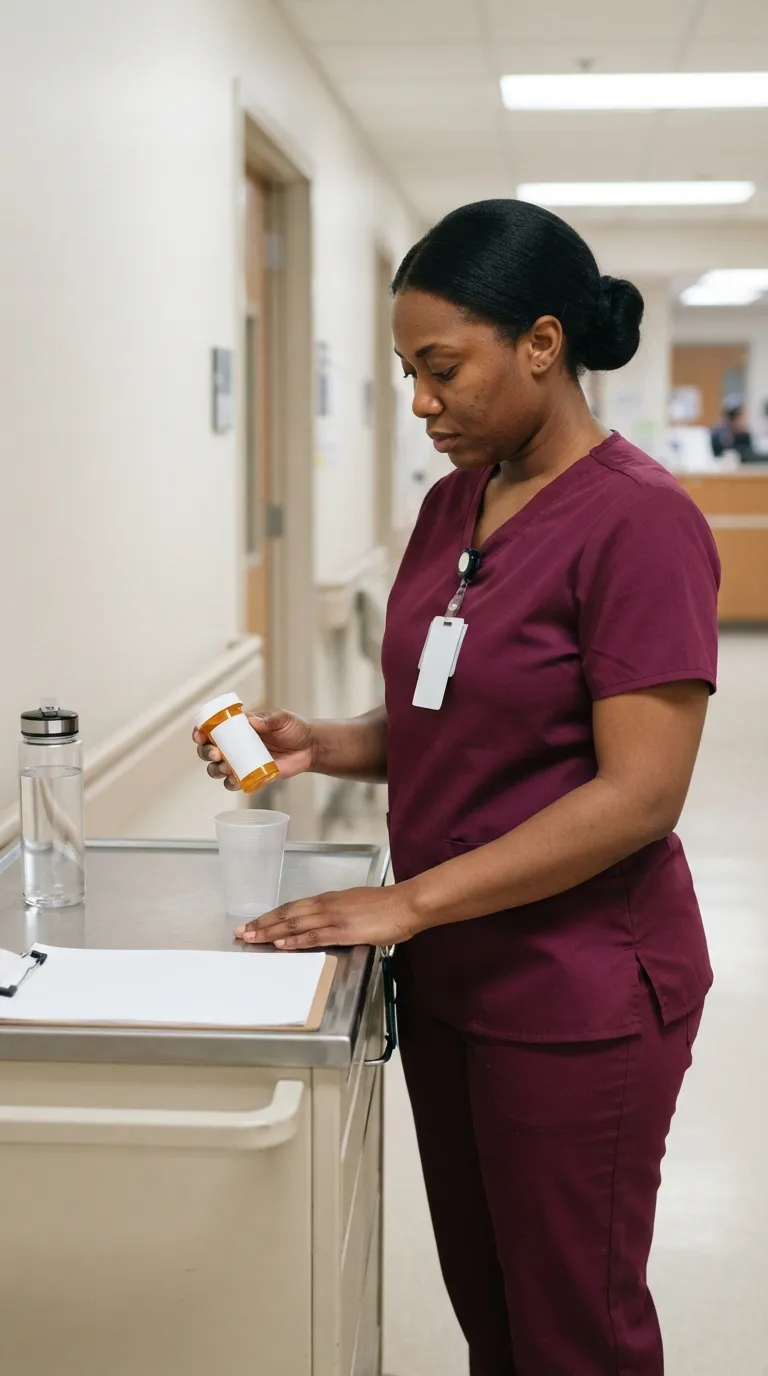
Problem: Metoprolol 100 mg is ordered. The supply on hand is 50 mg scored tablets. How many tablets do you give?
Formula: Dose = (Desired / Have) x Quantity, here (100 mg / 50 mg) x 1 tablet.
- Set up with units: (100 mg / 50 mg) x 1 tablet.
- Divide 100 mg by 50 mg; the mg units cancel, leaving 2.
- Multiply by the quantity: 2 x 1 tablet = 2 tablets.
Answer: 2 tablets. The division lands exact, so whole tablets are given; a scored tablet is split only when the dose needs a half.
Check: The ordered dose is double the tablet strength, so two tablets is the size to expect, and no split is needed.
Ratio and Proportion

The formula method and the proportion are the same truth written two ways. A proportion sets the supply pair equal to the order pair: Have : vehicle :: Desired : X, so 50 mg : 1 tablet :: 100 mg : X tablets. Cross multiply the diagonal pairs, 50 x X and 1 x 100, then divide to isolate X. The ratio and proportion dosage calculations walkthrough shows the setup step by step.
Study tip: Keep the units in the same seats on both sides, dose with dose and amount with amount, or the cross multiplication answers the wrong question.
Liquid and Suspension Doses
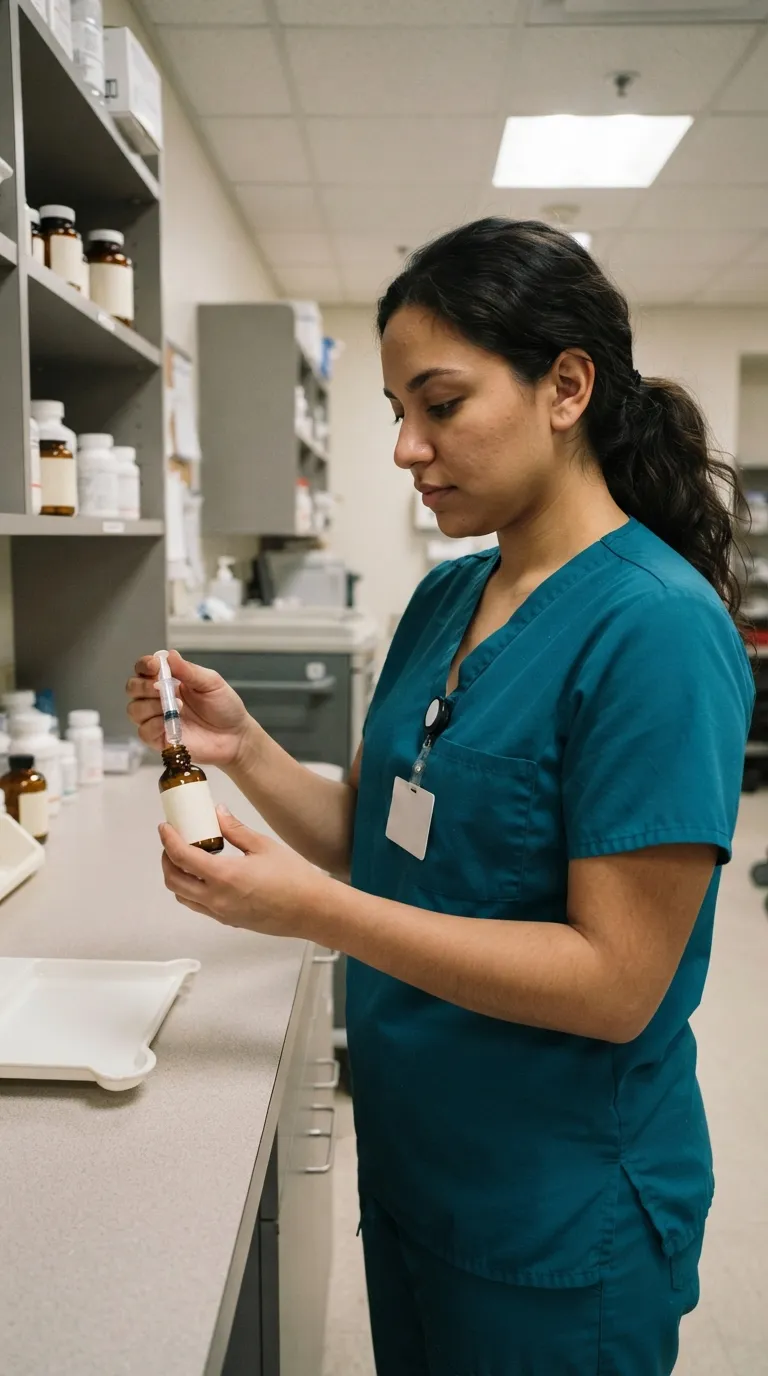
Problem: Amoxicillin 250 mg is ordered. The suspension on hand carries 125 mg in 5 mL. How many milliliters do you give?
Formula: Dose = (Desired / Have) x Quantity, here (250 mg / 125 mg) x 5 mL.
- Set up with units: (250 mg / 125 mg) x 5 mL.
- Divide 250 mg by 125 mg; the mg units cancel, leaving 2.
- Multiply by the quantity: 2 x 5 mL = 10 mL.
Answer: 10 mL. The result lands exact, so no rounding is needed; liquids are otherwise measured to the nearest tenth of a milliliter.
Check: 250 mg is double the labeled 125 mg, so the volume doubles with it: 2 x 5 mL = 10 mL.
IV Flow Rate in mL per Hour

Pump problems collapse to one division: flow rate in mL per hour = total volume in mL / total time in hours. The pump never asks for drops, totals or leftovers; it asks for one number, the rate it should push each hour. If the order gives the time in minutes, convert it to hours before dividing. The registerednursing.org dosage calculations review works the same rate problems with units carried through.
Study tip: Say the rate back as a sentence, 125 mL each hour for 8 hours; if the total is not the ordered bag, the division went wrong.
A Pump Rate Worked End to End

Problem: An IV bag of 1,000 mL infuses over 8 hours on a pump set in mL per hour. At what rate do you set it?
Formula: mL/hr = total volume / total time, here 1,000 mL / 8 hr.
- Volume: 1,000 mL.
- Time: 8 hr.
- Divide: 1,000 mL / 8 hr = 125 mL/hr.
Answer: 125 mL/hr, an exact whole rate, so no rounding rule is needed.
Check: Run the rate backward: 125 mL/hr x 8 hr = 1,000 mL, the full ordered bag in the ordered time.
Drip Rate in Drops per Minute

When a line runs by gravity instead of a pump, the rate is counted in drops: gtt/min = (volume in mL x drop factor in gtt/mL) / time in minutes. The drop factor belongs to the tubing, not the patient; it is printed on the package as 10, 15, 20 or 60 gtt/mL, and microdrip sets are always 60. The trap is the denominator: hours from the order must become minutes first, or the rate comes out 60 times too slow.
Study tip: Circle the drop factor and the minutes in every gravity problem; those numbers are where drip rates are won and lost.
Memory trick: Hour rate divides, drip rate multiplies first: volume over hours sets the pump, while volume times drop factor over minutes sets the drip. If your setup has no drop factor, you are solving the wrong IV problem.
A Drip Rate Worked End to End

Problem: An IV of 1,000 mL runs over 8 hours by gravity, through tubing with a drop factor of 15 gtt/mL. How many drops per minute do you count?
Formula: gtt/min = (volume x drop factor) / time in minutes, here (1,000 mL x 15 gtt/mL) / 480 min.
- Convert the time first: 8 hr x 60 min = 480 min.
- Multiply: 1,000 mL x 15 gtt/mL = 15,000 gtt; the mL units cancel.
- Divide by the minutes: 15,000 gtt / 480 min = 31.25 gtt/min.
Answer: 31 gtt/min. Drops are counted whole, so 31.25 rounds down to 31 whole drops per minute.
Check: At 31 gtt/min with a 15 gtt/mL set, the line delivers about 2 mL each minute, which reaches roughly 1,000 mL across the 8 hours.
Weight-Based Dosing

Weight-based problems are two calculations stacked. First, multiply the ordered mg/kg by the patient weight in kilograms; that product is the dose in mg. Only then does the formula method turn those mg into tablets or milliliters from the supply on hand. The pediatric dosage calculation set works this two-step pattern again and again, because most weight-based orders land in pediatrics, where the range check matters most.
Study tip: Box the mg answer from step one before step two; mixing the stages is how a correct weight turns into a wrong volume.
A Weight-Based Dose Worked End to End

Problem: A child weighs 18 kg, and the order reads 15 mg/kg. The supply carries 100 mg in 2 mL. How many milliliters do you give?
Formula: dose in mg = mg/kg x weight in kg, then Dose = (Desired / Have) x Quantity.
- Find the dose first: 15 mg/kg x 18 kg = 270 mg; the kg units cancel.
- Set up the formula method: (270 mg / 100 mg) x 2 mL.
- Divide 270 mg by 100 mg, the mg cancel, then multiply: 2.7 x 2 mL = 5.4 mL.
Answer: 5.4 mL. The volume sits at the nearest tenth of a milliliter, the rounding rule for liquids, so it is given as written.
Check: 270 mg is a little under three times the 100 mg in 2 mL, so just under 6 mL is expected, and 5.4 mL fits.
Pounds to Kilograms Before Anything Else

Every mg/kg formula assumes the weight is already in kilograms. When the chart gives pounds, convert first: kg = lb / 2.2, one division before any dose math begins. A weight left in pounds is 2.2 times too big, so every dose built on it inflates by the same factor, and the error hides inside an otherwise perfect setup. The metric conversions for nursing review drills the 2.2 division until it is automatic.
Study tip: Write the converted kg weight on the problem, circled, so no later step can reach back and grab the pound number.
The Safe-Range Check

Problem: A child weighs 12 kg. The safe range for the ordered drug is 10-20 mg/kg/day, and the order reads 100 mg every 12 hours. Is the order safe?
Formula: low = kg x low mg/kg/day; high = kg x high mg/kg/day; then compare the ordered daily total.
- Find the low end: 10 mg/kg/day x 12 kg = 120 mg/day; the kg units cancel.
- Find the high end: 20 mg/kg/day x 12 kg = 240 mg/day.
- Total the order: 100 mg x 2 doses a day = 200 mg/day.
- Compare: 200 mg/day sits between 120 mg/day and 240 mg/day.
Answer: The order is safe: 200 mg/day sits inside the 120-240 mg/day range for this child, so the dose can be prepared.
Check: Never give a weight-based dose before this comparison; the range check is the step that makes the math safe to use, not an extra added after it.
Percent Strength and Ratio Strength

Some labels state strength as a percent or a ratio instead of mg per mL, and the formula only works once you translate. A percent strength is grams of drug in 100 mL: 0.9% sodium chloride holds 0.9 g in every 100 mL, which is 900 mg when a problem needs milligrams. A ratio strength flips the reading: 1:1,000 means 1 g in 1,000 mL. Read the label strength first and translate it into an amount you can divide before setting up.
Study tip: Rewrite every percent or ratio strength as mg per mL in the margin before calculating; one translation up front prevents a hundred-fold slip.
Reconstitution Problems

Problem: A dose of 750 mg is ordered from a 1 g vial of powder. After the directed diluent is added, the reconstituted vial yields 500 mg in each 1 mL. How many milliliters do you draw up?
Formula: Dose = (Desired / Have) x Quantity, here (750 mg / 500 mg) x 1 mL.
- Set up with units: (750 mg / 500 mg) x 1 mL.
- Divide 750 mg by 500 mg; the mg units cancel, leaving 1.5.
- Multiply by the quantity: 1.5 x 1 mL = 1.5 mL.
Answer: 1.5 mL, exact at the nearest tenth of a milliliter, the rounding rule for liquids, so no further rounding applies.
Check: The dose is one and a half times the 500 mg in 1 mL, so one and a half mL is expected; the powder volume is already counted in the labeled strength after the directed diluent is added.
The Sense Check That Catches Slips

Run a sense check at both ends. Estimate first: a dose near the stock strength should land near one unit of vehicle, and a dose twice the strength near two. Then interrogate the result: more than 3 tablets, or a volume no syringe on the cart can hold, means recheck, never give. A dose smaller than the stock strength must come out under one unit of vehicle, every time.
The check reads the order itself. Abbreviation traps, a dose written with a trailing zero or a bare U for units, can turn 10 units into 100 before any formula is touched, which is why the dosage calculation abbreviations list belongs in the same session.
Study tip: If the estimate and the calculation disagree, believe the disagreement, not either number; redo the setup from the order before touching the supply.
Which Step Gives You Trouble?
Start where your own errors live. If setups flip, drill the formula method and the proportion until the units sit in their seats without thinking. If the arithmetic is fine but the answers feel shaky, live in the worked problems and the sense check for a week. Fifteen points, run in the same order every time, turn a wall of formulas into one routine.
When you are ready to go deeper on the setup itself, the formula method dosage calculations walkthrough slows the Desired over Have setup down to one problem at a time. So, honestly: which step gives you trouble, the setup, the conversion, or the nerve to trust your own check?