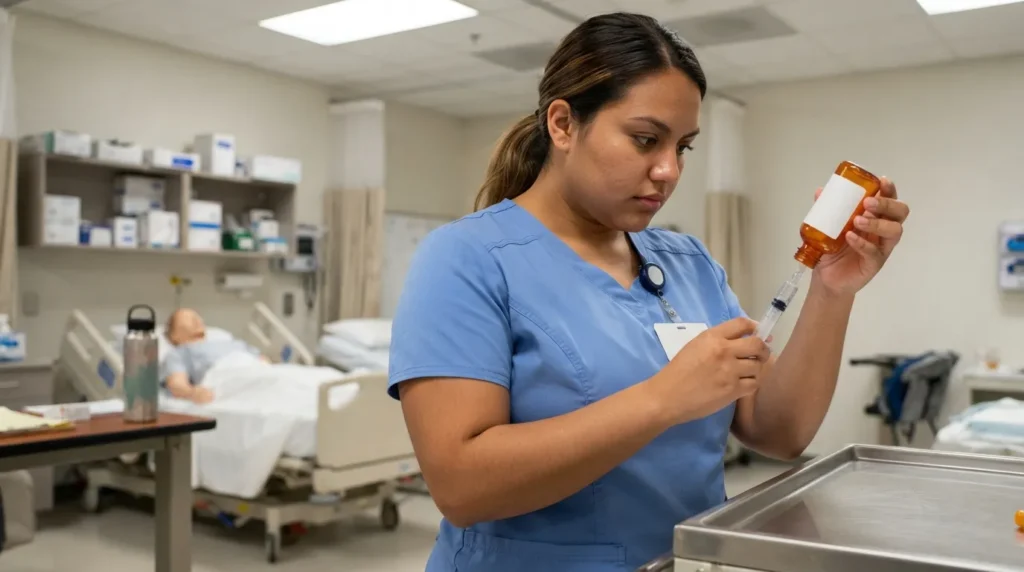

A kitchen teaspoon can hold anywhere from about 2.5 mL to 7.5 mL, so the same spoonful can deliver half a dose or one and a half doses. That gap is why liquid dosage calculations are always measured in milliliters with an oral syringe. This practice set gives you 20 oral liquid problems with every step worked: single-strength liquids, concentration conversions, weight-based pediatric doses, and safety checks that catch a bad order before it reaches the patient.
Work each problem on paper before you look at the answer. The worked problems show the full setup, and the question cards explain why each wrong option fails, so a miss teaches the fix instead of marking you wrong.
How to Use This Practice Set
Cover the answer, write your setup with units, then compare. For a refresher on the formula setup behind these problems, work through this dosage calculations review first, then test yourself cold.
Sets 1 and 2 use adult orders, set 3 switches to weight-based pediatric math, and set 4 trains the pause before you pour. If pediatric math is your weak spot, the pediatric dosage calculation set gives you 20 more weight-based problems.
Single-Strength Syrups and Suspensions

Every liquid here comes in one strength, so the skill is a clean desired-over-have setup. Read the label as milligrams per volume, write the units, and let them cancel before you reach for the syringe.
Problem 1
Problem: The order is amoxicillin 500 mg PO. The suspension on hand is 250 mg per 5 mL. How many milliliters do you give?
Formula: Desired / Have x Quantity = 500 mg / 250 mg x 5 mL.
- Desired dose: 500 mg.
- Divide by stock strength: 500 mg / 250 mg = 2, units cancelled.
- Multiply by quantity: 2 x 5 mL = 10 mL.
Answer: 10 mL, a whole number, so no rounding is needed.
Check: Reverse: two 5 mL portions make 10 mL, and 2 x 250 mg = 500 mg, the ordered dose.
Problem 2
The order is acetaminophen 240 mg PO. The liquid on hand is 160 mg per 5 mL. How many milliliters do you give?
- A. 5 mL
- B. 7.5 mL
- C. 10 mL
- D. 12.5 mL
Answer: B. 7.5 mL.
Rationale: Desired over have: 240 mg / 160 mg x 5 mL = 1.5 x 5 mL = 7.5 mL. Option A, 5 mL, delivers only the stock 160 mg, with no scaling at all. Option C, 10 mL, delivers 320 mg, and option D, 12.5 mL, delivers 400 mg. Both overshoot: the ratio stops at 1.5.
Problem 3
Problem: The order is cephalexin 250 mg PO. The suspension on hand is 125 mg per 5 mL. How many milliliters do you give?
Formula: Desired / Have x Quantity = 250 mg / 125 mg x 5 mL.
- Desired dose: 250 mg.
- Divide by stock strength: 250 mg / 125 mg = 2, units cancelled.
- Multiply by quantity: 2 x 5 mL = 10 mL.
Answer: 10 mL, a whole number, so no rounding is needed.
Check: Reverse: two 5 mL portions make 10 mL, and 2 x 125 mg = 250 mg, the ordered dose.
Problem 4
The order is ibuprofen 150 mg PO. The suspension on hand is 100 mg per 5 mL. How many milliliters do you give?
- A. 2.5 mL
- B. 5 mL
- C. 7.5 mL
- D. 15 mL
Answer: C. 7.5 mL.
Rationale: Set it up: 150 mg / 100 mg x 5 mL = 1.5 x 5 mL = 7.5 mL. Option A, 2.5 mL, holds only 50 mg. Option B, 5 mL, holds the stock 100 mg, still short of the order. Option D, 15 mL, holds 300 mg, double the dose, from flipping the ratio.
Problem 5
Problem: The order is furosemide 30 mg PO. The oral solution on hand is 10 mg per 1 mL. How many milliliters do you give?
Formula: Desired / Have x Quantity = 30 mg / 10 mg x 1 mL.
- Desired dose: 30 mg.
- Divide by stock strength: 30 mg / 10 mg = 3, units cancelled.
- Multiply by quantity: 3 x 1 mL = 3 mL.
Answer: 3 mL. The quantity here is 1 mL, so the ratio itself is the volume.
Check: Reverse: 3 mL x 10 mg per mL = 30 mg. A concentrated stock like this is why the label gets read twice.
Study tip: Write the stock as a fraction, milligrams over milliliters, before you set up any liquid problem. Seeing 250 mg per 5 mL as one unit stops the most common slip: dividing by 5 twice.
Concentration Conversions
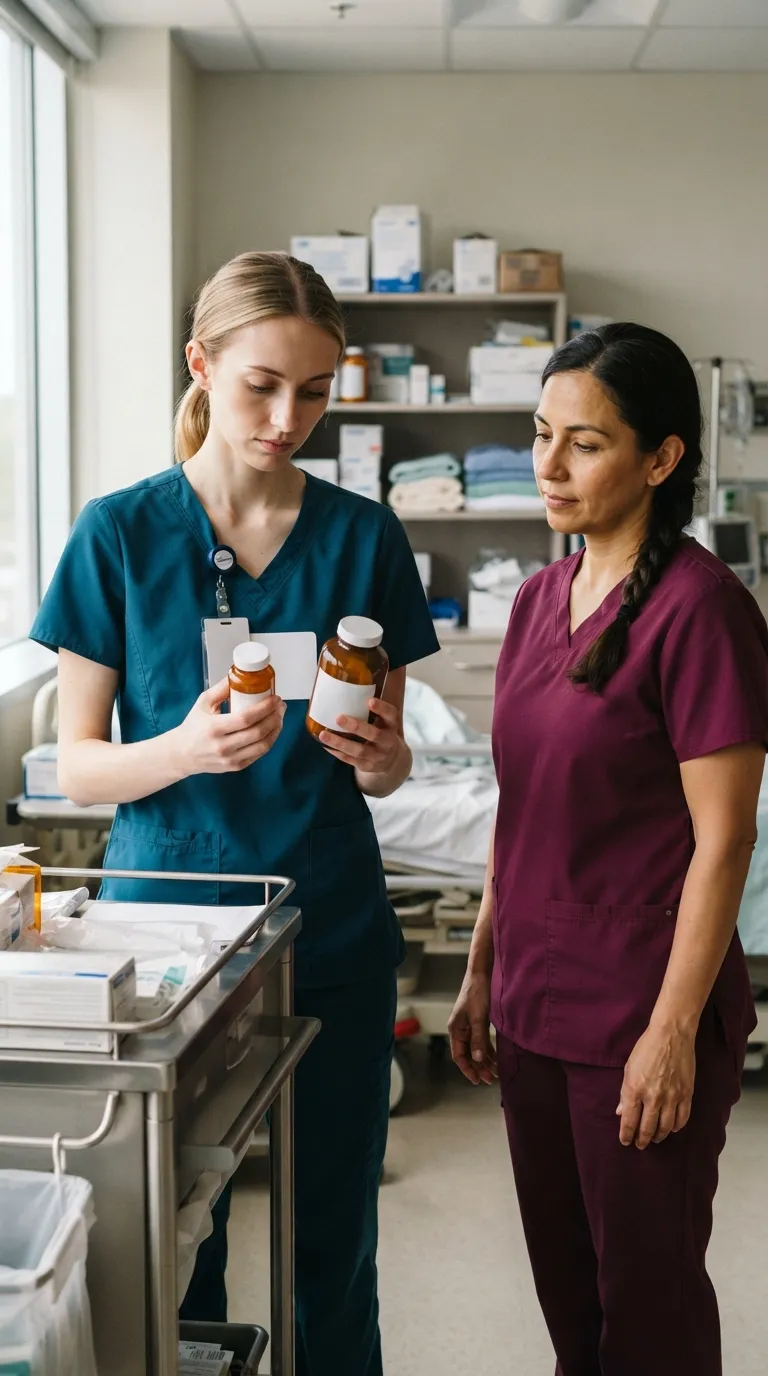
Here the stock strength changes shape: milligrams per milliliter, grams per volume, decimals that hide micrograms. Convert first, then calculate. If the setup feels shaky, review the formula method and come back.
Problem 6
The order is digoxin 0.125 mg PO. The elixir on hand is 0.05 mg per 1 mL. How many milliliters do you give?
- A. 2.5 mL
- B. 0.25 mL
- C. 1.25 mL
- D. 25 mL
Answer: A. 2.5 mL.
Rationale: Divide with care: 0.125 mg / 0.05 mg x 1 mL = 2.5 mL. Option B, 0.25 mL, is a tenth-dose decimal slip. Option C, 1.25 mL, delivers 0.0625 mg, half the order. Option D, 25 mL, delivers 1.25 mg, ten times too much. With digoxin, that error can be fatal, so the decimal gets counted twice.
Problem 7
Problem: The order is potassium chloride 40 mEq PO. The liquid on hand is 20 mEq per 15 mL. How many milliliters do you give?
Formula: Desired / Have x Quantity = 40 mEq / 20 mEq x 15 mL.
- Desired dose: 40 mEq.
- Divide by stock strength: 40 mEq / 20 mEq = 2, units cancelled.
- Multiply by quantity: 2 x 15 mL = 30 mL.
Answer: 30 mL, a whole number, so no rounding is needed.
Check: Reverse: 30 mL is two 15 mL portions, and 2 x 20 mEq = 40 mEq. Per policy, dilute it in water or juice and give it with food: undiluted potassium irritates the stomach.
Problem 8
The order is lactulose 20 g PO. The solution on hand is 10 g per 15 mL. How many milliliters do you give?
- A. 10 mL
- B. 15 mL
- C. 20 mL
- D. 30 mL
Answer: D. 30 mL.
Rationale: Use the label ratio: 20 g / 10 g x 15 mL = 2 x 15 mL = 30 mL. Option A mistakes the ordered grams for milliliters. Option B, 15 mL, delivers only the stock 10 g, half the order. Option C restates the order as a volume, but grams and milliliters never swap without the ratio.
Problem 9
Problem: The order is phenytoin 200 mg PO. The suspension on hand is 125 mg per 5 mL. How many milliliters do you give?
Formula: Desired / Have x Quantity = 200 mg / 125 mg x 5 mL.
- Desired dose: 200 mg.
- Divide by stock strength: 200 mg / 125 mg = 1.6, units cancelled.
- Multiply by quantity: 1.6 x 5 mL = 8 mL.
Answer: 8 mL, a whole number, so no rounding is needed.
Check: Reverse: 8 mL / 5 mL = 1.6 portions, and 1.6 x 125 mg = 200 mg. Shake the bottle well first: a settled suspension pours weak at the top and strong at the bottom.
Problem 10
The order is ondansetron 6 mg PO. The oral solution on hand is 4 mg per 5 mL. How many milliliters do you give?
- A. 3.75 mL
- B. 7.5 mL
- C. 5 mL
- D. 6 mL
Answer: B. 7.5 mL.
Rationale: Set it up: 6 mg / 4 mg x 5 mL = 1.5 x 5 mL = 7.5 mL. Option A, 3.75 mL, is half the correct volume, a halving slip after the setup. Option C, 5 mL, delivers only the stock 4 mg. Option D copies the ordered milligrams straight into milliliters and skips the ratio.
Pediatric Liquid Doses

Pediatric orders add two steps before the formula: multiply the rate by the child’s weight, then divide the daily total by the number of doses. Students who drilled tablet dosage calculations will find the same setup, in milliliters.
Problem 11
Problem: A child weighs 18 kg. The order is amoxicillin 40 mg/kg/day PO, divided every 8 hours. The suspension on hand is 250 mg per 5 mL. How many milliliters is each dose?
Formula: (40 mg/kg x 18 kg) / 3 doses, then Desired / Have x Quantity.
- Daily total: 40 mg/kg x 18 kg = 720 mg per day.
- Split the day into 3 equal doses: 720 mg / 3 = 240 mg per dose.
- Set up the dose: 240 mg / 250 mg = 0.96, and 0.96 x 5 mL = 4.8 mL.
Answer: 4.8 mL per dose. Liquids are measured to the nearest tenth, and 4.8 mL sits exactly on a tenth.
Check: Reverse the day: 4.8 mL x 3 doses = 14.4 mL; 14.4 mL / 5 mL x 250 mg = 720 mg, the daily order.
Problem 12
A child weighs 12 kg. The order is acetaminophen 15 mg/kg PO for one dose. The liquid on hand is 160 mg per 5 mL. How many milliliters do you give?
- A. 3.6 mL
- B. 7.5 mL
- C. 5.6 mL
- D. 11.3 mL
Answer: C. 5.6 mL.
Rationale: Weight first: 15 mg/kg x 12 kg = 180 mg. Then 180 mg / 160 mg x 5 mL = 5.625 mL, rounded to 5.6 mL, because liquids are measured to tenths. Option A skips the weight step. Option B, 7.5 mL, delivers 240 mg, too much for 12 kg. Option D doubles the quantity to 10 mL.
Problem 13
Problem: A child weighs 22 kg. The order is ibuprofen 10 mg/kg PO for one dose. The suspension on hand is 100 mg per 5 mL. How many milliliters do you give?
Formula: 10 mg/kg x 22 kg first, then Desired / Have x Quantity.
- Dose: 10 mg/kg x 22 kg = 220 mg.
- Divide by stock strength: 220 mg / 100 mg = 2.2.
- Multiply by quantity: 2.2 x 5 mL = 11 mL.
Answer: 11 mL, a whole number, so no rounding is needed.
Check: Reverse: 11 mL / 5 mL = 2.2 portions; 2.2 x 100 mg = 220 mg.
Problem 14
A child weighs 15 kg. The order is cephalexin 25 mg/kg/day PO, divided every 6 hours. The suspension on hand is 125 mg per 5 mL. How many milliliters is each dose?
- A. 1.9 mL
- B. 3.8 mL
- C. 7.5 mL
- D. 15 mL
Answer: B. 3.8 mL.
Rationale: Daily total first: 25 mg/kg x 15 kg = 375 mg. Split four ways: 375 mg / 4 = 93.75 mg per dose. Then 93.75 mg / 125 mg x 5 mL = 3.75 mL, rounded to 3.8 mL. Option A is half a dose. Option C skips the split and doubles the dose. Option D gives the whole day at once.
Problem 15
Problem: A child weighs 20 kg. The order is prednisolone 1 mg/kg PO once daily. The syrup on hand is 15 mg per 5 mL. How many milliliters do you give?
Formula: 1 mg/kg x 20 kg first, then Desired / Have x Quantity.
- Dose: 1 mg/kg x 20 kg = 20 mg.
- Divide by stock strength: 20 mg / 15 mg = 1.33.
- Multiply by quantity: 1.33 x 5 mL = 6.67 mL.
Answer: 6.7 mL once daily. The raw result, 6.67 mL, rounds to the nearest tenth, the standard rule for liquids.
Check: Reverse: 6.7 mL / 5 mL x 15 mg = 20.1 mg, within rounding of 20 mg.
NCLEX tip: Pediatric stems hide the real order inside the weight. The exam expects you to multiply mg/kg by the weight in kilograms first; a stem given in pounds must be converted first.
Safety Checks and Reconstitution
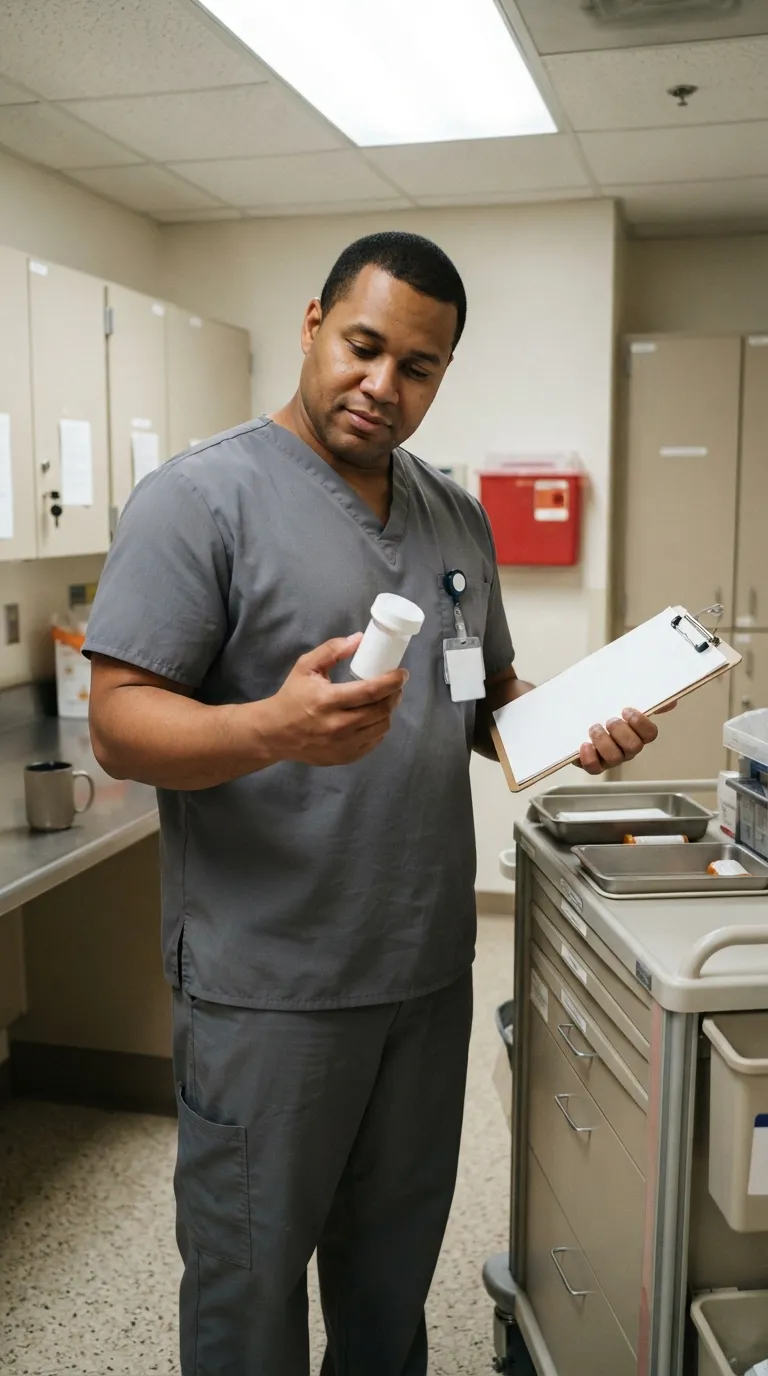
The last set is about stopping. Reconstitution labels, household measures, concentrated stock and pre-dose checks all reward the nurse who pauses, rereads the label and questions a number that looks wrong.
Problem 16
A powder label reads: add 9.5 mL of water to yield 100 mg per 1 mL. The order is 350 mg PO. After reconstituting, how many milliliters do you draw up?
- A. 3.5 mL
- B. 0.35 mL
- C. 35 mL
- D. 9.5 mL
Answer: A. 3.5 mL.
Rationale: The yield sets the strength: 100 mg per 1 mL. Dose = 350 mg / 100 mg x 1 mL = 3.5 mL. Option D is the trap: 9.5 mL is the water added to the powder, not a dose. Option C is a tenfold error. Option B is one tenth of the dose.
Problem 17
Problem: The order is morphine oral solution 10 mg PO for an opioid-naive patient. The only bottle on the shelf is the concentrated solution, 20 mg per 1 mL. What does the math say, and what do you do?
Formula: Desired / Have x Quantity = 10 mg / 20 mg x 1 mL.
- Run the formula honestly: 10 mg / 20 mg = 0.5, and 0.5 x 1 mL = 0.5 mL.
- Read the bottle again: this is the concentrated solution, stocked only for patients already tolerant to opioids.
- The standard solution, 10 mg per 5 mL, would measure 5 mL for this same order.
Answer: Do not give the dose from the concentrated bottle. Hold it, and verify with pharmacy and the prescriber so the standard solution is dispensed. The math was right; the bottle was wrong.
Check: A 0.5 mL volume for a routine 10 mg order is a stop sign, not a shortcut. When a calculated volume looks surprisingly small or large, reread the label before anything is poured.
Problem 18
The order reads: give 2 teaspoons of cough mixture PO. An oral syringe is available. How many milliliters do you measure?
- A. 5 mL
- B. 10 mL
- C. 15 mL
- D. 30 mL
Answer: B. 10 mL.
Rationale: One teaspoon equals 5 mL, so 2 teaspoons = 10 mL. Option A measures a single teaspoon. Option C uses the tablespoon value, 15 mL; option D doubles it. Measure the 10 mL with the oral syringe: kitchen spoons vary too much to trust with medicine.
Problem 19
Problem: The order is digoxin 0.25 mg PO. The elixir on hand is 0.05 mg per 1 mL. How many milliliters do you give?
Formula: Desired / Have x Quantity = 0.25 mg / 0.05 mg x 1 mL.
- Desired dose: 0.25 mg.
- Divide by stock strength: 0.25 mg / 0.05 mg = 5, units cancelled.
- Multiply by quantity: 5 x 1 mL = 5 mL.
Answer: 5 mL, a whole number, so no rounding is needed.
Check: Reverse: 5 mL x 0.05 mg per mL = 0.25 mg, the order. Safety step: take the apical pulse for one full minute before giving; if it is under 60 beats per minute in an adult, hold the dose and report it.
Problem 20
Your calculation for an oral liquid dose comes out to 6.66 mL, and the dose is due now. What is the correct way to give it?
- A. 6 mL in a medicine cup
- B. 7 mL rounded up in a cup
- C. 6.7 mL measured in an oral syringe
- D. 6.66 mL by household teaspoon
Answer: C. 6.7 mL measured in an oral syringe.
Rationale: Liquids round to the nearest tenth, so 6.66 mL becomes 6.7 mL, and an oral syringe can measure it exactly. Option A underdoses at 6 mL. Option B rounds the wrong way, up to a full 7 mL. Option D asks a kitchen teaspoon to hold an exact volume it cannot measure.
Answer Review Tips
Sort every miss by its cause: wrong setup, skipped conversion, decimal slip, or a weight step out of order. Most students find one cause behind nearly all their misses, and that cause is the fastest fix.
A misread abbreviation can change the dose before the math starts, so drill the dosage calculation abbreviations until the unsafe ones jump out on sight. Then redo each missed problem the next day from a blank page.
Your Next Practice Set
The setup you used here, desired over have times quantity with units cancelling in a chain, is the same setup behind tablets, injections and IV rates.
Next, run a mixed set that swaps liquid, tablet and weight-based problems without warning, the way a real med pass does. When the setup stays automatic across formats, exam dosage questions stop being the section you dread.
For study use only. Always follow your program, your facility’s policy and current drug and lab references.