
Plenty of students memorize the oxygen devices in a straight list, flow rates first, then miss questions that only ask which device fits the patient. These nclex oxygen therapy questions work the other way: 20 questions that make you pick a device, set a flow, catch an unsafe setup and read the monitor.
The four sets move from FiO2 numbers to device choice, then safety checks, then monitoring. Cover the answers as you go, and read every rationale even on the ones you get right, because the wrong options are the ones the exam loves to reuse.
How to Use This Practice Set
Cover the options and work each stem like a bedside decision: name the device, flow and FiO2 before you look down. If a number feels shaky, the oxygenation equipment review from Open RN lists every device with its flow range, so check your pick against it.
Time yourself, about a minute a question, and mark your guesses. When you want a wider mix after this set, the wider NCLEX questions set keeps the same answer and rationale format on other topics.
Set 1: Devices and FiO2 Numbers
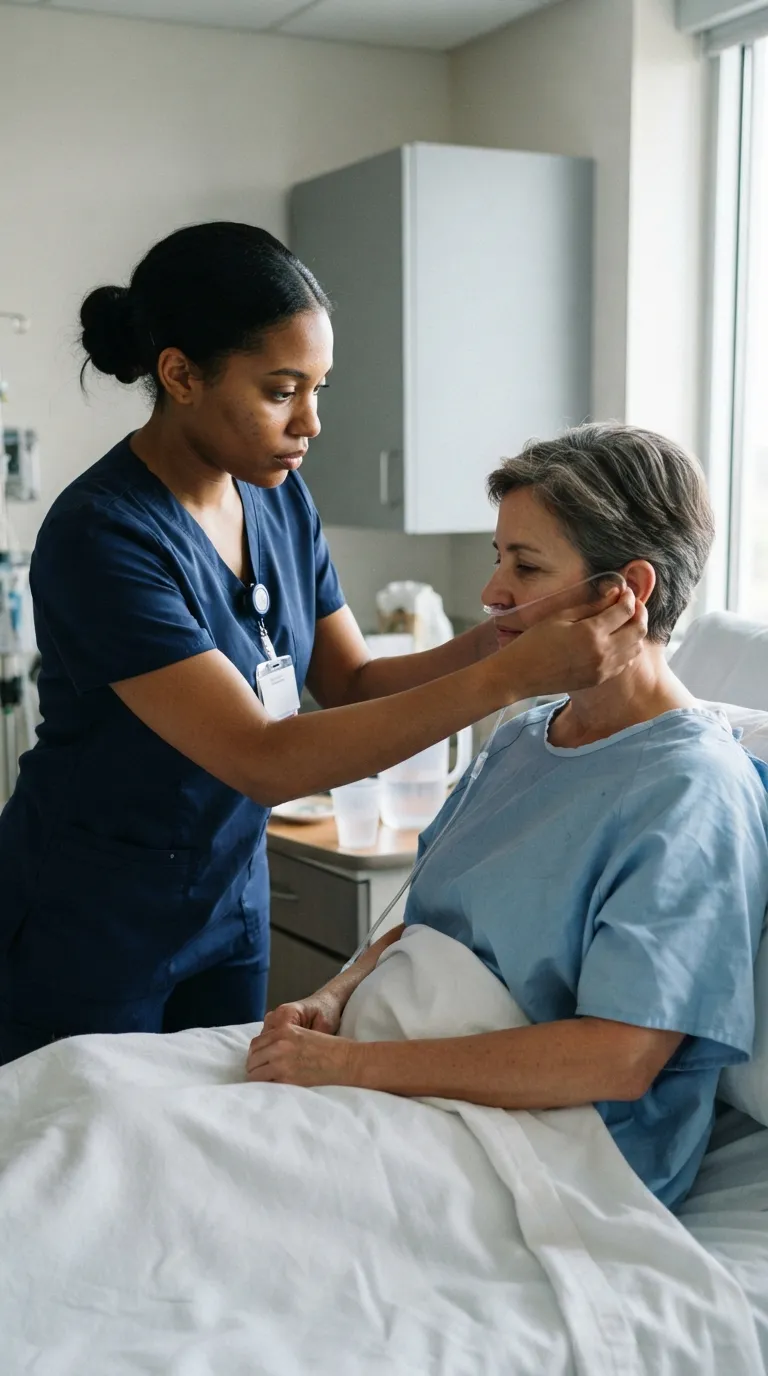
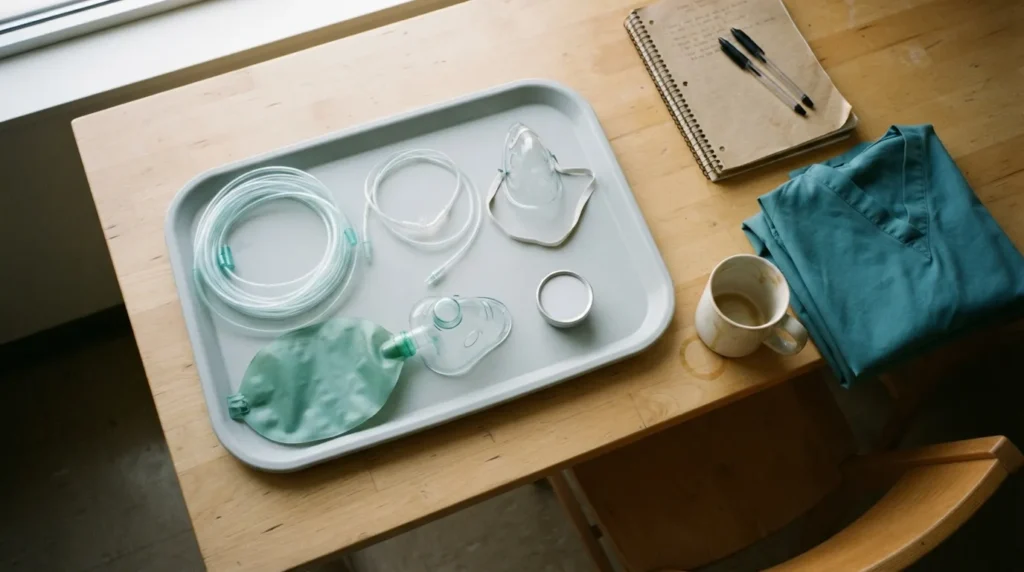
Five questions on the numbers each device can deliver. Keep the cannula steps beside you, and if blood gas numbers are your weak spot, the lab value practice questions pair well with this set.
Question 1
An adult patient is receiving oxygen by nasal cannula at 3 L/min. The approximate FiO2 this delivers is:
- A. About 24%
- B. About 28%
- C. About 32%
- D. About 44%
Answer: C. About 32%.
Rationale: A nasal cannula adds about 4% per liter: 1 L/min gives about 24% and 2 L/min about 28%, so 3 L/min lands at about 32%. A is 1 L/min, B is 2 L/min. D, 44%, is the cannula ceiling at 6 L/min.
Question 2
A patient is wearing a simple face mask with the flow meter set at 4 L/min. Which action is correct?
- A. Increase the flow to at least 6 L/min
- B. Leave the flow, since masks run safely at any setting
- C. Decrease the flow to 2 L/min for comfort
- D. Tape over the exhalation ports to keep the oxygen in
Answer: A. Increase the flow to at least 6 L/min.
Rationale: A simple mask must run at 6 to 10 L/min. Below 6 L/min, exhaled carbon dioxide collects in the mask and is rebreathed, so the flow goes up, not down. B ignores that floor. C makes the rebreathing worse. D blocks the ports carbon dioxide escapes through.
Question 3
A non-rebreather mask is set at 15 L/min and fits snugly on a patient breathing on his own. The FiO2 it delivers is approximately:
- A. 24% to 44%
- B. 60% to 80%
- C. 35% to 50%
- D. Exactly 100%
Answer: B. 60% to 80%.
Rationale: At 10 to 15 L/min with a good fit, a non-rebreather delivers about 60% to 80%, the highest range here. A is the cannula range. C fits a simple or partial rebreather mask. D overstates it: room air still mixes in, so it never reaches 100%.
Question 4
Which device delivers the most precise, preset FiO2, set by an adapter rather than by the flow meter?
- A. Nasal cannula
- B. Simple face mask
- C. Non-rebreather mask
- D. Venturi mask
Answer: D. Venturi mask.
Rationale: Venturi adapters fix the FiO2 in the 24% to 60% range, and flow follows the adapter, not the meter. That precision is why it is chosen when an exact percentage matters. A cannula only estimates. A simple mask varies with fit. A non-rebreather aims high.
Question 5
A critically ill patient is on high-flow nasal cannula therapy, which can deliver heated, humidified oxygen at flows up to:
- A. 6 L/min
- B. 60 L/min
- C. 15 L/min
- D. 10 L/min
Answer: B. 60 L/min.
Rationale: High-flow therapy runs up to 60 L/min of heated, humidified oxygen, up to 100%, so these patients are critically ill and closely monitored. A is a regular cannula’s ceiling. C and D top the non-rebreather and simple mask ranges.
Study tip: Build one small table before you test: device, flow range, FiO2, one limit. Most oxygen questions collapse once you can say, without looking, that a cannula tops out at 44% and a simple mask never runs below 6 L/min.
Set 2: Choosing the Right Device
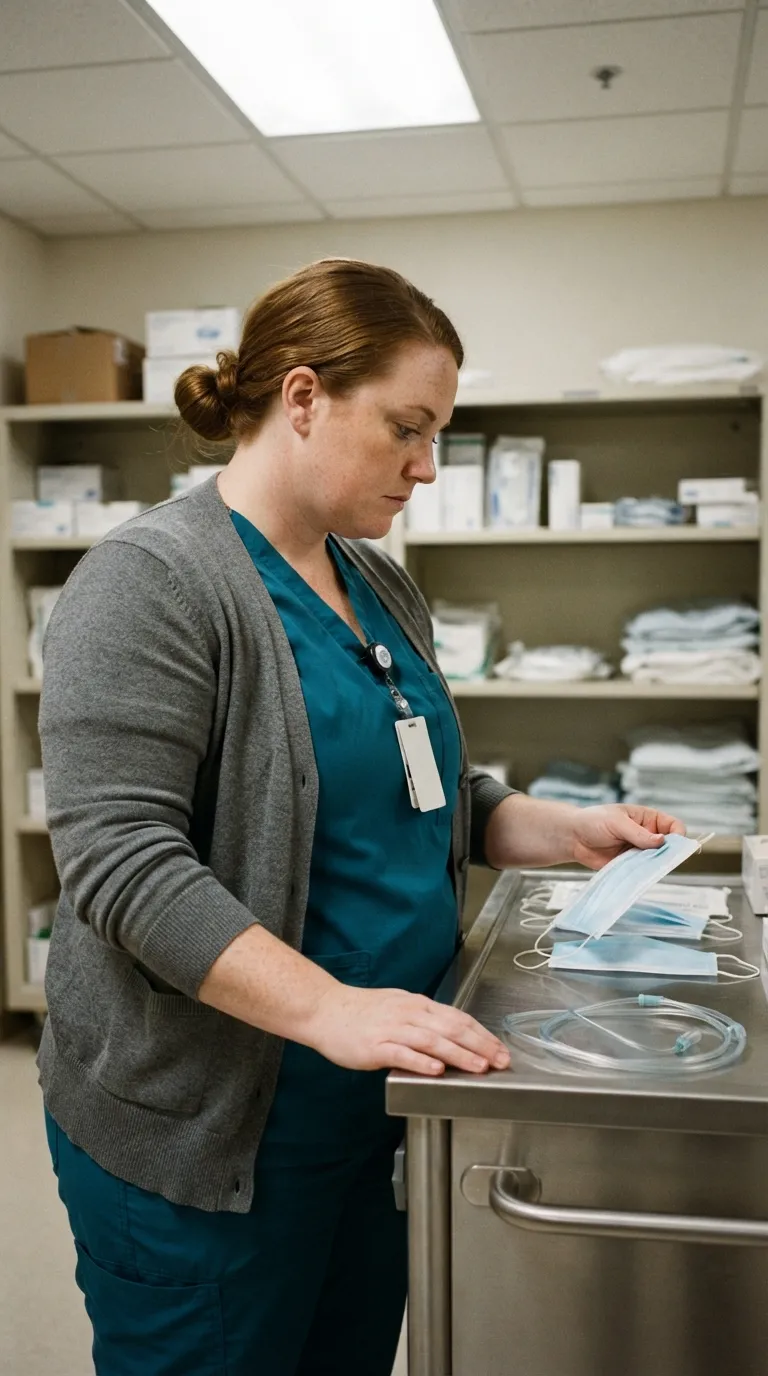
Now the stem hands you a patient instead of a device. Read for the one detail that decides it: how exact the FiO2 must be, how much oxygen is needed, and whether the patient can eat, talk or breathe through the mouth. Breathing problems tied to the heart show up in the NCLEX heart failure questions too.
Question 6
A provider orders an exact FiO2 of 28% for a patient with COPD. Which device should the nurse set up?
- A. Nasal cannula at 2 L/min
- B. Venturi mask with the 28% adapter
- C. Simple mask at 8 L/min
- D. Non-rebreather mask at 15 L/min
Answer: B. Venturi mask with the 28% adapter.
Rationale: Only the Venturi mask locks in a specific percentage, because its adapters set the FiO2. That precision is why it is used in COPD, where oxygen must stay controlled. A cannula at 2 L/min lands near 28% but drifts with breathing. The mask options give far more, the non-rebreather most of all.
Question 7
A patient arrives breathing on his own, SpO2 82%, needing the highest FiO2 a noninvasive device can give. The nurse applies:
- A. A nasal cannula at 6 L/min
- B. A simple mask at 10 L/min
- C. A Venturi mask at 40%
- D. A non-rebreather mask at 15 L/min
Answer: D. A non-rebreather mask at 15 L/min.
Rationale: The non-rebreather is built for this: at 10 to 15 L/min with a tight seal it delivers about 60% to 80%, more than any other option. A cannula tops out near 44%. A simple mask reaches about 50%. A Venturi aims for precision instead.
Question 8
A stable patient on long-term oxygen wants to eat and talk with family. Which device interferes least?
- A. Nasal cannula
- B. Simple face mask
- C. Non-rebreather mask
- D. Venturi mask
Answer: A. Nasal cannula.
Rationale: A nasal cannula leaves the mouth free, so the patient can eat and talk while oxygen keeps running, and it suits stable long-term use. Every mask covers the mouth. The masks must come off for meals, and a non-rebreather also blocks talking.
Question 9
A patient breathes mostly through his mouth and has badly blocked nostrils. The nurse expects the nasal cannula to be:
- A. Just as effective as in a nose breather
- B. Dangerous at any flow rate
- C. Less effective, because the oxygen is delivered into the nares
- D. More effective, because mouth breathing pulls in extra oxygen
Answer: C. Less effective, because the oxygen is delivered into the nares.
Rationale: The cannula delivers oxygen through prongs in the nares, so blocked nostrils and mouth breathing let it bypass the airway, and the FiO2 drops. A ignores the delivery route. B goes too far: weaker here, not unsafe. D reverses it, since the extra air drawn in is room air.
Question 10
Which statement about the partial rebreather mask is correct?
- A. Its one-way valves keep all exhaled air out of the reservoir bag
- B. It has no one-way valves, so exhaled air mixes with the inhaled oxygen
- C. It delivers a higher FiO2 than a non-rebreather mask
- D. Its reservoir bag must be inflated before it is placed
Answer: B. It has no one-way valves, so exhaled air mixes with the inhaled oxygen.
Rationale: The partial rebreather looks like a non-rebreather but has no one-way valves, so exhaled air mixes with the inhaled oxygen; it delivers 35% to 50%. A describes the non-rebreather’s valves. C is backwards: the non-rebreather reaches 60% to 80%. D is a non-rebreather step too.
Set 3: Safety and Troubleshooting
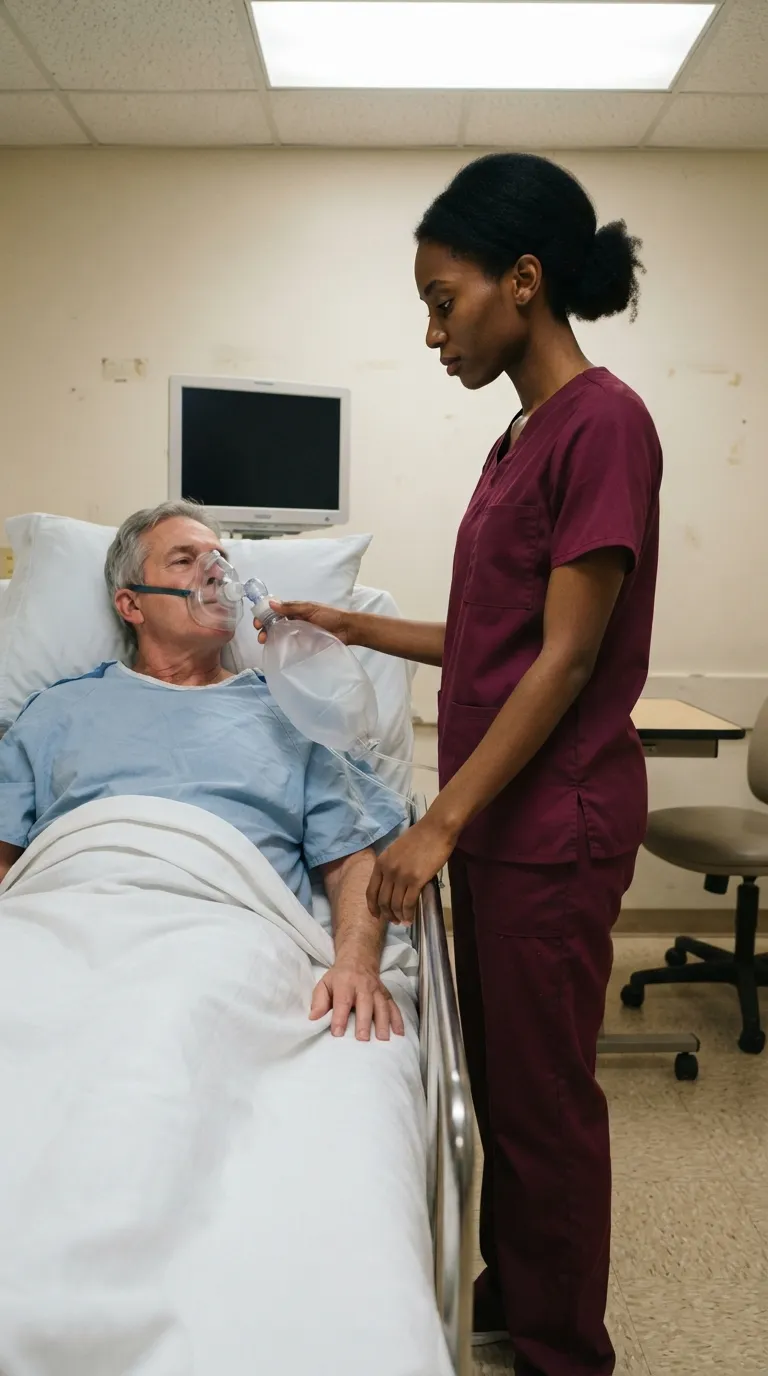
Every setup here looks fine at first glance. One part is wrong each time: a flow set too low, a bag left flat, the wrong lubricant, a flow that stops. Spot the unsafe detail before you touch the options.
Question 11
On rounds, the reservoir bag on a patient’s non-rebreather mask collapses completely with every breath. The nurse should:
- A. Chart it and recheck on the next rounds
- B. Lower the flow so the bag empties more slowly
- C. Check the flow and setup right away and correct the problem
- D. Remove the oxygen and let the patient rest on room air
Answer: C. Check the flow and setup right away and correct the problem.
Rationale: A reservoir bag should never totally deflate. A flat bag means the setup is failing and needs immediate intervention. A delays a safety fix. B lowers the flow the wrong way; the mask needs 10 to 15 L/min. D removes oxygen from a patient who needs the most.
Question 12
The tubing disconnects and flow stops while a tight non-rebreather mask stays sealed on the patient’s face. The greatest immediate danger is:
- A. Dryness of the nasal mucosa
- B. Suffocation, because the one-way valves and tight seal cut off room air
- C. Skin breakdown above the ears
- D. A falsely low pulse oximeter reading
Answer: B. Suffocation, because the one-way valves and tight seal cut off room air.
Rationale: Its one-way valves let the patient breathe in only from the bag, and the mask seals tightly. Stop the gas flow and no air source is left, so suffocation is the urgent risk. A and C are real cannula problems, but slow ones. D is a monitoring issue, not this stem’s danger.
Question 13
A patient’s daughter has been applying petroleum jelly inside his nares to soothe dryness from his nasal cannula. The nurse should teach her to:
- A. Keep using it, since it seals the prongs in place
- B. Use it only during the day while staff are nearby
- C. Switch to a water-based lubricant, since petroleum-based products are a fire risk
- D. Stop the oxygen whenever the jelly is applied
Answer: C. Switch to a water-based lubricant, since petroleum-based products are a fire risk.
Rationale: Petroleum-based products can catch fire around oxygen, so they never belong in the nares on oxygen. A water-based lubricant soothes the same dryness safely. A keeps the hazard. B keeps the same product and risk. D treats the oxygen as the problem, not the lubricant.
Question 14
A nursing student sets a simple face mask at 3 L/min, explaining that the patient only needs a little oxygen. The instructor corrects the student because at this flow:
- A. The mask delivers nearly 100% oxygen
- B. The exhalation ports seal shut
- C. The oxygen damages the patient’s lungs within minutes
- D. Exhaled carbon dioxide builds up in the mask and is rebreathed
Answer: D. Exhaled carbon dioxide builds up in the mask and is rebreathed.
Rationale: A simple mask needs at least 6 L/min to wash exhaled air out. At 3 L/min, exhaled carbon dioxide stays inside and is rebreathed. A describes no mask at this flow. B is backwards: the ports are holes that stay open. C invents a harm no device here carries.
Question 15
After four days on a nasal cannula at 5 L/min, a patient’s nares are sore and the skin above her ears is red. Which action helps most?
- A. Add humidification, pad the tubing, and inspect the nares and ears regularly
- B. Change her to petroleum jelly for the sore areas
- C. Raise the flow to 8 L/min so the therapy ends sooner
- D. Tape the prongs firmly so they cannot move
Answer: A. Add humidification, pad the tubing, and inspect the nares and ears regularly.
Rationale: Flows above 4 L/min dry the mucous membranes, so humidification is added, and the tubing needs padding and regular skin checks. B swaps in a flammable product. C pushes a cannula past its 6 L/min range and dries tissue more. D holds prongs tighter against skin already breaking down.
Set 4: Monitoring the Patient on Oxygen
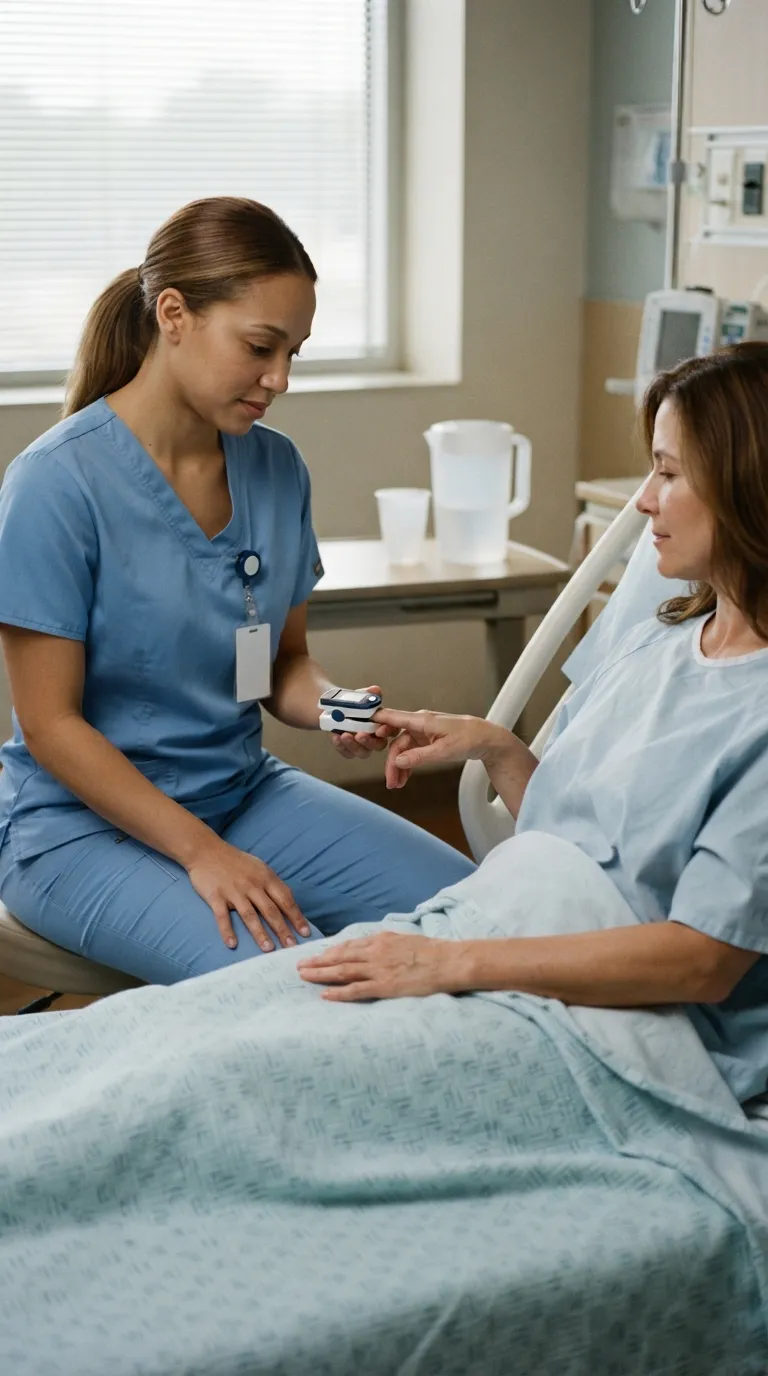
The last set is about trusting the number on the screen. Some readings lie, and the stem tells you why. Oxygen decisions also ride on chest pain findings, so the MI and angina questions make a good next set.
Question 16
A pulse oximeter reading jumps between 88% and 97% while the patient eats and gestures. The most common cause of this inaccurate reading is:
- A. Motion artifact
- B. Carbon monoxide poisoning
- C. A warm, well perfused finger
- D. Room air leaking into the mask
Answer: A. Motion artifact.
Rationale: Motion artifact is the most common cause of a false reading: movement makes venous flow look like arterial pulses, so numbers swing. B causes a falsely high reading, not a jumping one. C describes the finger you want. D affects delivered oxygen, not what the probe measures.
Question 17
A patient’s fingers are cold and the oximeter will not settle on a reading. The nurse’s best first step is to:
- A. Remove the patient’s nail polish
- B. Chart the lowest number shown
- C. Move the probe to a toe and leave it there
- D. Warm the fingers with moist heat or a warm blanket, then reapply the probe
Answer: D. Warm the fingers with moist heat or a warm blanket, then reapply the probe.
Rationale: Cold fingers mean poor perfusion at the probe site. Warming the hand restores the flow the oximeter needs; then reapply the probe. A treats nail polish, not this problem. B charts a number already known to be unreliable. C changes sites without fixing perfusion.
Question 18
Before placing the probe, the nurse notices dark nail polish on the patient’s fingernails. She should:
- A. Place the probe over the polish and add 2% to the result
- B. Skip oximetry for this patient entirely
- C. Remove the polish from one nail before applying the probe
- D. Use the polish color to mark the probe site for later
Answer: C. Remove the polish from one nail before applying the probe.
Rationale: Nail polish blocks the light the probe shines through the finger, so it comes off one nail first. A invents a correction factor that does not exist. B gives up a basic safety check over a small barrier. D treats the polish as a label when it is the obstacle.
Question 19
A patient rescued from a house fire shows an SpO2 of 99% on the pulse oximeter but looks unwell and is confused. The nurse interprets the reading with caution because in carbon monoxide poisoning the oximeter:
- A. Can read falsely high, since molecules other than oxygen attach to hemoglobin
- B. Always reads exactly half the true saturation
- C. Cannot be used at all after any fire
- D. Reads falsely low because of soot on the skin
Answer: A. Can read falsely high, since molecules other than oxygen attach to hemoglobin.
Rationale: In carbon monoxide poisoning, other molecules attach to hemoglobin, which the probe reads as oxygen, so the SpO2 can read falsely high while the tissues are starving. That is why the number never overrules how the patient looks. B invents a fixed fraction. C goes too far: doubtful, not forbidden. D names the wrong direction.
Question 20
A patient with obstructive sleep apnea uses a CPAP device at home. Which statement shows the nurse understands this therapy?
- A. CPAP breathes for the patient through the night
- B. CPAP can be borrowed from a roommate without an order
- C. CPAP delivers 60 L/min of oxygen like a high-flow cannula
- D. CPAP keeps the airway open with mild pressure while the patient breathes on his own
Answer: D. CPAP keeps the airway open with mild pressure while the patient breathes on his own.
Rationale: CPAP applies continuous mild pressure that holds the airway open in a person breathing spontaneously, the picture in sleep apnea. A describes a ventilator, not CPAP. B ignores that a prescription is required. C mixes CPAP up with high-flow cannula therapy, a different system.
Answer Review Tips
Sort your misses by the step that failed. A wrong FiO2 is a numbers miss: rebuild the device table from memory. A wrong device is a reading miss: underline the stem detail that should have decided it, exact percentage, highest concentration, eating and talking, or a safety flag.
Rerun each miss the next day before rereading its rationale. If your misses cluster on infection patients who need oxygen, the antibiotics practice questions cover the drug side of those cases, and the two sets fix both halves.
One Last Test-Taking Tip
On the real exam, oxygen questions are rarely about the fanciest device. They are about the match: the simplest device that safely delivers what this patient needs. When two options both give oxygen, choose the one whose flow, FiO2 and limits fit the stem detail you underlined.
One practical tip to take to your next practice run: say the FiO2 out loud for every option before you pick. Hearing “cannula at 6, about 44%” next to “non-rebreather, 60 to 80%” makes most of these 20 questions answer themselves.
For study use only. Always follow your program, your facility’s policy and current drug and lab references.