

A full minute on the apical pulse, not fifteen seconds times four, is how digoxin safety starts: under 60 in an adult, the dose is held. These 25 nclex cardiac medication questions test that judgment across the drugs the exam returns to most: rate and rhythm agents, heart failure medicines, angina relief, and the holds, interactions and teaching points where easy marks are lost.
Each item has four options, one best answer and a rationale that names the trap: the value that should have stopped the dose, the pair that must never meet, the expected effect dressed as an emergency. Commit to a letter before you read why the wrong options fail.
How to Use This Practice Set
Cover the answer, read the stem, and say your letter out loud before you look. These items reward a routine: find the drug, name its check, judge the options against that check.
Work one set at a time; mark each miss by kind: missed hold, missed interaction, expected effect read as danger. The checks follow standard drug references; the MedlinePlus digoxin guide shows the plain-language version of the pulse and toxicity checks in Sets 1 and 2.
Rate and Rhythm Drugs

Question 1
A client with heart failure is due metoprolol: heart rate 52, blood pressure 96/58. What does the nurse do?
- A. Give the dose; the values are acceptable
- B. Hold the dose and notify the provider
- C. Give half the dose and recheck in an hour
- D. Give the dose and document both values
Answer: B. Hold the dose and notify the provider
Rationale: Beta blockers slow the heart and lower pressure: rate under 60 with systolic under 100 is the hold-and-call pair. Giving it anyway (A, D) deepens both problems; halving a prescribed dose (C) is not a nursing decision. Nonselective agents in the family also tighten airways, the trap drilled in the asthma practice questions.
Question 2
Before the morning digoxin, the nurse counts the apical pulse for a full minute: 58. What is the nurse’s action?
- A. Hold the dose, assess, and notify the provider
- B. Give it; 58 is close enough to 60
- C. Recount at the wrist for 15 seconds; give if higher
- D. Give it now and recount next round
Answer: A. Hold the dose, assess, and notify the provider
Rationale: Digoxin slows conduction, so an apical rate under 60 in an adult is a hold parameter, counted a full minute at the apex, never a 15-second wrist estimate (C). Close enough (B) deepens bradycardia; giving now and recounting later (D) reverses the check and the dose.
Question 3
A client in supraventricular tachycardia is ordered adenosine 6 mg IV. How does the nurse give it?
- A. Slow IV push over 2 minutes, then saline
- B. Mixed in a minibag and infused over 30 minutes
- C. Into the deltoid muscle, reassessed in 15 minutes
- D. Rapid push over 1 to 2 seconds, fast flush, arm lifted
Answer: D. Rapid push over 1 to 2 seconds, fast flush, arm lifted
Rationale: Adenosine clears in seconds, so only a rapid push, fast flush and lifted arm deliver it to the heart; brief flushing and chest tightness are expected. A slow push (A) or 30-minute infusion (B) lets it vanish first. It is never given into muscle (C).
Question 4
A client is dizzy, with a heart rate of 38 and a blood pressure of 88/54. Which drug does the nurse prepare first?
- A. Adenosine
- B. Amiodarone
- C. Atropine
- D. Digoxin
Answer: C. Atropine
Rationale: Symptomatic bradycardia gets atropine first: it blocks the vagus so the rate rises, and a dose too small or slow can worsen the slowing. Adenosine (A) slows conduction, the opposite need. Amiodarone (B) belongs to fast rhythms. Digoxin (D) slows this heart further.
Question 5
After eight months on amiodarone, a client reports a new dry cough and growing breathlessness. What does the nurse do?
- A. Reassure the client that a cough is expected at first
- B. Report the symptoms promptly as possible lung damage
- C. Advise stopping the drug today and resting
- D. Suggest a cough syrup and recheck next month
Answer: B. Report the symptoms promptly as possible lung damage
Rationale: Amiodarone can scar the lungs over months: new cough with growing breathlessness is reported the same day, not watched at home (D) or dismissed (A). Stopping a rhythm drug on the client’s own call (C) is unsafe; the prescriber changes it after the report.
Question 6
IV metoprolol and IV verapamil are ordered within the same hour. The nurse’s best action?
- A. Clarify the orders with the prescriber first
- B. Give both; the pair is a routine rate-control plan
- C. Give verapamil first, metoprolol an hour later
- D. Give the metoprolol and skip the verapamil without calling
Answer: A. Clarify the orders with the prescriber first
Rationale: Both slow AV node conduction, and IV forms given close together can stack into heart block. Spacing them an hour apart (C) leaves the overlap in place; skipping one silently (D) hides it. Surface the pair before either drug is given.
Question 7
A client with atrial fibrillation, ventricular rate 142, starts diltiazem. Which result shows the drug working?
- A. The rhythm converts to regular sinus rhythm
- B. The blood pressure rises to normal
- C. The ventricular rate slows as AV node conduction slows
- D. Ankle swelling resolves over the shift
Answer: C. The ventricular rate slows as AV node conduction slows
Rationale: Diltiazem controls rate, not rhythm: it slows the AV node so fewer signals reach the ventricles. It does not convert the rhythm (A) and tends to lower, not raise, pressure (B). Ankle swelling (D) is its cousin amlodipine’s effect.
Heart Failure Medicines
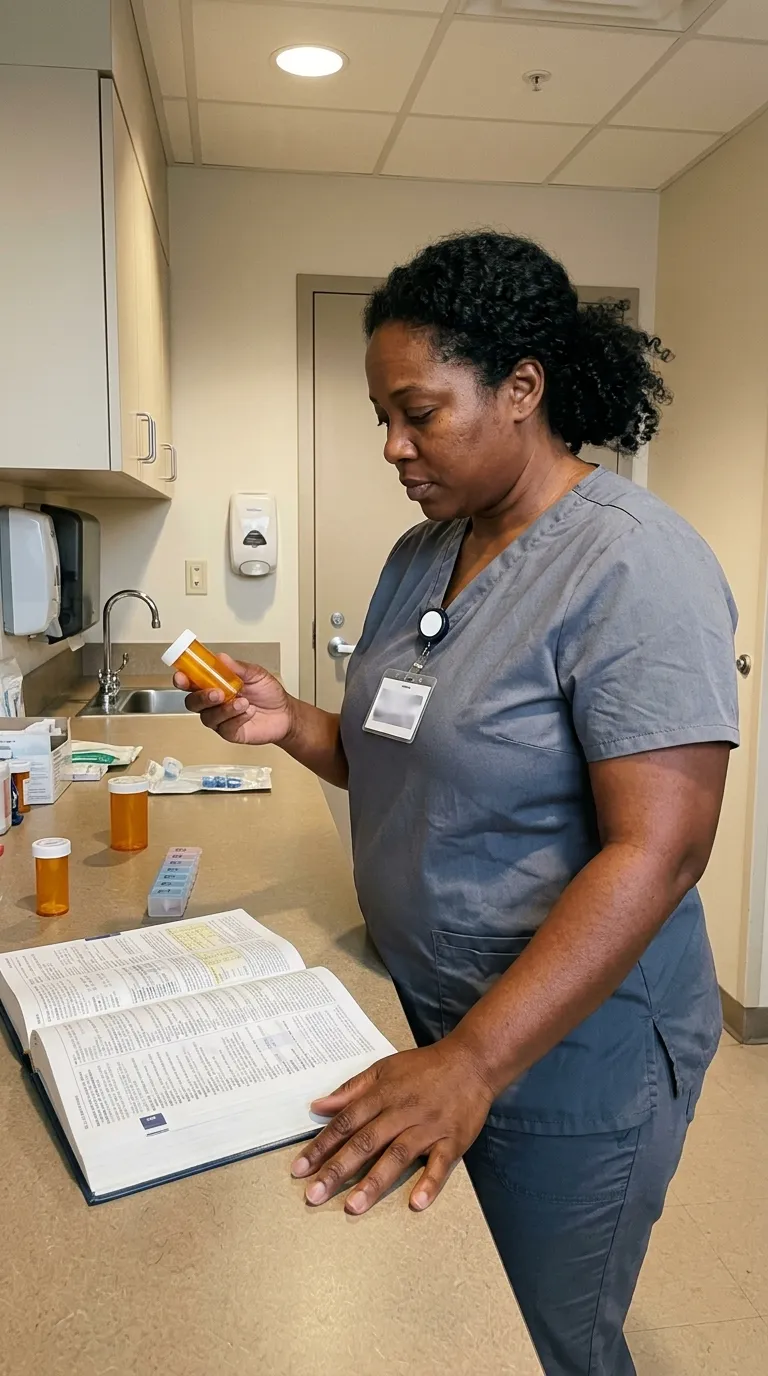
Question 8
Two months after starting lisinopril, a client reports a dry cough that will not quit; lungs are clear, no fever. The nurse’s best action?
- A. Teach night dosing to sleep through the cough
- B. Suggest a suppressant and chart it as a cold
- C. Hold all blood pressure medicines until the cough resolves
- D. Report it; a dry cough is the classic ACE inhibitor effect, and the prescriber may switch families
Answer: D. Report it; a dry cough is the classic ACE inhibitor effect, and the prescriber may switch families
Rationale: ACE inhibitors block bradykinin breakdown, and a dry cough is the signature nuisance effect; the fix is a prescriber switch, often to an ARB. A suppressant (B) buries a drug effect as a cold, night dosing (A) changes nothing, holding every pressure drug (C) overcorrects. Potassium, creatinine and first-dose drops stay watched.
Question 9
Thirty minutes after a first lisinopril dose, a client’s lips and tongue swell and the voice turns hoarse. First action?
- A. Offer ice chips and recheck in one hour
- B. Stop the drug, assess the airway, call for help
- C. Give an antihistamine and finish the round
- D. Lay the client flat and encourage slow breathing
Answer: B. Stop the drug, assess the airway, call for help
Rationale: Lip and tongue swelling after an ACE inhibitor is angioedema; the threat is the airway: stop the drug, assess breathing, call for help. An antihistamine alone (C) cannot secure a closing airway. Ice chips and an hour’s wait (A) gamble against fast obstruction. Lying flat (D) makes a tight airway harder.
Question 10
A client switched from lisinopril to losartan after months of coughing. Which monitoring still applies?
- A. Potassium and kidney function, on schedule
- B. Apical pulse for a full minute before each dose
- C. Liver enzymes weekly for the first month
- D. No routine monitoring is needed
Answer: A. Potassium and kidney function, on schedule
Rationale: Losartan spares the cough but keeps the family profile: potassium can climb, kidneys can slip, pregnancy stays a hard stop. A full-minute apical count (B) belongs to digoxin, weekly liver enzymes (C) to statins. No cautions at all (D) is the trap.
Question 11
A client on digoxin reports nausea and yellow-green halos. The level returns at 2.4 ng/mL. What does the nurse do?
- A. Give the next dose; the level is in range
- B. Recheck the level in a week and continue
- C. Hold the drug, notify the provider, check potassium; severe cases get digoxin immune fab
- D. Advise a large meal to settle the stomach
Answer: C. Hold the drug, notify the provider, check potassium; severe cases get digoxin immune fab
Rationale: The usual digoxin range runs about 0.5 to 2.0 ng/mL, so 2.4 with nausea and halos is toxicity, not a passing value (A) or a week-later recheck (B). Hold, report, check potassium; severe toxicity is reversed with digoxin immune fab. A large meal (D) misses the drug.
Question 12
A client takes digoxin and furosemide; the morning potassium is 3.1 mEq/L. Why does the nurse act before the digoxin dose?
- A. Low potassium makes digoxin leave the body too fast
- B. The value must be a lab error; potassium relates to neither drug
- C. Low potassium causes cramps that mimic toxicity
- D. Low potassium makes the heart more sensitive to digoxin, inviting toxicity and rhythm problems
Answer: D. Low potassium makes the heart more sensitive to digoxin, inviting toxicity and rhythm problems
Rationale: Furosemide drains potassium in urine; a potassium-starved heart binds digoxin more strongly, so toxicity can appear at an in-range level. It does not speed the drug through (A), it is tied to both drugs (B), and cramps (C) are minor beside rhythm risk. The medication safety questions drill this habit.
Question 13
A client on spironolactone asks about a neighbor’s salt substitute. What does the nurse teach?
- A. “Salt substitutes are safe with this drug.”
- B. “Most are potassium chloride; they can push potassium dangerously high on this drug.”
- C. “Use it only on days you skip the pill.”
- D. “They interact only with insulin, not this drug.”
Answer: B. “Most are potassium chloride; they can push potassium dangerously high on this drug.”
Rationale: Spironolactone holds potassium in, so a potassium-chloride substitute feeds its main risk: high potassium. Safe here (A) is exactly backwards. Skipping doses to make room (C) trades dangers, and the insulin line (D) is a deflection.
Study tip: sort the cardiac drugs by the check that comes first: pulse before digoxin and beta blockers, potassium beside digoxin and the diuretics, pressure before a first ACE inhibitor dose. Stems usually hand you the check as a number.
Angina and Blood Pressure Traps
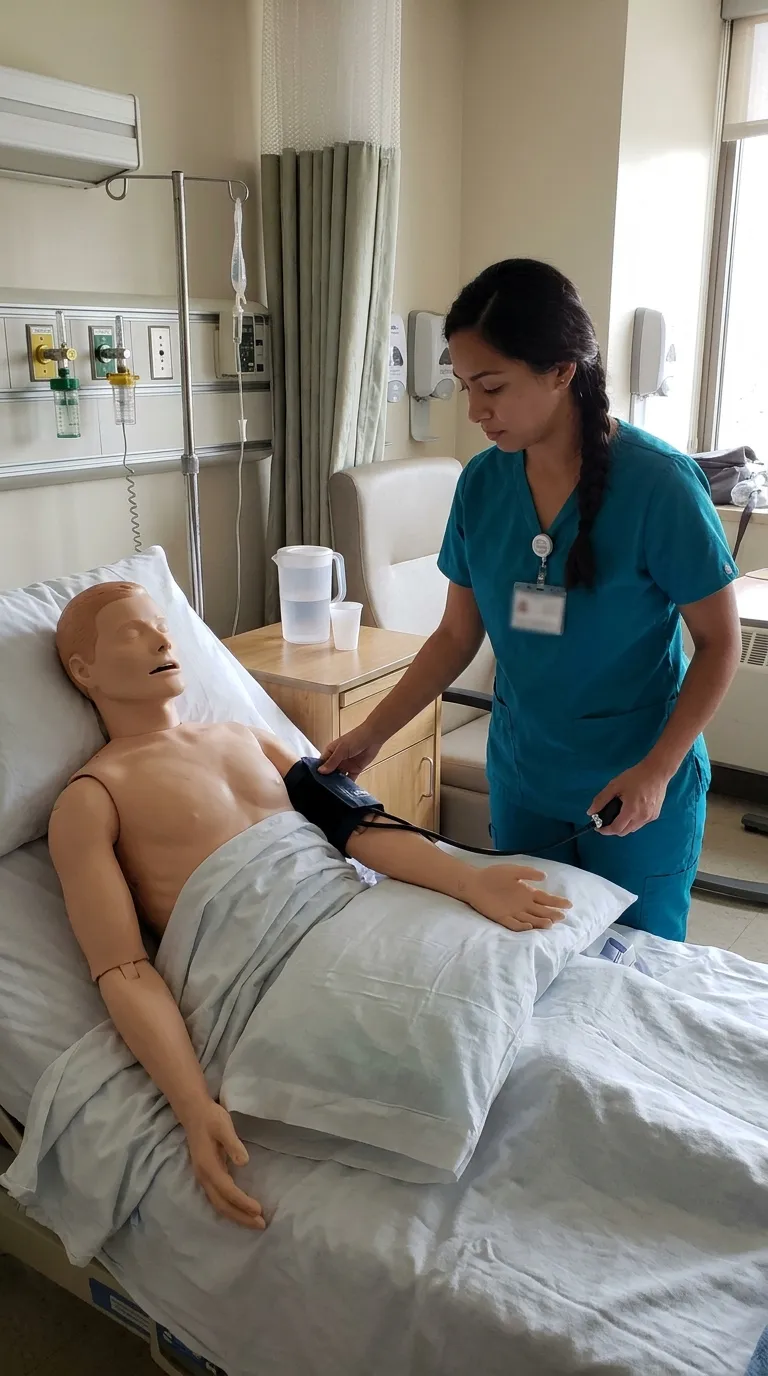
Question 14
A client with angina takes one sublingual nitroglycerin 0.4 mg tablet; five minutes later the pain is unchanged. What does the nurse teach?
- A. Call emergency services now; repeat doses follow the plan, one every 5 minutes, up to three
- B. Take three more tablets at once
- C. Drive to the hospital while pain is mild
- D. Lie down and wait an hour before judging
Answer: A. Call emergency services now; repeat doses follow the plan, one every 5 minutes, up to three
Rationale: Pain surviving the first tablet is an emergency: call while repeat doses run on the plan. Three at once (B) can crash the pressure, driving in pain (C) risks a collapse at the wheel, waiting an hour (D) spends time the heart muscle cannot spare. The medication calculation questions drill such sequences.
Question 15
A client took sildenafil yesterday evening; this morning, sublingual nitroglycerin is ordered for chest pain. What does the nurse do?
- A. Give it; a full day has passed
- B. Give half a tablet and watch the pressure
- C. Do not give it; notify the prescriber: the pair can drop pressure severely within 24 to 48 hours
- D. Give it with the client sitting upright
Answer: C. Do not give it; notify the prescriber: the pair can drop pressure severely within 24 to 48 hours
Rationale: Both widen vessels, and within a day or two together they can drop pressure dangerously: withhold the dose, report the timing. Half a tablet (B) does not halve the interaction, sitting upright (D) does not neutralize it, and a full day (A) sits inside the window.
Question 16
A client wearing a nitroglycerin patch around the clock says it no longer helps. Which change does the nurse expect?
- A. Add a second patch on the opposite arm
- B. Build in a daily patch-off window, usually overnight
- C. Move the patch to the chest, over the heart
- D. Cover the patch with a heating pad to boost absorption
Answer: B. Build in a daily patch-off window, usually overnight
Rationale: Constant exposure breeds tolerance; the fix is a daily patch-off window of about 10 to 12 hours, usually overnight. A second patch (A) deepens the tolerance it aims to beat, placement over the heart (C) changes nothing, and heat (D) speeds absorption unpredictably.
Question 17
A client keeps nitroglycerin tablets in a pill organizer on the bathroom counter; they no longer relieve pain. The teaching point?
- A. The tablets grow stronger with age; halve them
- B. Bathroom humidity keeps the tablets fresh
- C. Organizers protect tablets better than the bottle
- D. Nitroglycerin loses strength to light, air and moisture; keep it in the original dark bottle
Answer: D. Nitroglycerin loses strength to light, air and moisture; keep it in the original dark bottle
Rationale: Nitroglycerin is fragile: light, air and humidity drain its strength, so tablets live in the original dark bottle, tightly closed, replaced on schedule. Stronger with age (A) reverses the truth; humidity (B) and organizers (C) ruined this supply.
Question 18
Ten minutes after sublingual nitroglycerin, a client reports a throbbing headache; the chest pain is easing. The nurse’s best response?
- A. Explain the headache is expected with vessel widening; give acetaminophen if ordered
- B. Stop all future doses and chart an allergy
- C. Call a rapid response; the headache signals bleeding
- D. Give the next dose early to push through it
Answer: A. Explain the headache is expected with vessel widening; give acetaminophen if ordered
Rationale: Nitroglycerin widens vessels in the head too, so headache beside easing pain is the drug working, not an allergy (B) or a bleed (C). Manage it with reassurance and acetaminophen when ordered. An early extra dose (D) adds widening to resolving pain.
Question 19
After two months on amlodipine, a client’s ankles are puffy by evening, normal by morning; heart and lung findings are unchanged. The nurse explains:
- A. “This means the heart failure is worsening.”
- B. “Stop the amlodipine today; keep your legs raised.”
- C. “Ankle swelling is common with this drug; report it, and call sooner if breathlessness comes.”
- D. “The dose is too low; double it.”
Answer: C. “Ankle swelling is common with this drug; report it, and call sooner if breathlessness comes.”
Rationale: Amlodipine widens arteries more than veins, so fluid shifts into the ankles: worse by evening, better by morning. Report it; never self-stop (B) or double (D). Worsening failure (A) is the trap to rule out, and unchanged breathing with morning clearing points away from it.
Safety Holds, Interactions and Teaching

Question 20
Six weeks after a coronary stent, a client on aspirin and clopidogrel says a dentist wants both stopped for a week first. What does the nurse teach?
- A. Stopping both for a week is routine dental practice
- B. Do not stop either on your own; the pair protects the stent, and pauses are planned with cardiology
- C. Stop the clopidogrel, keep the aspirin
- D. Stop both only on the extraction day, then restart
Answer: B. Do not stop either on your own; the pair protects the stent, and pauses are planned with cardiology
Rationale: A fresh stent is raw surface to the blood, and the aspirin-clopidogrel pair keeps it open; stopping early is a classic cause of stent thrombosis. A week off (A), one drug alone (C) and a one-day client pause (D) hand a cardiology decision to the calendar.
Question 21
Which pairing for heparin therapy is correct?
- A. Monitored by INR; antidote vitamin K
- B. Monitored by platelet count; antidote digoxin immune fab
- C. Monitored by aPTT; antidote naloxone
- D. Monitored by aPTT; antidote protamine sulfate
Answer: D. Monitored by aPTT; antidote protamine sulfate
Rationale: Heparin is titrated to the aPTT, and protamine sulfate reverses it when bleeding starts. INR and vitamin K (A) belong to warfarin, digoxin immune fab (B) to digoxin, naloxone (C) to opioids. The exam swaps these pairs on purpose.
Question 22
A client on warfarin has blood drawn to judge the dose. Which test decides?
- A. INR
- B. aPTT
- C. Platelet count
- D. Troponin
Answer: A. INR
Rationale: Warfarin dosing is steered by the INR: too thin, too thick or in range, that number decides. The aPTT (B) steers heparin, the pairing just before this one. Platelets (C) matter for bleeding risk but set no dose; troponin (D) marks heart injury.
Question 23
A client on atorvastatin reports unexplained thigh muscle aches and urine the color of cola. What does the nurse do?
- A. Reassure the client; such aches are harmless on statins
- B. Advise fluids and a recheck in a month
- C. Hold the drug and report urgently; muscle breakdown can injure the kidneys
- D. Suggest a morning dose to ease the aches
Answer: C. Hold the drug and report urgently; muscle breakdown can injure the kidneys
Rationale: Muscle pain with cola-colored urine is the rhabdomyolysis pattern: breakdown products threaten the kidneys, so hold the drug and report both the same day. Mild aches alone are common (A); dark urine changes the column. Fluids and a month’s wait (B) and a morning switch (D) spend kidney time.
Question 24
A client starting verapamil asks whether the morning grapefruit habit can stay. The nurse answers:
- A. “Yes; food does not affect this family.”
- B. “No; grapefruit raises levels in this family, so it comes off the menu.”
- C. “Only the juice is a problem; the fruit is safe.”
- D. “Take the pill at night to miss the grapefruit.”
Answer: B. “No; grapefruit raises levels in this family, so it comes off the menu.”
Rationale: Grapefruit blocks a gut enzyme that trims this family, so more drug reaches the blood and effects overshoot. The block outlasts the morning, so separating pill and fruit by hours (D) fails, and the compound sits in the whole fruit as much as the juice (C).
Question 25
A client with diabetes takes metoprolol. Which teaching about low blood sugar signs is correct on this drug?
- A. “Your warning signs will feel stronger; you will notice lows sooner.”
- B. “Low blood sugar cannot happen on a beta blocker.”
- C. “Rely on the racing heart and tremor; they come first.”
- D. “Tremor and racing heart may be blunted; sweating still shows, so check glucose if you feel off.”
Answer: D. “Tremor and racing heart may be blunted; sweating still shows, so check glucose if you feel off.”
Rationale: Beta blockers damp the adrenaline warnings of low blood sugar: tremor and palpitations fade, and waiting for them waits too long (C). Sweating runs on a different pathway and survives, so trust it beside the meter. Warnings do not grow stronger (A), and lows stay possible (B).
Answer Review Tips
Sort misses by the check that failed, not by drug name. If holds beat you, rebuild the short list: pulse under 60, systolic under 100, potassium out of range. If interactions beat you, put the pairs that must never meet on one card and read it before every set.
Redo only the missed questions in two days, rationales covered, saying the trap aloud first. For the plain-language picture of how these families fit heart failure care, the MedlinePlus heart failure summary is a steady companion.
Which Questions Did You Miss?
Start where the misses cluster: hold misses mean the pre-dose checks need a card of their own; interaction misses mean the danger pairs need one. The same level-and-antidote habit is drilled in the antibiotic practice questions, where levels and toxicities decide the answers.
Pick the weaker family tonight, redo its missed questions in two days, rationales covered, and track whether the same trap catches you twice. Which of your misses was a value you did not know, and which was a check you knew but skipped?
For study use only. Always follow your program, your facility’s policy and current drug and lab references.