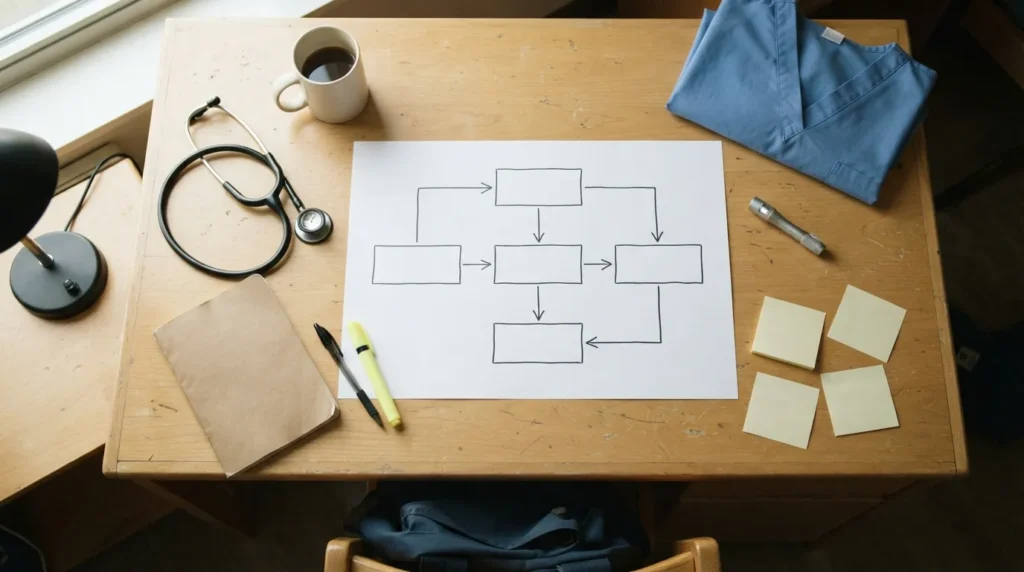

A map drawn from memory shows you exactly what you do not know, while a highlighted page hides the same gaps behind familiar ink. That honesty is why a concept map for nursing students is one of the strongest study tools in a med surg course: it forces every cause, sign, drug and priority onto one page where the connections either hold or fall apart. These 14 steps build one complete map, start to finish, using heart failure as the running example.
Work through the steps in order the first time, with a blank sheet and a pen. Later maps go faster, and by the third disease the layout starts to feel automatic.
Choose One Disease and One Patient [Start Here]

Start with one disease and one simple patient. A map falls apart when it tries to hold two diseases at once, and heart failure alone can fill a full page. Give the patient an age and one or two plain facts, such as a 68-year-old who gets short of breath lying flat, so every later branch has a real person to attach to.
One patient keeps the map concrete. Exam questions are always about one patient, never about a disease in the abstract, so the map trains the same focus you need in the testing room. When a course sits on one unit, such as cardiac week, map the disease your instructor returns to most.
Write the Medical Diagnosis in the Center Box [Center]

Draw one box in the middle of the page and write the medical diagnosis inside it: heart failure. Nothing else goes in the center box. Every other box on the page has to earn its place by connecting back to this one, which is what makes the finished sheet a map instead of a pile of notes.
Leave more white space around the box than feels natural. The branches you add in the next steps need room to spread without crossing each other, and a cramped center is the main reason first maps turn unreadable halfway through.
Study tip: Draw the center box on a fresh sheet for every new disease instead of erasing the last one, so your old maps stay available for review week.
List the Cause and Risk Factors [Roots]

Above the center box, list what caused the disease. For heart failure the usual roots are long-standing hypertension, coronary artery disease, a past heart attack, valve disease and diabetes. These causes are the etiology, the reason this patient has this disease, and they sit at the top because everything below them flows from them.
In a second small box, add the risk factors that push the disease further: a high-salt diet, missed medicine doses, infections and anemia. Causes explain how the patient got here. Risk factors explain what makes this week worse than last week, and keeping the two groups in separate boxes stops them blurring together on the page.
Map the Pathophysiology in Plain Words [Mechanism]

Below the center box, write the chain of what goes wrong, one short box per link, in your own plain words: the weakened heart pumps less blood forward, blood backs up into the lungs and the body, pressure rises in the veins, and fluid leaks into the tissues. Plain words matter here. A box that needs a textbook sentence copied word for word is a box you do not own yet, and the same plain-word habit runs through med surg semester survival tips for a reason: understanding survives exam day, memorized wording does not.
Keep each link to a few words. If one box holds two events, split it, because the signs in the next step hang off single links in this chain.
Study tip: Read the chain out loud from the center box down; a link you cannot say plainly is a link to restudy before you move on.
Branch Out the Signs and Symptoms [What Shows]
From each link in the pathophysiology chain, branch out what the nurse actually sees: shortness of breath, orthopnea (breathlessness that hits when lying flat), crackles in the lungs, swollen ankles, fast weight gain, deep fatigue and, when the failure turns severe, pink frothy sputum. Each sign hangs off the step in the chain that causes it, not off the diagnosis box.
That layout turns a list into logic. Weight gain hangs off the fluid backup link, so on an exam you can rebuild the whole branch from one idea: fluid is sitting where it should not be. Signs you cannot attach to a link are signs to look up before the map goes any further.
Add the Labs and Tests That Prove It [Evidence]

Add a branch for the tests that confirm the disease and track it. In heart failure, BNP (a hormone the heart releases when its walls stretch) climbs as the failure worsens, a chest X-ray shows fluid and an enlarged heart, and an echocardiogram measures ejection fraction, the share of blood the heart pumps out with each beat. Each test box names what the test shows, not just the test.
Add daily weights to the same branch as a bedside test. A gain of 2 to 3 pounds in a day, or 5 pounds in a week, means fluid is building again, and it often shows up before the patient feels any worse.
Study tip: Beside each test, write the result you expect before you look it up; a wrong guess marks the exact branch to review that night.
Link Every Drug to Its Job [Medications]

Give each drug class its own small box, tied by an arrow to the problem it fixes. Diuretics pull off fluid, so their arrow points at the fluid backup link. ACE inhibitors lower the pressure the heart has to pump against. Beta blockers slow the heart and protect it from overwork. Write the generic name and the job in two or three words, nothing more.
Never park a drug box without its arrow. On the NCLEX, drug questions are really connection questions: which problem does this drug solve, and which sign tells you it worked. A drug that connects to nothing on your map is a drug you cannot reason about yet, and the map shows you that gap honestly.
Memory trick: Say the heart failure chain as one short sentence, weak pump, backup, fluid, signs, and the whole map hangs on those four hooks when you redraw it from memory.
Place Nursing Diagnoses on the Map [Priorities]

Now add the nursing diagnoses, the problems the nurse treats directly: excess fluid volume, impaired gas exchange, activity intolerance and risk for impaired skin integrity from the edema. Write them in a different shape or color from the medical boxes, so the eye can tell at a glance which boxes belong to medicine and which belong to nursing.
Place them in priority order as you write: breathing and fluid first, comfort, skin and teaching after. The finished map should show which diagnosis you would act on before all the others without a single extra note in the margin.
Study tip: Star the diagnosis you would treat first; exam priority questions usually ask for exactly that star.
Connect Complications With Arrows [What If]

Add a branch for what happens when the disease wins: fluid flooding the lungs as acute pulmonary edema, kidneys starved of blood flow, a heart rhythm that turns unstable. Draw each complication off the pathophysiology link that produces it, not off the center box. In clinicals the same habit pays off, since steady nursing clinical study tips keep returning to one skill: following a change in the patient back to its cause.
Complications are where priority questions live. A patient sliding toward pulmonary edema changes every other plan on the page at once, and the map shows why in a single line of arrows, faster than any paragraph could.
Add Patient Teaching at the Edge [Teaching]

Reserve the edge of the page for what the patient does at home: weigh every morning at the same time, keep salt low, take the medicines even on good days, and call the clinic for a gain of 2 to 3 pounds in a day, worse breathlessness, or needing extra pillows to sleep. Teaching sits at the edge because it depends on everything in the middle, and the edge keeps it visible instead of buried.
Study tip: Write each teaching point as the patient’s own action, in the patient’s words, so it is ready to hand back to you in a teach-back check.
Color-Code by Body System [Systems]

Give each body system one color and stay with that code on every map you draw: lungs one color, kidneys another, skin and tissues a third. In heart failure the lung branch and the fluid branch separate at a glance, and a crowded page stays readable under time pressure. Small systems habits like this are the quiet nursing students productivity tips that save real minutes during a review week.
Keep a tiny key in the corner of the page: color, system, nothing more. When a sign could sit in two systems, place it where its cause lives and add one thin arrow to the second system instead of drawing the box twice.
Draw the Arrows and Label Each One [Connections]

Go back over the whole page and draw the arrows you skipped, each with a short linking word or two on the line: causes, leads to, shows up as, is treated by, gets worse with. An arrow without words is decoration. The words are the thinking, because they say how one box acts on the next.
Finish by counting the boxes with no arrow touching them. An orphan box is either a fact still waiting for its connection or a fact that does not belong on this map at all, and both answers teach you something.
Study tip: Cover the linking words with your hand and quiz yourself; if you cannot supply the missing word, that connection is not learned yet.
Check the Map Against the Care Plan [Cross-Check]

Lay the finished map beside a care plan for the same patient and compare them line by line. Every nursing diagnosis on the map should appear in the plan with a goal and actions, and every drug in the plan should sit on the map with its job written beside it. A mismatch in either direction marks the exact spot where your understanding is thin.
Fix the map, not the plan, during study time. The plan shows what care looks like when it is written by someone who already understands the disease; the map is the tool that gets you to that same understanding before clinicals.
Shrink It to One Page From Memory [Recall Drill]

Put the finished map away and redraw it on a fresh page from memory, smaller and plainer. Keep the center box, the chain and every branch you can rebuild without peeking. The gaps in the redraw become your study list for tomorrow, which is the same honest signal that makes cornell notes for nursing students work: the page shows what stuck and what did not, with no place to hide.
Study tip: Redraw on a timer, ten minutes per disease, so the drill matches the pace of an exam review session.
Pick Two and Start
If you remember one thing: a concept map is not art homework, it is one disease explained in your own boxes and arrows, and a map you can redraw from memory is a topic you actually know.
Start tonight with two diseases from your current unit, one you find easy and one you avoid. Draw both maps, compare the redraws tomorrow, and let the weaker map set your study order for the rest of the week.