

The instructor slides a practice sheet across the desk, and the same blood gas result keeps getting circled in red. That moment is exactly where a fixed routine helps. Good abg interpretation is not a talent, it is an order: pH first, then the respiratory value, then the metabolic value, then compensation and oxygen. Pair that order with better exam study tips and it starts to stick.
This guide walks through 10 steps in that exact order, with worked numbers in most steps. Each step uses the same adult ranges, so the pattern stays steady from the first example to the last. By the end, a full label such as partially compensated metabolic acidosis reads like a short sentence, not a guess.
| At a Glance | Detail |
|---|---|
| Course | Med Surg |
| Best for | Students meeting ABGs in class or reviewing before an exam |
| Study time | 25 to 35 minutes |
1. Start With the pH

The pH tells you one thing first: whether the blood is too acidic, too alkaline, or inside the normal range. The adult range is 7.35 to 7.45, and the MedlinePlus ABG test ranges list the same values. Nothing else gets named until this first call is made.
Problem: A practice result shows a pH of 7.28. Is the blood acidic, alkaline, or normal?
Formula: Compare the pH with the normal range, 7.35 to 7.45.
- Write the range down: 7.35 to 7.45.
- Place 7.28 next to it. The value sits below 7.35.
- Subtract to size the gap: 7.35 minus 7.28 equals 0.07.
Answer: Acidemia. The pH of 7.28 sits 0.07 below the normal range.
Check: Count back up from 7.28 to 7.35. The distance is 0.07, so the value is low, never high.
2. Check Carbon Dioxide for the Respiratory Side

PaCO2, the partial pressure of carbon dioxide, is the respiratory value, and the lungs control it breath by breath. The normal range is 35 to 45 mmHg. Carbon dioxide acts like an acid in the blood, so a high PaCO2 pushes the pH down, and a low PaCO2 pushes the pH up. Direction matters more than the exact number here.
Say the PaCO2 reads 58 mmHg beside that low pH. Breathing has slowed or the lungs cannot clear carbon dioxide well, so acid builds up. A quiet corner and simple study space ideas make drills like this easier to repeat each day. Slow, deep breathing clears more carbon dioxide, while shallow breathing holds it in.
Study tip: Say the direction out loud for every practice value, high equals acid effect, low equals alkaline effect, before looking at any other number.
3. Check Bicarbonate for the Metabolic Side

Bicarbonate, written as HCO3, is the metabolic value, and the kidneys hold it or release it to balance acid. The normal range is 22 to 26 mEq/L. Bicarbonate is a base, so a low value points to a metabolic acid problem, and a high value points to a metabolic alkaline problem.
Problem: A result lists bicarbonate at 16 mEq/L. Which side of the range does it fall on, and by how much?
Formula: Compare bicarbonate with the normal range, 22 to 26 mEq/L.
- Write the range down: 22 to 26 mEq/L.
- Place 16 mEq/L next to it. The value sits below 22 mEq/L.
- Subtract: 22 minus 16 equals 6 mEq/L.
Answer: A metabolic acid effect. Bicarbonate is 6 mEq/L below the normal range.
Check: Add the gap back. Sixteen plus 6 equals 22, the bottom of the range, so the math holds.
4. Match the pH to the Right System

Now match the pH direction to one of the two values. The memory aid is ROME: Respiratory Opposite, Metabolic Equal, a pattern also shown in the OpenStax acid-base notes. In a respiratory problem, the pH and PaCO2 move in opposite directions. In a metabolic problem, the pH and bicarbonate move the same way.
Test it twice. A low pH with a high PaCO2 moves in opposite directions, so the lungs are the match. A low pH with a low bicarbonate moves the same way, so the metabolic side is the match. Short drills built from helpful study guide ideas turn this matching step into a habit.
Study tip: Draw two small arrows for each practice gas, one for the pH and one for each value, then circle the pair that follows the ROME pattern.
5. Name the Primary Disorder

With the match made, the primary disorder gets its name: respiratory or metabolic, paired with acidosis or alkalosis. Use the system that matches the pH, not the value that looks most dramatic.
Problem: pH 7.30, PaCO2 50 mmHg, bicarbonate 24 mEq/L. Name the primary disorder.
Formula: Match the pH to the value moving with it under the ROME pattern.
- The pH of 7.30 is low, so the problem is an acidosis.
- PaCO2 at 50 mmHg is high, the opposite direction from the pH, a respiratory match.
- Bicarbonate at 24 mEq/L sits inside 22 to 26 mEq/L, so no metabolic match exists.
Answer: Respiratory acidosis.
Check: Only one value is abnormal, and it matches the pH under ROME, so the name rests on a single clear cause.
6. Look for Compensation

The body answers a primary disorder with the other system. Lungs adjust breathing within minutes, while kidneys adjust bicarbonate far more slowly. Three labels cover the result. Uncompensated means the other value still sits normal. Partially compensated means the other value moved, yet the pH stays outside the range. Fully compensated means the pH returned to 7.35 to 7.45 while both values sit abnormal.
Read this set: pH 7.36, PaCO2 55 mmHg, bicarbonate 30 mEq/L. The pH is normal but sits closer to the acid end, both values are high, and the high bicarbonate is the kidneys answering a long-running respiratory problem. That is fully compensated respiratory acidosis. The same careful reading shows up in care plan study tips for other lab patterns.
Study tip: Judge compensation in a fixed order, first ask whether the other value moved, then ask whether the pH reached the normal range.
NCLEX tip: A normal pH with both PaCO2 and bicarbonate outside the normal ranges is a compensated disorder on exam questions, never a normal result. Find the primary side by asking which end of the normal pH range the value sits closer to.
7. Check Oxygenation Levels

Acid-base and oxygenation are two separate reads on the same report. PaO2 shows oxygen pressure in arterial blood, with a normal range of 75 to 100 mmHg. SaO2 shows how much hemoglobin carries oxygen, with a normal range of 95 to 100 percent.
Problem: PaO2 68 mmHg and SaO2 92 percent. How is oxygenation?
Formula: Compare each oxygen value with its own normal range.
- PaO2: 75 minus 68 equals 7 mmHg below the normal range.
- SaO2: 95 minus 92 equals 3 points below the normal range.
- Both oxygen values are low, in the same direction.
Answer: Hypoxemia, meaning low blood oxygen, sits beside the acid-base problem.
Check: Low oxygen never changes the acid-base name from Steps 1 to 6, so the two labels stay separate and both get reported.
8. Calculate the Anion Gap
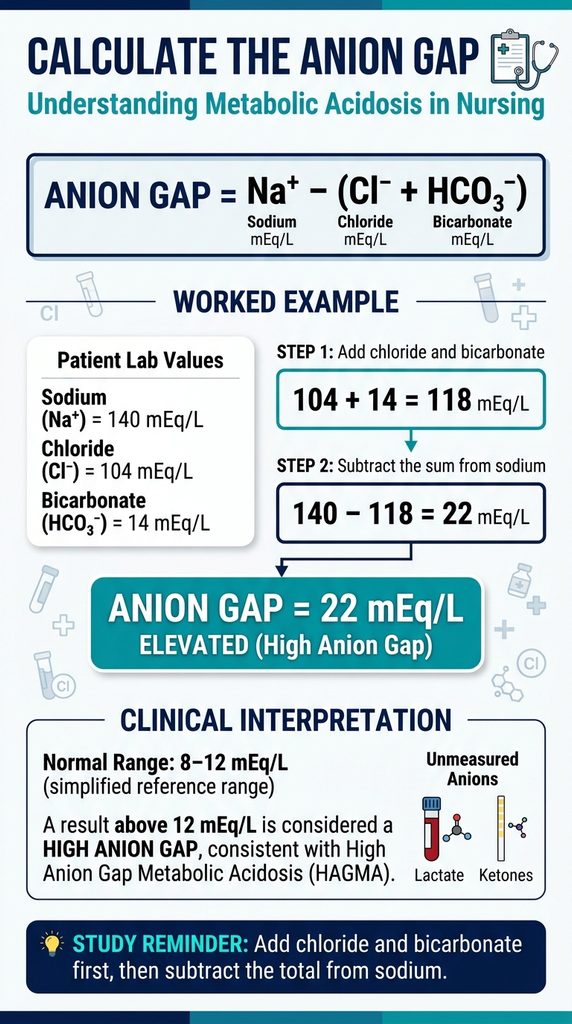
When bicarbonate runs low, one short calculation adds useful detail. The anion gap estimates the unmeasured negative ions in the blood, and a wide gap points to an added acid, such as lactate or ketones. Exam questions use the gap to sort metabolic acidosis into types, a skill that grows with steady clinical study tips and short practice sets.
- Formula: Anion gap equals sodium minus the sum of chloride and bicarbonate, all in mEq/L.
- Example: Sodium 140 mEq/L, chloride 104 mEq/L, bicarbonate 14 mEq/L. First add 104 and 14 for 118, then subtract: 140 minus 118 equals 22 mEq/L.
- Meaning: A gap above 12 mEq/L is high, so this result fits a high anion gap metabolic acidosis.
Study tip: Run the addition first and write the sum down before subtracting, since most gap errors happen in that hidden first step.
9. Put the Full Label Together

Every step now joins into one label with three parts: compensation state, primary system, and acidosis or alkalosis. Say the parts in that order, every time.
Problem: pH 7.22, PaCO2 28 mmHg, bicarbonate 11 mEq/L. Build the full label.
Formula: Label equals compensation state plus primary system plus acidosis or alkalosis.
- The pH of 7.22 is low, so an acidosis is present.
- Bicarbonate at 11 mEq/L is low and moves the same way as the pH, a metabolic match under ROME.
- PaCO2 at 28 mmHg is low, showing the lungs blowing off carbon dioxide to help.
- The pH still sits below 7.35, so compensation is partial, never full.
Answer: Partially compensated metabolic acidosis.
Check: Without compensation, PaCO2 would rest inside 35 to 45 mmHg. A value of 28 mmHg proves the lungs are answering, and the low pH proves the answer is not finished yet.
10. Recheck Against the Patient Picture
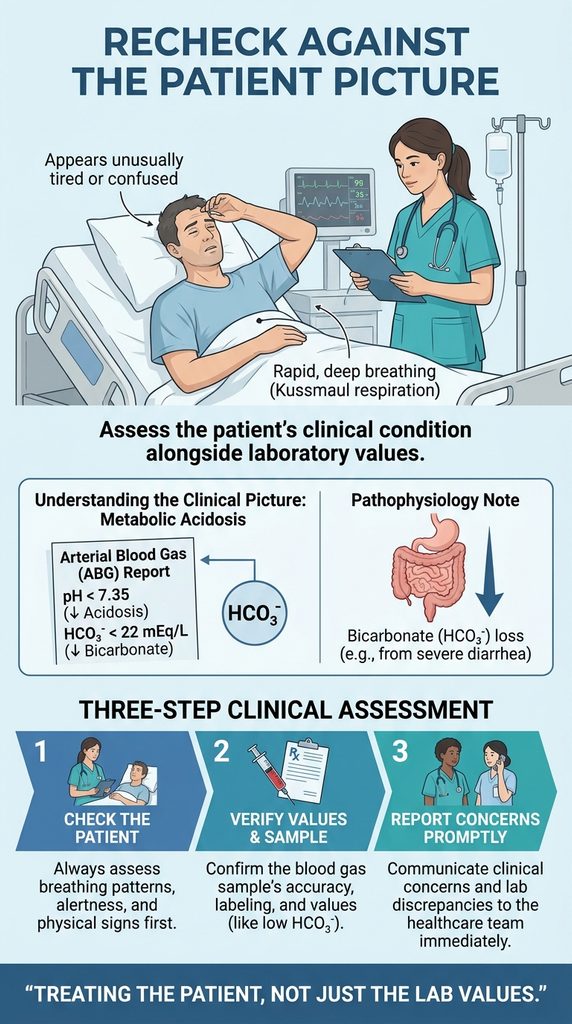
A finished label still needs one last test: does it fit the person in the bed? Fast, deep breathing fits the lungs compensating for metabolic acidosis, and confusion or unusual tiredness can appear with acidosis as well. A history clue matters too. Days of diarrhea fit bicarbonate loss, since the gut loses bicarbonate in stool.
When the picture and the numbers disagree, recheck the values and the sample before trusting the label, then report the concern to the provider promptly. Numbers guide care, yet the patient in front of you always gets the final say in how urgent the finding feels.
Study tip: For each practice gas, write one patient clue the label predicts, such as a breathing pattern, and check that clue against the case stem.
Common Mistakes
- Reading PaCO2 first: Start with the pH, since acidemia or alkalemia frames every call that follows.
- Calling a normal pH a normal gas: Check both other values, because abnormal PaCO2 and bicarbonate with a normal pH mean a compensated disorder.
- Reversing PaCO2: High PaCO2 has an acid effect and low PaCO2 has an alkaline effect, the opposite of bicarbonate.
- Skipping oxygen: Read PaO2 and SaO2 on every result, since hypoxemia can sit beside any acid-base label.
Quick Questions
What Order Should the Values Be Read In?
Read the pH first, then PaCO2, then bicarbonate. Next match the pH to the right system with ROME, name the primary disorder, judge compensation, and finish with PaO2 and SaO2. A fixed order stops random guessing and makes each new practice result feel familiar within a few days of steady drills.
Can a Normal pH Still Hide a Disorder?
Yes. A pH inside 7.35 to 7.45 with both PaCO2 and bicarbonate outside the normal ranges points to a fully compensated disorder. Look at which end of the range the pH sits closer to. A pH of 7.36 leans acid, so the primary problem sits on the acid side, with the other system answering.
Why Does the Anion Gap Matter?
The gap sorts metabolic acidosis by cause. A high gap means an acid was added to the blood, such as ketones in diabetic ketoacidosis or lactate during poor perfusion. A normal gap points more toward bicarbonate loss, such as through diarrhea. That split guides which cause a care team hunts first.
What to Practice Next
Start with five practice gases a day, read in the full 10 step order, with the label said out loud before checking any answer key. Keep a short error log beside the practice set. Most errors cluster in one step, often the ROME match or the compensation call, and that cluster shows exactly where the next study session belongs.
Next, pair this routine with lab value drills, since bicarbonate, sodium and chloride return in many exam topics. A simple kit from a student essentials checklist, such as blank cards and a timer, keeps those drills short and repeatable. Small daily sets beat one long session the night before a test.
For study use only. Always follow your program, your facility’s policy and current drug and lab references.