
Many students memorize the letters of a mnemonic and skip the harder step of learning what each letter means. That habit backfires on test day, when the question asks about a side effect or an antidote, not the word itself. This sheet fixes that gap: 24 pharmacology mnemonics, each one opened up in full, with the drug, the class and the safety check that goes with it.
Start with the table, then work through the three groups below it. Antidotes come first, drug endings second, safety checks third. Short sessions with solid nursing pharmacology notes beside the table help the pairs stick faster.
Quick Reference

| Mnemonic | Helps You Remember | Drug or Class |
|---|---|---|
| SLUDGE | Signs of cholinergic excess | Acetylcholine overload |
| Six classic phrases | Signs of anticholinergic toxicity | Anticholinergic drugs |
| Opioid triad | Opioid overdose signs | Opioid analgesics |
| Naloxone pair | Opioid reversal | Opioid antagonist |
| Protamine pair | Heparin reversal | Antidote |
| Vitamin K pair | Warfarin reversal | Antidote |
| Flumazenil pair | Benzodiazepine reversal | Antidote |
| Acetylcysteine pair | Acetaminophen toxicity | Antidote |
| -pril ending | ACE inhibitors | Lisinopril |
| -sartan ending | Angiotensin receptor blockers | Losartan |
| -olol ending | Beta blockers | Metoprolol |
| -dipine ending | Calcium channel blockers | Amlodipine |
| -statin ending | Cholesterol lowering drugs | Atorvastatin |
| -prazole ending | Proton pump inhibitors | Omeprazole |
| -floxacin ending | Fluoroquinolone antibiotics | Levofloxacin |
| -azepam ending | Benzodiazepines | Diazepam |
| Apical pulse rule | Digoxin safety check | Cardiac glycoside |
| INR rule | Warfarin monitoring | Anticoagulant |
| aPTT rule | Heparin monitoring | Anticoagulant |
| Loops lose potassium | Loop diuretic effect | Furosemide |
| Cool and clammy | Low blood glucose signs | Insulin safety |
| Hot and dry | High blood glucose signs | Insulin safety |
| Mean mycins | Aminoglycoside toxicity watch | Gentamicin |
| Tetracycline T list | Teeth, pregnancy and sun warnings | Tetracycline antibiotics |
Read the table once, then cover the third column and say each drug or class out loud.
Antidotes and Toxicity Signs

Antidotes are pure matching questions, and exams love to swap the heparin and warfarin answers. Learn each pair as one unit, drug on one side and reversal on the other, the way these nclex pharmacology notes set them out. The two toxicity sign sets at the top of this group work the same way.
SLUDGE for Cholinergic Excess
Too much acetylcholine floods the body with secretions. The word SLUDGE lists the muscarinic signs, in the expansion given in StatPearls on cholinergic toxicity.
- S = salivation, extra saliva
- L = lacrimation, tearing eyes
- U = urinary frequency
- D = diaphoresis and diarrhea
- G = gastrointestinal cramping and pain
- E = emesis, vomiting
Use it for cholinesterase inhibitor or organophosphate stems with a wet, slowed picture.
Hot as a Hare Signs
Anticholinergic toxicity is the dry opposite of SLUDGE. Six phrases paint the picture, as recorded in StatPearls on anticholinergic medications.
- Red as a beet = flushed skin
- Dry as a bone = no sweat, dry mouth
- Blind as a bat = dilated pupils, blurred vision
- Mad as a hatter = confusion, delirium
- Hot as a hare = raised temperature
- Full as a flask = urinary retention
Use it when an anticholinergic patient turns hot, dry, flushed and confused.
Opioid Triad to Spot Fast
Opioid overdose slows breathing and consciousness together. Three findings point to it at once.
Pinpoint, slow, sleepy sums up the triad:
- Pupils = pinpoint and constricted
- Breathing = slow and shallow
- Consciousness = lowered, hard to wake
Use it in stems with an opioid, slow respirations and a patient who cannot stay awake.
Naloxone Reverses Opioids
Naloxone pushes opioids off their receptors and restarts breathing. Pair the drug and its job as one unit.
- Drug = naloxone, opioid antagonist
- Action = blocks opioid receptors
- First gain = breathing improves
- Watch = effect wears off sooner than many opioids
- Repeat = further doses may be needed
Use it whenever a question pairs opioid overdose signs with a reversal drug.
Protamine Reverses Heparin
Heparin has its own reversal drug, and mixing it up with the warfarin answer is a classic lost mark.
- Drug = heparin, anticoagulant
- Antidote = protamine sulfate
- Job = binds heparin and switches it off
- Setting = heparin overdose or heavy bleeding
Use it in matching questions that list both anticoagulants side by side.
Vitamin K Reverses Warfarin
Warfarin cuts vitamin K dependent clotting factors, so its reversal drug is vitamin K itself.
- Drug = warfarin, oral anticoagulant
- Antidote = vitamin K
- Job = restarts clotting factor production
- Speed = works over hours, not minutes
Use it when a stem asks how warfarin effect is reversed or corrected.
Flumazenil and Benzodiazepine Caution
Flumazenil blocks benzodiazepines at their receptor, yet it carries the strongest caution of any antidote here.
- Drug group = benzodiazepines
- Antidote = flumazenil
- Action = benzodiazepine receptor antagonist
- Caution = can trigger seizures in dependent patients
- Result = used rarely and with care
Use it when a benzodiazepine reversal question includes a long history of daily sedative use.
Acetylcysteine for Acetaminophen Toxicity
Acetaminophen overdose injures the liver quietly. Its antidote protects the liver when given early.
- Drug = acetaminophen
- Antidote = acetylcysteine
- Job = protects the liver from toxic breakdown products
- Timing = earlier is better
- Watch = liver labs and level checks
Use it in any overdose stem that names acetaminophen.
Drug Class Endings to Know
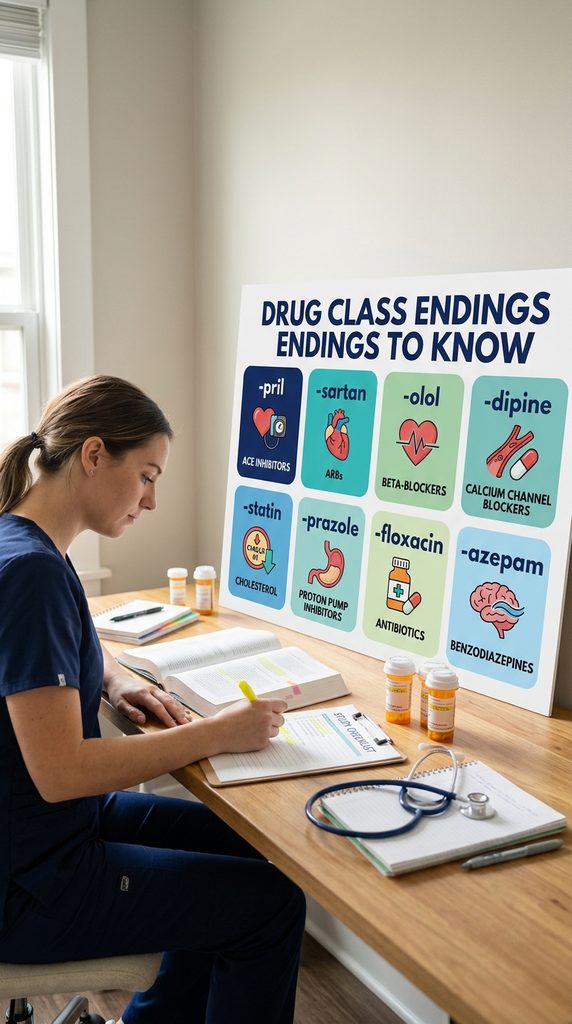
Drug endings are the fastest sorting tool in pharmacology. One ending can point to the class, the use and the watch point before the full stem is read. Pair this group with pharmacology notes for nclex review and drill the endings in mixed order, not in class order.
Pril Means ACE Inhibitor
The ending -pril flags the ACE inhibitors. They block conversion of angiotensin I to angiotensin II, so vessels relax and pressure falls.
- Ending = -pril
- Class = ACE inhibitor
- Example = lisinopril, enalapril
- Watch = dry cough, angioedema, raised potassium
- Avoid = pregnancy
Use it when a blood pressure drug name ends in -pril and the stem asks for side effects.
Sartan Means ARB Blocker
The ending -sartan marks the angiotensin receptor blockers. They block angiotensin II at its receptor.
- Ending = -sartan
- Class = angiotensin receptor blocker
- Example = losartan, valsartan
- Watch = raised potassium, kidney function
- Note = dry cough is less common here
Use it when a patient who coughed on an ACE inhibitor is switched to a similar drug.
Olol Means Beta Blocker
The ending -olol is one of the most tested on any drug list. These drugs slow the heart and lower pressure.
- Ending = -olol
- Class = beta blocker
- Example = metoprolol, atenolol
- Watch = slow pulse, low pressure, tiredness
- Caution = can hide low blood glucose signs
Use it when rate control or a post heart attack drug shows up in a stem.
Dipine Means Calcium Channel Blocker
Most calcium channel blockers carry the -dipine ending. They relax blood vessels.
- Ending = -dipine
- Class = calcium channel blocker
- Example = amlodipine, nifedipine
- Watch = ankle swelling, headache, flushing
- Exceptions = verapamil and diltiazem lack the ending
Use it when ankle swelling appears beside a blood pressure drug.
Memory trick: Read a drug name from the end backwards. The last few letters carry the class, so metoprolol, lisinopril and amlodipine sort themselves in seconds.
Statin Lowers Cholesterol
A -statin ending names the cholesterol lowering family. These drugs cut the amount of cholesterol the liver makes.
- Ending = -statin
- Class = cholesterol lowering drug
- Example = atorvastatin, simvastatin
- Watch = muscle aches
- Report = severe muscle pain or dark urine at once
Use it when a stem mixes a statin with new muscle pain.
Prazole Means Proton Pump Inhibitor
The ending -prazole marks the strong acid reducers. Proton pump inhibitors shut down the final step of acid production in the stomach.
- Ending = -prazole
- Class = proton pump inhibitor
- Example = omeprazole, pantoprazole
- Used for = reflux, ulcer protection
- Watch = headache, diarrhea, low magnesium with long use
Use it to sort a reflux drug from an H2 blocker such as famotidine.
Floxacin Means Fluoroquinolone Antibiotic
The ending -floxacin names the fluoroquinolone antibiotics. Its tendon warning is a favorite test point.
- Ending = -floxacin
- Class = fluoroquinolone antibiotic
- Example = levofloxacin, ciprofloxacin
- Watch = tendon pain or swelling
- Action = stop and report tendon pain promptly
Use it when an antibiotic stem adds new tendon pain near the heel.
Azepam Means Benzodiazepine Sedative
Names ending in -azepam, and relatives ending in -zolam, are benzodiazepines. They calm anxiety and cause sleepiness.
- Ending = -azepam or -zolam
- Class = benzodiazepine
- Example = diazepam, alprazolam, midazolam
- Watch = sleepiness, slowed breathing with opioids
- Caution = dependence with regular use
Use it when a sedative question also lists an opioid on the same chart.
Safety Checks and Side Effects

Safety checks are where memory tricks turn into marks. A slow pulse, a lab value or a skin sign often decides the answer, and each trick here ties a drug to the one check that must happen first.
Digoxin Needs Apical Pulse First
Digoxin slows the heart, so the pulse check comes before the dose. The rule below follows Open RN Nursing Pharmacology.
- Check = apical pulse for one full minute
- Hold = under 60 beats per minute in an adult
- Report = hold the dose and notify the provider
- Watch = low potassium raises toxicity risk
- Antidote = digoxin immune fab for toxicity
Use it on every digoxin stem, before reading the choices.
Warfarin Needs INR Checks
Warfarin dosing is steered by a lab result. The INR, taken from the prothrombin time, shows the effect strength.
- Lab = PT and INR
- Drug = warfarin
- Watch = bleeding gums, bruising, blood in urine or stool
- Food point = keep vitamin K food intake steady
- Interactions = many drugs shift the INR
Use it when a warfarin stem gives a lab value and asks for the next action.
Red flag: Bleeding that will not stop, blood in urine or stool, or a sudden severe headache in a patient on an anticoagulant needs urgent action and a call to the provider or the rapid response team.
Heparin Needs aPTT Checks
A heparin infusion is steered by the aPTT. Keeping the two labs apart, INR for warfarin and aPTT for heparin, clears a whole family of questions.
- Lab = aPTT
- Drug = heparin infusion
- Watch = bleeding signs
- Platelets = a sharp drop can signal heparin induced thrombocytopenia
- Antidote link = protamine sulfate
Use it when an infusion stem asks which lab guides the rate.
Loops Lose Potassium
Loop diuretics pull water out through the kidneys, and potassium leaves with it.
Loops lose potassium:
- Drug = furosemide, loop diuretic
- Loss = potassium and fluid
- Check = potassium level, blood pressure, urine output
- Signs of low potassium = cramps, weakness, irregular pulse
Use it when a heart failure stem pairs furosemide with muscle cramps.
Cool and Clammy Needs Candy
Low blood glucose sets off body alarm signals, and the skin tells the story. Cool, clammy skin points to low, not high.
- Skin = cool, clammy, sweaty
- Other signs = shakiness, fast pulse, hunger
- Cause link = insulin effect stronger than intake
- First step = check the blood glucose
- Teaching = carry a fast sugar source as instructed
Use it when a diabetes stem describes a sweaty, shaky patient after insulin.
Hot and Dry Sugar High
High blood glucose dries the body out as extra glucose pulls water into urine. The skin sign mirrors the low sign.
- Skin = hot and dry
- Other signs = thirst, frequent urination
- Cause link = too little insulin effect
- First step = check the blood glucose
- Contrast = dry here, clammy in low blood glucose
Use it beside the previous trick until the pair sorts itself.
Mycins Can Hurt Ears and Kidneys
Aminoglycosides such as gentamicin carry two organ warnings, and the nickname keeps both in view.
Mean mycins sums up the risk:
- Drug = gentamicin, aminoglycoside
- Ear risk = hearing loss, ringing, balance problems
- Kidney risk = falling urine output, rising kidney labs
- Watch = drug levels and hearing changes
Use it when an infection stem adds ringing in the ears during antibiotic therapy.
Tetracycline and Teeth Warning
Tetracyclines bind calcium, and that one fact explains their big warnings. The letter T starts each one.
- T = teeth, permanent staining in children under 8
- T = pregnancy, avoid unless no other option works
- T = sun, strong sunburn reaction is possible
- T = take apart from dairy and calcium products
Use it when an antibiotic question involves a child, pregnancy or a beach trip.
Quick Questions
How Many Mnemonics Should You Learn at Once?
Five to eight at a time is a workable load. Say each letter out loud, cover the expansion, then repeat it from memory. Add the next set only when the first set comes back clean twice in a row, then mix old and new sets.
Why Do Drug Endings Matter So Much?
Endings sort an unfamiliar drug name into a class you already know. That clue points to the likely use, the side effects and the check to do first. On a long exam, that step saves time and stops random guessing.
What Should You Do When Two Mnemonics Conflict?
Trust the textbook or class notes your program assigns, and park the conflicting trick until it can be checked. Hold points and antidote pairs can vary by source, so one checked version beats two half checked versions on test day.
What to Study Next
The natural next step is to pair these tricks with full drug class notes, starting with the classes missed most often in practice sets. Work through the antidote pairs again after two days, then fold in care plan study tips so the same drugs show up inside patient problems, not only on flashcards.
Keep the table nearby during question practice for the first week. After that, answer from memory first and check the table second. That small switch turns a reference sheet into recall training, and recall is what carries into the exam room.
For study use only. Always follow your program, your facility’s policy and current drug and lab references.